
Preliminary Care Coordination Plan-Heart Disease as a Health Concern
Heart disease remains a global health concern and describes a spectrum of disorders that affect cardiovascular functionalities. These include congestive heart failure, coronary heart disease, hypertension, peripheral artery disease, and aortic sclerosis. Heart diseases are the leading cause of death and a major contributory factor for disability in the U.S and across the globe. Heart diseases accounted for one in every five deaths in the U.S. in 2020, translating to over 690,000 deaths. Coronary artery disease and myocardial infarction are the leading cause of mortality among all heart diseases. The burden of these diseases is also high, with over 220 billion dollars incurred by the U.S healthcare system (Abdalla et al., 2020). The costs are mainly due to the loss of productivity accustomed to the high mortality rates of these diseases, costs of medications, and costs of healthcare services utilizable in managing these disorders.
The healthcare burden of heart disease continues to increase. This is attributable to the increasing prevalence of these diseases and the advanced screening for these diseases (Abdalla et al., 2020). This makes it a concern for the global healthcare system. It also reinforces the need to heighten preventive measures against the disease and implement the existing policies and interventions to mitigate these diseases’ health risks.
Best Practice for Health Improvement
Best practices in cardiac care are targeted at preserving lives with heart diseases. Collaborative practice agreements are the first best practice. Collaborative drug therapy management allows pharmacists to work with other caregivers to assume greater responsibility in assessing, monitoring, initiating, and adjusting drug regimens for patients with heart disease to optimize care. Collaborative paradigms in cardiac care have been lauded for their effectiveness in enhancing clinical outcomes and patient experiences (Mehta et al., 2019). It is for this reason that this approach maintains superiority over fragmented care. Quality and safety safeguards are best assured when a synchrony of care is provided to the patients.
Another best practice is to empower patients to implement steps to lower their risk for disease exacerbation and optimize their disease management. This enables them to take a much more active role in their care process. It also provides them with a framework for making necessary adjustments in their therapeutic plans (Zhang et al., 2020). Integrating community health workers into the clinical care teams is another best practice in cardiac care. Community health workers are important links between the community and various health and social services. They, therefore, promote access to care and improve the quality of services given to patients (Tsai et al., 2022). Community health workers also improve the cultural competence of healthcare services provided to patients.
The underlying assumption in the analysis of best practices is that patients with heart diseases will seek healthcare and cooperate with other caregivers in the care processes. This informs the synchrony in care approaches targeted towards them. A point of uncertainty in the analysis is the ability of transcultural patients to articulate educative provisions targeted toward them. Transcultural barriers to the care process may jeopardize the effective care provided to these patients.
Specific Goals
Comprehensive management of heart diseases is targeted at secondary prevention, quality of life enhancement, and prolongation of life of patients with heart diseases. The first goal in this regard is to educate the patients on self-management. Self-management focuses on the individual’s role in managing their disease. Notably, self-management may be particularly valuable in the care continuum in home-based care. Educating the patients on self-management enhances their capacity to monitor their disease and inform adjustments. The second goal is to improve access to medications to manage heart disease. This can be achieved through policy provisions regulating the pricing of drugs and by encouraging patients with heart diseases to seek insurance coverage. Insurance coverage may bridge the gap in not only access to drugs but also to cardiac care services.
Another goal is to synchronize healthcare services targeted to patients through collaborative paradigms. Interprofessional collaborations remain valuable in cardiac care. The diverse roles of healthcare professionals in interdisciplinary healthcare teams widen the scope of care and enhance the quality of care provided to patients. Healthcare collaborations are superior to fragmented care because they address broader healthcare aspects. Accordingly, this will improve clinical outcomes and enhance patient experiences.
Available Community Resources
Several community resources are available for patients with heart disease. The American Heart Association (AHA), CDC, the National Heart, Lung, and Blood Institute (NHLBI), and the Office on Women’s Health are valuable community resources for patients with heart diseases. AHA is an organization that is targeted at fighting heart disease and stroke. This organization funds research on heart diseases and informs on management interventions for these diseases. The CDC is another community resource under the federal government that informs effective disease management. In addition, NHLBI aims to create awareness of heart, lung, and blood diseases. This organization engages communities and educates them on preventive measures against these diseases. These community resources maintain significance in improving the quality of cardiac care and preventing disease. Their efforts have prolonged the lives of many patients with cardiac diseases and improved their quality of life.
Conclusion
Heart diseases remain a global healthcare concern. The high prevalence of these diseases and their high mortality rate reinforces the need to address them. Best practices that improve the health of patients with heart diseases include self-management, healthcare collaborations, and others. The goal of care approaches is often to prevent secondary risks and improve patients’ quality of life with these diseases. Community resources such as the AHA and CDC maintain significance in improving the quality of life of these individuals.
References
Abdalla, S. M., Yu, S., & Galea, S. (2020). Trends in cardiovascular disease prevalence by income level in the United States. JAMA Network Open, 3(9). https://doi.org/10.1001/jamanetworkopen.2020.18150.
Mehta, R., Tahir, A., Hallak, O., & Gonzalez, J. (2019). Collaborative cardiac care. JACC: Case Reports, 1(5), 873–875. https://doi.org/10.1016/j.jaccas.2019.11.028.
Tsai, E., Allen, P., Saliba, L. F., & Brownson, R. C. (2022). The power of Partnerships: State Public Health Department multisector collaborations in major chronic disease program areas in the United States. Health Research Policy and Systems, 20(1). https://doi.org/10.1186/s12961-021-00765-3.
Zhang, S., Liang, C., Zhang, J., Yang, X., & Meng, X. (2020). The role and effectiveness of self-management in a home-based cardiac rehabilitation program. Medicine, 99(31). https://doi.org/10.1097/md.0000000000020972.
ORDER A PLAGIARISM-FREE PAPER HERE
We’ll write everything from scratch
Question 
Develop a 3-4 page preliminary care coordination plan for a selected health care problem. Include physical, psychosocial, and cultural considerations for this healthcare problem. Identify and list available community resources for a safe and effective continuum of care.
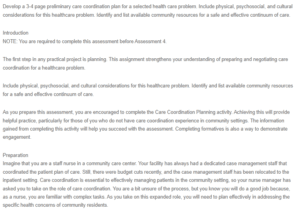
Preliminary Care Coordination Plan-Heart Disease as a Health Concern
Introduction
NOTE: You are required to complete this assessment before Assessment 4.
The first step in any practical project is planning. This assignment strengthens your understanding of preparing and negotiating care coordination for a healthcare problem.
Include physical, psychosocial, and cultural considerations for this healthcare problem. Identify and list available community resources for a safe and effective continuum of care.
As you prepare this assessment, you are encouraged to complete the Care Coordination Planning activity. Achieving this will provide helpful practice, particularly for those of you who do not have care coordination experience in community settings. The information gained from completing this activity will help you succeed with the assessment. Completing formatives is also a way to demonstrate engagement.
Preparation
Imagine that you are a staff nurse in a community care center. Your facility has always had a dedicated case management staff that coordinated the patient plan of care. Still, there were budget cuts recently, and the case management staff has been relocated to the inpatient setting. Care coordination is essential to effectively managing patients in the community setting, so your nurse manager has asked you to take on the role of care coordination. You are a bit unsure of the process, but you know you will do a good job because, as a nurse, you are familiar with complex tasks. As you take on this expanded role, you will need to plan effectively in addressing the specific health concerns of community residents.
To prepare for this assessment, you may wish to:
Review the assessment instructions and scoring guide to ensure that you understand the work you will be asked to complete.
Allow plenty of time to plan your chosen healthcare concern.
Instructions
Note: You are required to complete this assessment before Assessment 4.
Develop the Preliminary Care Coordination Plan
Complete the following:
Identify a health concern as the focus of your care coordination plan. In your plan, please include physical, psychosocial, and cultural needs. Possible health concerns may include, but are not limited to:
Stroke.
Heart disease (high blood pressure, stroke, or heart failure).
Home safety.
Pulmonary disease (COPD or fibrotic lung disease).
Orthopedic concerns (hip replacement or knee replacement).
Cognitive impairment (Alzheimer’s disease or dementia).
Pain management.
Mental health.
Trauma.
Identify available community resources for a safe and effective continuum of care.
Document Format and Length
Your preliminary plan should be an APA scholarly paper, 3–4 pages long.
Remember to use active voice, which means being direct and writing concisely, as opposed to passive voice, which means writing with a tendency to wordiness.
In your paper, include possible community resources that can be used.
Be sure to review the scoring guide to make sure all criteria are addressed in your paper.
Study the subtle differences between primary, proficient, and distinguished.
Supporting Evidence
Cite at least two credible sources from peer-reviewed journals or professional industry publications that support your preliminary plan.
Grading Requirements
The requirements below correspond to the grading criteria in the Preliminary Care Coordination Plan Scoring Guide, so address each point. Read the performance-level descriptions for each criterion to see how your work will be assessed.
Analyze your selected health concern and the associated best practices for health improvement.
Cite supporting evidence for best practices.
Consider underlying assumptions and points of uncertainty in your analysis.
Describe specific goals that should be established to address the healthcare problem.
Identify available community resources for a safe and effective continuum of care.
Organize content so ideas flow logically with smooth transitions; contain few errors in grammar/punctuation, word choice, and spelling.
Apply APA formatting to in-text citations and references, exhibiting nearly flawless adherence to APA format.
Write with a specific purpose with your patient in mind.
Adhere to scholarly and disciplinary writing standards and current APA formatting requirements.
Additional Requirements
Before submitting your assessment, proofread your preliminary care coordination plan and community resources list to minimize errors that could distract readers and make it more difficult for them to focus on the substance of your plan. Be sure to submit both documents.
Portfolio Prompt: Save your presentation to your ePortfolio.
Competencies Measured
By completing this assessment, you will demonstrate your proficiency in the course competencies through the following assessment scoring guide criteria:
Competency 1: Adapt care based on patient-centered and person-focused factors.
Analyze a health concern and the associated best practices for health improvement.
Competency 2: Collaborate with patients and families to achieve desired outcomes.
Describe specific goals that should be established to address a selected healthcare problem.
Competency 3: Create a satisfying patient experience.
Identify available community resources for a safe and effective continuum of care.
Competency 6: Apply professional, scholarly communication strategies to lead patient-centered care.
Organize content so ideas flow logically with smooth transitions; contain few errors in grammar/punctuation, word choice, and spelling.
Apply APA formatting to in-text citations and references, exhibiting nearly flawless adherence to APA format.
 Complete the order form and upload all of your files, including any instructions, rubrics, or other materials provided by your instructor.
 Complete the order payment after filling in the order form. We’ll receive your order and assign it to a writer.
 The assigned writer will complete your paper and forward it to our Editing Team for review and approval.
 Once approved by the editor, the completed paper will be uploaded to your account for you to download, review and approve.