
Capstone Project Change Proposal
Background
The United States (U.S) is the world’s most diverse country. However, this diversity has contributed to the problem of discrimination in all aspects of society, from the criminal justice system to education to health care. Discrimination in the U.S is majorly against minority racial groups. Discrimination also occurs against an individual’s gender, social class, and healthcare condition, among other reasons. Discriminatory practices against minority racial groups have permeated and persisted in the health care system. Discrimination within the U.S healthcare system includes practices and actions that do not consider an individual’s or group’s physical and mental health outcomes (Togioka et al., 2022). Racial discrimination within the health care system can occur directly and indirectly through association, perception, victimization, and harassment.
Racial discrimination in health care in the United States against minority racial minorities, especially Latinos, Hispanics, and African Americans, is majorly perpetuated by the health providers individuals seek health care assistance from. Racially motivated discrimination by health providers leads to an individual or whole community feeling disempowered and marginalized, developing lower self-perception, lower self-confidence, weakening their social ties, and mistrust towards the health care system (Carter et al., 2018). The negative healthcare outcomes for these minority groups due to racial discrimination and the experiences of healthcare professionals from related backgrounds remain a healthcare issue of concern in the U.S.
The current racially discriminatory practices in the U.S healthcare system have developed from the previously existing segregated healthcare systems. It has much been influenced by the pre-existing Jim Crow laws and racist codes that have racialized access to social and economic opportunities, healthcare delivery and access, and open medical and social discrimination. The current social restructuring happening in the U.S, majorly fueled by post-COVID-19 pandemic, racially-motivated events, and the use of social media such as Twitter, has ignited discussions on the existence of structural racism, racial discrimination, and disparities in healthcare access. As frontline and primary healthcare providers, nurses have a role to play in identifying and eliminating structural racism and racial discrimination within the U.S healthcare system. For such progress to be achieved, research needs to focus on nurses’ and healthcare providers’ roles in exacerbating racial discrimination against minority racial groups within the healthcare system. The focus should be paid to various provider-focused interventions and compare such interventions in solving racial discrimination as well as barriers to the interventions and ways of overcoming such barriers to achieve racially equitable healthcare systems.
Clinical Problem Statement
The provisions of the U.S. Constitution require that every individual residing within the U.S have full access to healthcare services regardless of race, age, gender, and nationality. This means every person has a right to non-discriminative, safe, high-quality care. However, there exist major racial disparities in health access in the U.S. The COVID-19 pandemic has exposed rampant racial segregation and discriminatory practices within the U.S, as identified in post-pandemic research (Hu et al., 2020). For instance, compared to Whites, a majority of people from minority racial and ethnic backgrounds have limited access to mental health care, majorly due to healthcare provider-related discrimination based on race (Green et al., 2020). Individuals from racial minority backgrounds are more likely to be denied access to quality care, less likely to access preventive health care services, or more likely to receive lower levels of quality and culturally insensitive care than their White counterparts.
The discrimination based on race within the health care systems is much fed by the lack of diversity among the health care professionals, especially the nursing profession, and the existence of implicit and explicit biases from the nurses. These long-held biases are the basic factors promoting the current racial disparities experienced in the U.S and the open racial segregation within nursing care. The implicit and explicit bias is being fed by structural racism and the lack of knowledge and appreciation of other cultures among major nursing professions. The structural racism and previous acts of racial segregation within the U.S society have also created the perception of a dominant culture held majorly by nurses and other healthcare professionals from white majority backgrounds. The experiences of the previously identified forms of racial discrimination within the healthcare system have major negative health and social outcomes among racial minority groups. To help counter this persistent issue and eliminate the biases contributing to racially discriminative practices, the adoption of culturally appropriate care by improving the cultural competence of healthcare providers has been proposed as a nursing intervention. This nursing intervention requires nurses to acknowledge racial and cultural differences and race as a factor of access to health care services and help improve the accessibility of health care for minority racial populations population groups as well as reduce structural racial discrimination within the healthcare system.
Purpose of the Proposal
Racism is a social construct (Togioka et al., 2022). It will always persist within social contexts, such as the health care system, due to the observable differences in skin color, cultural practices, and beliefs. This means that the U.S being a socially diverse population in terms of race, the issue of macroaggressions and microaggressions within the health care system will exist unless substantial and sustainable nursing interventions are developed and implemented. Racism contributes to implicit and explicit biases linked to the limited health care services to people from racial minority backgrounds. The experiences of macroaggressions, microaggressions, and other racially-motivated behaviors that affect healthcare access and delivery towards Latinos, Hispanics, and African Americans by healthcare providers hurt the quality and safety of care delivered, as well as the health outcomes of these population groups. Implicit and explicit biases lead to stereotyping; subsequently, racial stereotyping influences the development of negative race- and culture-specific attitudes, which impairs the ability of a nurse to deliver safe and quality patient-specific care services.
Developing the cultural competence of the nurses, especially those providing care in racially diverse settings, will improve their ability to understand and appreciate cultural differences and tailor care to meet the needs of the patients. Cultural competence is the first step towards enabling nurses to deliver culturally appropriate care. This means that these nurses appreciate and value the way the U.S society has changed over the years and the diversity within the U.S, and the way that diversity means having to deal with various cultures and races as a primary care provider. Improving the nurses’ cultural competency means they can appreciate and be aware of explicit and implicit bias and discrimination within the healthcare system. They will also understand how such biases and discriminations impact the delivery of care services and the experiences of the patients who experience or perceive the prejudice or prejudice. This will turn nurses who perpetuate racial discrimination into advocates for racial equity in health care access as well as in the design of the health care system. Therefore, the development of the nursing care teams’ cultural competency is an important approach to support the delivery of culturally appropriate care, which can help address the issues of racial discrimination and health disparities in a racially diverse health care system.
PICOT Question
In minority populations, especially Latinos, Hispanics, and African Americans who experience discrimination and violence in health care, what is the effect of adopting culturally appropriate care as compared to the diversification of the healthcare workforce on provider-related health disparities and discrimination in six months?
Literature Search Strategies
The literature search was carried out within the university’s virtual library and from other external databases, including PubMed Central, the National Library of Medicine (NLM), The Wiley Online Library, and the Cochrane Reviews database. The search framework was developed based on this proposal’s PICOT question. The literature search framework included the use of search concepts, search terms, phrases, keywords, the topic focused in the proposal, Boolean logic, as well as a review of citations and abstracts of current articles that addressed racism in the healthcare system in the U.S, racial discrimination in medication, health care delivery, healthcare access, other related topics. The major concepts, search terms, search phrases, and keywords used to identify searched included “health racial segregation,” “discrimination,” “racial discrimination,” “implicit bias,” “nursing racial discrimination,” “cultural competence,” “culturally appropriate care,” “implicit bias and cultural competence” “discrimination and cultural competence” among others. Each search term, concept, or phrase was twisted in various ways, and the Boolean logic, including “AND” and “OR,” was applied to improve the search results. A thesaurus was also used to find synonyms of some of the keywords used in the literature search. The search was also limited to articles published between 2019 and 2022, including first-hand research and systematic review articles and journals. The search returns numerous related articles. However, only eight of these were selected and reviewed.
Evaluation of Literature
The evaluation process of the identified and selected literature focused on examining the article’s title and the journal in which the article was published. The examination then included a review of the authors’ names, the articles’ abstracts, the introduction and clearly stated objectives of the study, and the research methods employed. Additionally, I evaluated the results, how the findings were presented and discussed in the articles, and the conclusions the authors drew from the research findings. Besides these, the evaluation criteria I employed focused on each article’s accuracy, authority, objectivity, currency, coverage, and the information presented in the findings.
On accuracy, I evaluated the reliability of the information about the problem I sought to address and as an analysis of errors within the information and findings presented. I also checked the facts presented and verified such facts against other sources within the searched literature.
The evaluation of the authority of the authors focused on their qualifications to address the topic and any institutional and organizational affiliations. I evaluated the articles’ objectivity by examining the study’s purposes and presented ideologies and opinions. I also checked for any author biases that may have influenced their conclusions. For the currency of the articles selected, I ensured that they were all published within the set period of 2019 and 2022. Finally, on the evaluation of the coverage of the information presented in the reviewed articles, I checked whether the papers added new concepts, addressed the PICOT question developed in-depth, whether the methods used supported the findings and conclusions drawn, and if the findings supported the development of the intervention proposed.
The selected articles were closely related to my health care issue fixed and well informed the intervention proposed by the PICOT question. A majority of the articles addressed racism, implicit bias, and its impact on healthcare access and its role in creating healthcare disparities. From the reviewed articles, the inequitable access to high-quality healthcare services in the United States has been attributed to the existence of structural racism within the structures of the healthcare system, from policy systems to delivery systems. The reviewed literature also sufficiently informed the proposed intervention of providing culturally appropriate care to solve health care disparities and racial discrimination in the health care system. The reviewed literature has achieved this by identifying cultural competence and cultural awareness and addressing the need to appreciate racism in health care.
Applied Nursing Theory
This Capstone project aims to determine the effect of adopting culturally appropriate care on reducing and resolving provider-related health disparities and discrimination. To understand the role of cultural competence in delivering culturally appropriate care, the focus should be on the provider’s knowledge of other cultures and the consequences of cultural competence and culturally appropriate care. The impact of cultural competence and culturally appropriate care can be determined by the patient’s care provider’s health outcomes-related consequences (Sharifi et al., 2019). Therefore, the applicable nursing theory must address how cultural competence and congruency can be achieved in health care systems and health care delivery.
Of all reviewed nursing and change theories, Leininger’s Theory of Culture Care Diversity and Universality was the most applicable in developing this project. Leininger’s Theory of Culture Care Diversity and Universality aimed to provide an understanding of culturally congruent nursing care by defining how it can be achieved, what it encompasses, its benefits, and how it can help tailor care to fit the personal needs of the patients. The theory defines culturally congruent care as care based on the need to provide support and assistance and facilitate and enable patients to make decisions that help meet the needs of an individual or community’s cultural values, beliefs, and lifestyles (McFarland & Wehbe-Alamah, 2019). The theory notes that culturally congruent care results from developing nurse-patient relationships. The nurse applies generic and professional knowledge to the best applicable methods to fit care to diverse populations. Care plans are developed based on collaboration between the patient and the nurse. The nurse makes decisions based on the need to deliver holistic and personalized care to an individual or group. Therefore, Leininger’s Theory of Culture Care Diversity and Universality can help provide care to patient populations from diverse or similar backgrounds.
Proposed Implementation Plan with Outcome Measures
The proposed implementation plan will involve having participants undergo a cultural learning process. The implementation plan will adopt all forms of cultural learning, including imitative, instructed, and collaborative learning. The artistic learning process was selected as it enables individuals to learn, acquire, and retain new knowledge and skills about culture and other social aspects in an efficient way that overcomes the inability to understand independently. The process will eliminate any assumptions about knowledge of culture or awareness of cultural competence and perform a cultural competence assessment on all participants. This will help identify the strengths and weaknesses of each participating nurse regarding cultural competence and delivering care to diverse patient populations. It is the first step towards shaping the proposed nursing intervention as it will help me fine-tune the approaches designed to develop cultural competence among nurses.
The participating nurses will be required to identify cultural elements within the workplace and barriers that may exist while delivering care services. This may include communication, language, and care beliefs, among others. The next phase of the implementation will require the nurses to directly engage with patients from different cultural backgrounds to improve the nurses’ understanding of the patients. Besides this, the nurses will be needed to engage with other healthcare professionals from different cultures and hold discussions on healthcare and culture. Finally, the nurses will be certified to have completed a cultural learning course and approved for delivering culturally appropriate care.
The progress and success of the intervention will include the patient and nurses’ experiences, ease of access to health care for individuals from minority backgrounds, and other measures related to racial discrimination and health care disparities.
Evidence-based Practice Used in the Creation of the Intervention Plan
The proposed nursing intervention plan was developed based on available evidence and identified gaps in reducing and eliminating racial discrimination and provider-related health disparities in the U.S. A PICOT question was designed to help guide the research and search for related literature. Various peer-reviewed journal articles were identified from a PICOT question-guided literature search and reviewed to inform the research question and proposed intervention further. Additionally, a literature review focused on the proposed nursing intervention was conducted to help understand factors that support and act as barriers to implementing the intervention within nursing care settings and the methods to overcome implementation barriers.
Evaluation of the Proposed Nursing Intervention
As an evidence-based intervention, the ability of the nurses to deliver culturally appropriate care will be evaluated based on the providers’ cultural values and beliefs, depth of understanding of their patients in terms of their culture, and the ability of the nurses to develop individual relationships with the patients. The evaluation will consider the major components of cultural competency in nursing care, including the providers’ cultural awareness, attitudes towards other cultures, overall cultural worldviews, understanding and appreciation of different cultural practices, and identifiable cross-cultural skills developed throughout the implementation process.
Potential Barriers to Plan Implementation and Overcoming Implementation Barriers
Various barriers to the implementation of the intervention are anticipated. The major barrier is the system’s design, including the lack of diversity in the top healthcare leadership. This may require an overhaul of the top leadership to accommodate the plan, which may be hard to achieve within a limited time. Another barrier is the concern over the deep-rooted racial stereotypes and prejudices, which may be hard to clear. Additionally, the plan anticipates ethnocentric barriers that may include competing actions, behaviors, signs, and language.
To overcome these barriers, I will focus on promoting open communication among the nurses and presenting them with the need to embrace diversity across the healthcare and nursing leadership hierarchy. For this, I will also present evidence on related research to inform the health care and nursing leadership. Finally, I will seek to develop a more group-focused vision for the intervention plan to get all participants engaged and committed throughout the implementation period.
References
Carter, R. T., Johnson, V. E., Kirkinis, K., Roberson, K., Muchow, C., & Galgay, C. (2018). A Meta-Analytic Review of Racial Discrimination: Relationships to Health and Culture. Race and Social Problems 2018 11:1, 11(1), 15–32. https://doi.org/10.1007/S12552-018-9256-Y
Green, J. G., McLaughlin, K. A., Fillbrunn, M., Fukuda, M., Jackson, J. S., Kessler, R. C., Sadikova, E., Sampson, N. A., Vilsaint, C., Williams, D. R., Cruz-Gonzalez, M., & Alegría, M. (2020). Barriers to Mental Health Service Use and Predictors of Treatment Drop Out: Racial/Ethnic Variation in a Population-Based Study. Administration and Policy in Mental Health and Mental Health Services Research 2020 47:4, 47(4), 606–616. https://doi.org/10.1007/S10488-020-01021-6
Hu, T., Yue, H., Wang, C., She, B., Ye, X., Liu, R., Zhu, X., Guan, W. W., & Bao, S. (2020). Racial Segregation, Testing Site Access, and COVID-19 Incidence Rate in Massachusetts, USA. International Journal of Environmental Research and Public Health 2020, Vol. 17, Page 9528, 17(24), 9528. https://doi.org/10.3390/IJERPH17249528
McFarland, M. R., & Wehbe-Alamah, H. B. (2019). Leininger’s Theory of Culture Care Diversity and Universality: An Overview With a Historical Retrospective and a View Toward the Future. Journal of Transcultural Nursing, 30(6), 540–557. https://doi.org/10.1177/1043659619867134
Sharifi, N., Adib-Hajbaghery, M., & Najafi, M. (2019). Cultural competence in nursing: A concept analysis. International Journal of Nursing Studies, 99, 103386. https://doi.org/10.1016/J.IJNURSTU.2019.103386
Togioka, B. M., Duvivier, D., & Young, E. (2022). Diversity and Discrimination In Healthcare. StatPearls. https://www.ncbi.nlm.nih.gov/books/NBK568721/
ORDER A PLAGIARISM-FREE PAPER HERE
We’ll write everything from scratch
Question 
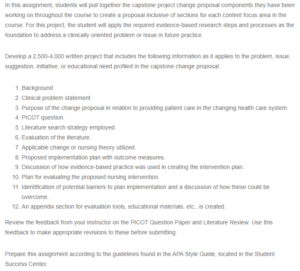
In this assignment, students will pull together the capstone project change proposal components they have been working on throughout the course to create a proposal inclusive of sections for each content focus area. For this project, the student will apply the required evidence-based research steps and processes as the foundation to address a clinically oriented problem or issue in future practice.
Capstone Project Change Proposal
Develop a 2,500-4,000 written project that includes the following information as it applies to the problem, issue, suggestion, initiative, or educational need profiled in the capstone change proposal:
- Background
- Clinical problem statement. The change proposal aims to provide patient care in the changing healthcare system.
- PICOT question.
- Literature search strategy employed.
- Evaluation of the literature.
- Applicable change or nursing theory utilized.
- She proposed an implementation plan with outcome measures.
- Discussion of how evidence-based practice was used in creating the intervention plan.
- Plan for evaluating the proposed nursing intervention.
- Identify potential barriers to plan implementation and discuss how these could be overcome.
- An appendix section for evaluation tools, educational materials, etc., is created.
Review the feedback from your instructor on the PICOT Question Paper and Literature Review. Use this feedback to make appropriate revisions to these before submitting.
Prepare this assignment according to the guidelines in the APA Style Guide in the Student Success Center.
 Complete the order form and upload all of your files, including any instructions, rubrics, or other materials provided by your instructor.
 Complete the order payment after filling in the order form. We’ll receive your order and assign it to a writer.
 The assigned writer will complete your paper and forward it to our Editing Team for review and approval.
 Once approved by the editor, the completed paper will be uploaded to your account for you to download, review and approve.