
Global Health Comparison Grid
| Global Healthcare Issue | HIV/AIDS | |
| Description |
HIV/AIDS is a problem of global concern. Various factors have been implicated in the transmission of the disease. They include the exchange of bodily fluids (semen, blood, vaginal secretions, and breast milk). It can also be transmitted vertically from mother to child (Ribeiro et al., 2019). Data from 2021 reveals that more than 38,000,000 people have been diagnosed with the disease globally (WHO, 2022). Furthermore, about 1.5 million incidences of the diseases were recorded in 2021, whereas more than 640,000 HIV-associated deaths were recorded (WHO, 2022). Approximately 75 percent of people with the disease are on treatment (WHO, 2022). |
|
| Country | United States | Haiti |
| Describe the policy in each country related to the identified healthcare issue. | The White House’s Office of National AIDS Policy has an elaborate National HIV/AIDS Strategy that seeks to eliminate the HIV/AIDs epidemic in the USA. This policy emphasizes prevention, diagnosis, quality treatment, and adequate coping strategies for patients with the disease. Specifically, the goal is to achieve a 90 percent reduction in the incidence of the disease in the U.S. by 2030 (HIV.gov, 2022). | The Country Operational Plan is an example of a policy document developed by the Public Health and Population Department to combat HIV/AIDs in Haiti. It aims to improve the quality of healthcare services, emphasizing the prevention of HIV/AIDs (State.gov, 2021). |
| What are the strengths of this policy? | It advocates for a concerted effort among various stakeholders in the national government to address HIV/AIDs.
It provides an elaborate blueprint for eliminating HIV/AIDS in the USA. |
The policy aims at improving access to quality healthcare services for all people living with HIV/AIDS. |
| What are the weaknesses of this policy? | The policy does not prioritize immigrants with limited access to healthcare, hence a high risk of poorly managed HIV/AIDs.
The policy does not provide an approximate numerical value of its priority populations (LGBTQ, black women, and people who inject drugs). |
The policy does not highlight its priority population. Furthermore, it does not address existing inequalities and disparities adequately. |
| Explain how the social determinants of health may impact the specified global health issue. (Be specific and provide examples)
|
Economic stability improves control of HIV/AIDs because people can afford quality healthcare services. In addition, access to quality education improves disease control because individuals are equipped with pertinent knowledge and facts concerning HIV/AIDS. Thirdly, access to quality healthcare services improves disease control because members get quality therapeutic and prevention services. | Economic stability improves control of HIV/AIDs because people can afford quality healthcare services. Similarly, access to quality education improves disease control because individuals are equipped with pertinent knowledge and facts concerning HIV/AIDS. Thirdly, access to quality healthcare services improves disease control because members get quality therapeutic and prevention services.
Sexual minorities are likely to experience difficulty accessing quality healthcare. |
| How has each country’s government addressed the cost, quality, and access to the selected global health issue? | The USA has engaged federal, state, and local stakeholders to provide culturally sensitive healthcare services. Additionally, it has expanded the Affordable.
Care Act (ACA) and availed it at various marketplaces to ensure cost-effective services. |
Haiti works in concert with the USA via the President’s Emergency Plan for AIDS Relief to provide quality, cost-effective healthcare services. |
| How has the identified health policy impacted the health of the global population? (Be specific and provide examples) | The policy provides a framework that can be adopted to prevent and manage HIV/AIDs adequately. The policy has improved care coordination among various stakeholders to address the epidemic. For example, all healthcare workers collaborate to achieve a 90 percent reduction in the incidence of HIV/AIDS by 2030. | The policy has enabled more Haitians living with HIV to access quality healthcare services. |
| Describe the potential impact of the identified health policy on the nurse’s role in each country. | The policy has impacted the nurse’s role by advocating for patient-centeredness, holistic care, and non-discriminatory care. As such, nurses uphold healthcare ethics and professionalism in executing their tasks. | The policy has impacted the nurse’s role in Haiti by necessitating care coordination. Due to an increased workload, nurses work with other healthcare providers to provide patient care. |
| Explain how global health issues impact local healthcare organizations and policies in both countries. (Be specific and provide examples) | Global health issues necessitate collaboration, research, and innovation among healthcare organizations.
They also necessitate policy formulation and modification to address the health issue. For example, the COVID-19 pandemic triggered research and vaccine discovery by various pharmaceutical industries in the USA, such as Moderna, Inc. |
As stated, global health issues necessitate collaboration between local and global healthcare organizations.
For example, Haiti’s Public Health and Population Department collaborated with the WHO to report the incidence, prevalence, and mortalities associated with COVID-19. |
| General Notes/Comments | The USA has made significant efforts to prevent, manage, and eradicate the HIV/AIDs epidemic. | Similarly, Haiti is committed to addressing its HIV/AIDs epidemic. This requires a concerted effort among national and global organizations. |
A Plan for Social Change
Various countries have unique policies to address global health issues. Desirable policies should be incorporated into various workplaces to improve workflow and overall productivity. In my role as a nurse leader, I can advocate for the incorporation of a global perspective via different strategies. Firstly, I would advocate via educating and training stakeholders in global policy. Education and training equip the stakeholders with pertinent information regarding the importance and relevance of a policy. This creates buy-in and facilitates its incorporation. Secondly, I would advocate for incorporating a global perspective via policy formulation. This entails developing local policies that acknowledge the global perspective.
Adopting a global perspective would impact my practice and role as a nurse leader. For example, the White House’s Office of National AIDS Policy would necessitate patient-centeredness, holistic care, and non-discriminatory care. As such, I would advocate for and create a culturally congruent environment. Furthermore, I would enforce nursing and healthcare ethics in my routine practice. I would also advocate for care coordination among interdisciplinary team members to achieve a continuum of care.
The incorporation of a global perspective will contribute to social change. Stakeholders must adopt specific practices or modify existing norms to match the global perspective. For example, the White House’s Office of National AIDS Policy will necessitate research and evidence-based practice. As a result, as a nurse leader, I will be required to coordinate with members of the interdisciplinary team in conducting research and adopting the best practices for the prevention and management of HIV/AIDS. Furthermore, I will emphasize accountability and continuous professional development among all interdisciplinary team members.
References
HIV. gov. (2022). National HIV/AIDS Strategy (2022-2025). https://www.hiv.gov/federal-response/national-hiv-aids-strategy/national-hiv-aids-strategy-2022-2025#:~:text=The%20Strategy%20sets%20bold%20targets,Prevent%20new%20HIV%20infections.
Ribeiro, L. C. S., Giami, A., & Freitas, M. I. de F. (2019). Representations of people living with HIV: Influences on the late diagnosis of infection. Revista Da Escola de Enfermagem, 53, 1–8. https://doi.org/10.1590/S1980-220X2018009703439.
State.gov. (2021). Country Operational Plan (COP/ROP) 2021: Strategic Direction Summary. https://www.state.gov/wp-content/uploads/2021/09/Haiti_SDS_Final-Public_Aug-13-2021.pdf.
WHO. (2022). HIV data and statistics. https://www.who.int/teams/global-hiv-hepatitis-and-stis-programmes/hiv/strategic-information/hiv-data-and-statistics.
ORDER A PLAGIARISM-FREE PAPER HERE
We’ll write everything from scratch
Question 
If you talk about a possible poor health outcome, do you believe that outcome will occur? Do you believe eye contact and personal contact should be avoided?
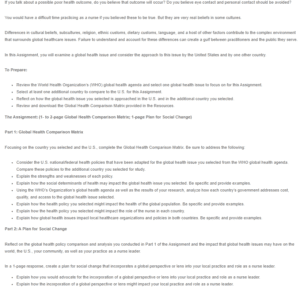
Global Health Comparison Grid
You would have difficulty practicing as a nurse if you believed these true. But they are very real beliefs in some cultures.
Differences in cultural beliefs, subcultures, religion, ethnic customs, dietary customs, language, and other factors contribute to the complex environment surrounding global healthcare issues. Failure to understand and account for these differences can create a gulf between practitioners and the public they serve.
In this Assignment, you will examine a global health issue and consider the approach to this issue by the United States and one other country.
To Prepare:
- Review the World Health Organization’s (WHO) global health agenda and select one global health issue to focus on for this Assignment.
- Select at least one additional country to compare to the U.S. for this Assignment.
- Reflect on how the global health issue you selected is approached in the U.S. and the other country you selected.
- Review and download the Global Health Comparison Matrix provided in the Resources.
The Assignment: (1- to 2-page Global Health Comparison Matrix; 1-page Plan for Social Change)
Part 1: Global Health Comparison Matrix
Complete the Global Health Comparison Matrix by focusing on the country you selected and the U.S. Be sure to address the following:
- Consider the U.S. national/federal health policies adapted for the global health issue you selected from the WHO global health agenda. Compare these policies to the additional country you selected for study.
- Explain the strengths and weaknesses of each policy.
- Explain how the social determinants of health may impact your selected global health issue. Be specific and provide examples.
- Using the WHO’s Organization’s global health agenda and the results of your research, analyze how each country’s government addresses cost, quality, and access to the selected global health issue.
- Explain how the health policy you selected might impact the global population’s health. Be specific and provide examples.
- Explain how the health policy you selected might impact the nurse’s role in each country.
- Explain how global health issues impact local healthcare organizations and policies in both countries. Be specific and provide examples.
Part 2: A Plan for Social Change
Reflect on the global health policy comparison and analysis you conducted in Part 1 of the Assignment and the impact that global health issues may have on the world, the U.S., your community, and your practice as a nurse leader.
In a 1-page response, create a social change plan incorporating a global perspective or lens into your local practice and role as a nurse leader.
- Explain how you would advocate for incorporating a global perspective or lens into your local practice and role as a nurse leader.
- Explain how incorporating a global perspective or lens might impact your local practice and role as a nurse leader.
- Explain how incorporating a global perspective or lens into your local practice as a nurse leader represents and contributes to social change. Be specific and provide examples.
 Complete the order form and upload all of your files, including any instructions, rubrics, or other materials provided by your instructor.
 Complete the order payment after filling in the order form. We’ll receive your order and assign it to a writer.
 The assigned writer will complete your paper and forward it to our Editing Team for review and approval.
 Once approved by the editor, the completed paper will be uploaded to your account for you to download, review and approve.