
Innovations and Changes in Health Care
Healthcare organizations are under pressure to meet the Institute of Health Improvement (IHI) Quadruple Aim and remain profitable (Arnetz et al., 2020). Luckily, new healthcare technologies and innovations enable healthcare organizations to change their healthcare service delivery processes efficiently and bring them closer to achieving the IHI Quadruple Aim and other industry demands. This article will focus on Baylor St. Luke’s Medical Center.
Baylor St. Luke’s Medical Center is a general medical-surgical and teaching hospital located in Houston, Texas. The hospital has focused on research and innovation in cardiovascular, neuroscience, and cancer care, among other specialized care services. As the hospital’s public relations director, I will discuss two recent innovations in healthcare, their impact on the existing systems, and how they impact one element of the IHI Quadruple Aim. Additionally, I will explain why and how these innovations impact the identified IHI Quadruple Aim and the innovation Baylor St. Luke’s Medical Center proposes to implement.
Two Recent Innovations in Health Care and Their Impact on Existing Systems
Meeting recent and current healthcare challenges and patient demands requires developing new and additional resources to enhance healthcare efficiency and meet these demands, challenges, and practice changes (Arnetz et al., 2020). The healthcare industry has recently experienced growth in new healthcare-focused technological innovations focused on meeting the challenges within the healthcare industry. Two of the major recent innovations in healthcare are the introduction of 3D-printed organs and telemedicine.
3D-Printed Organs
The advancements made in 3D printing have found applications in the healthcare industry. Currently, 3D printing technologies focus on healthcare and have enabled the production of lightweight prosthetics, bionics, and casts applicable in organ repairs and replacement and repairing bone fractures (Mason et al., 2019).
Telemedicine
Recent global healthcare events, such as the COVID-19 pandemic, have seen innovations in the processes of healthcare delivery. Telemedicine resulted from using telecommunication technologies to deliver remote clinical healthcare services such as diagnosis, evaluations, and consultations (Haleem et al., 2021).
3D-printed organs and telemedicine are disruptive innovations that could cause an overhaul of the existing systems. At Baylor St. Luke’s Medical Center, the application of 3-D printing technologies will change patient care, especially in cardiovascular and nephrology care, using bio-printed hearts and kidneys. On the other hand, the use of telemedicine in service delivery will completely change how patients connect with care providers and access care services.
How and Why 3D-Printed Organs and Telehealth Impact on IHI Quadruple Aim of Reducing Costs
Efficiency-focused interventions that modify work, work roles, and processes improve healthcare organizations’ achievement of the Quadruple Aims and the organization’s productivity (Arnetz et al., 2020). The application of 3D-printed organs and telemedicine in healthcare will improve the efficiency of care processes with an impact on the IHI Quadruple Aim of reducing costs.
For instance, 3D-printed organs eliminate the need for costly donor parts (Mason et al., 2019). 3D-printed organs are customizable to fit the needs of the specific patient. By using biocompatible materials, healthcare organizations will be able to print complex body organs and parts that help repair specific body parts, eliminating the need for whole body organs and costly prolonged care. Additionally, 3D printing of body organs allows the printing of the organs on demand, eliminating inventory storage costs for healthcare providers and reducing the overall costs of providing and receiving organ replacement and repair services (Mason et al., 2019).
Furthermore, the use of telemedicine in service delivery comes at a time when healthcare organizations are shifting their organizational models towards creating more collaborative care networks and integrated care systems that seek to reduce operational costs (Haleem et al., 2021). Telemedicine supports the delivery of clinical and non-clinical services remotely. This eliminates costs incurred during traveling and office visits, risks of overcrowding facilities, and reduces and prevents complications leading to emergency visits. This promises to reduce care costs and improve population health, patient experiences, and provider well-being.
Baylor St. Luke’s Medical Center’s Proposal to Implement Telemedicine
Baylor St. Luke’s Medical Center will implement the use of telemedicine as an addition to its service delivery processes. The plan to implement telemedicine is based on the current evidence on the benefits of using telemedicine in delivering both clinical and non-clinical patient care services. For instance, telemedicine during the COVID-19 pandemic significantly reduced physical interactions between care service providers and their patients, impacting the risk of exposure for both the patients and the care professionals (Haleem et al., 2021). Telemedicine will also reduce traveling time and related costs for patients and care providers, enabling the hospital to deliver timely and affordable care. Additionally, telemedicine will help Baylor St. Luke’s Medical Center’s care providers monitor and support the recovery of patients remotely, as well as improve collaboration within the hospital’s health system.
Conclusion
Healthcare organizations have always faced dynamic challenges. Consequently, these challenges demand systems-wide change and innovation. Healthcare technological and process innovations support the health industry’s efforts to meet the IHI Quadruple Aims. As such, 3D-printed organs and telemedicine are disrupting the existing healthcare systems. Regardless of the innovation or change adopted in the healthcare industry, the overall aim is to improve the value and sustainability of health systems.
References
Arnetz, B. B., Goetz, C. M., Arnetz, J. E., Sudan, S., Vanschagen, J., Piersma, K., & Reyelts, F. (2020). Enhancing healthcare efficiency to achieve the Quadruple Aim: an exploratory study. BMC Research Notes, 13(1). https://doi.org/10.1186/S13104-020-05199-8
Haleem, A., Javaid, M., Singh, R. P., & Suman, R. (2021). Telemedicine for healthcare: Capabilities, features, barriers, and applications. Sensors International, 2, 100117. https://doi.org/10.1016/J.SINTL.2021.100117
Mason, J., Visintini, S., & Quay, T. (2019). An Overview of Clinical Applications of 3-D Printing and Bioprinting. CADTH Issues in Emerging Health Technologies. https://www.ncbi.nlm.nih.gov/books/NBK542711/
ORDER A PLAGIARISM-FREE PAPER HERE
We’ll write everything from scratch
Question 
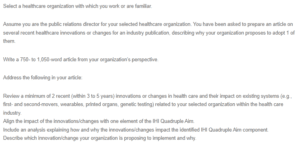
Select a healthcare organization with which you work or are familiar.
Assume you are the public relations director for your selected healthcare organization. You have been asked to prepare an article on several recent healthcare innovations or changes for an industry publication, describing why your organization proposes to adopt 1 of them.
Innovations and Changes in Health Care
Write a 750- to 1,050-word article from your organization’s perspective.
Address the following in your article:
Review a minimum of 2 recent (within 3 to 5 years) innovations or changes in health care and their impact on existing systems (e.g., first- and second-movers, wearables, printed organs, genetic testing) related to your selected organization within the health care industry.
Align the impact of the innovations/changes with one element of the IHI Quadruple Aim.
Include an analysis explaining how and why the innovations/changes impact the identified IHI Quadruple Aim component.
Describe which innovation/change your organization is proposing to implement and why.
 Complete the order form and upload all of your files, including any instructions, rubrics, or other materials provided by your instructor.
 Complete the order payment after filling in the order form. We’ll receive your order and assign it to a writer.
 The assigned writer will complete your paper and forward it to our Editing Team for review and approval.
 Once approved by the editor, the completed paper will be uploaded to your account for you to download, review and approve.