
Comparison of Cardiovascular Exemplars
| Angina | Acute Myocardial Infarction | |
| Pathophysiology | Decreased oxygen supply to the myocardium and increased oxygen demand to the myocardium causes angina. Blockage of the coronary artery causes ischemia and necrosis (Hermiz & Sedhai, 2021). | Occlusion of the coronary artery leads to decreased blood flow. Decreased oxygen supply causes the development of ischemia, causing cell injury and cell death (Mechanic et al., 2022). |
| Etiology | Risk factors include diabetes mellitus, smoking, hypertension, and coronary artery disease.
Precipitating factors include hyperthyroidism, fever, anaemia, and catecholamines. Preventive factors include physical activity. Congenital anomalies. It decreased the oxygen-carrying capacity of the blood. It decreased myocardial blood supply. Increased extravascular forces include left ventricular diastolic pressure (Hermiz & Sedhai, 2021). |
It decreased the oxygen supply.
It increased oxygen demand. Vasospasms (Mechanic et al., 2022). |
| Assessment Findings (including Diagnostics)
|
Pain scale, location, characteristics, onset, duration, relieving, and exacerbating factors.
Health history. Electrocardiography and Holter. Exercise stress test. Chest X-ray. Echocardiogram (Hermiz & Sedhai, 2021).
|
Pain scale, location, characteristics, onset, duration, relieving, and exacerbating factors.
Health history. ECG. CBC. Lipid profile, troponin levels, cardiac enzymes. Exercise stress test. Chest X-ray. MRI (Mechanic et al., 2022). |
| Nursing Diagnosis
|
Acute pain is related to increased oxygen consumption or decreased myocardial blood flow.
Decreased cardiac output is related to alterations in rhythm and ionotropic changes. Anxiety is related to changes in health status (Hermiz & Sedhai, 2021). |
Acute pain is related to occlusion of the coronary artery.
Decreased cardiac output is related to the decreased blood supply to the heart. Ineffective tissue perfusion is related to thromboembolism and vasoconstriction, interrupting blood supply. Excessive fluid volume is related to decreased renal perfusion. Anxiety is related to changes in health status (Mechanic et al., 2022). |
| Interventions (including meds and Surgical interventions)
|
Pain management.
Oxygen therapy. Treatment of angina through medications such as nitroglycerin, antiplatelets, beta-blockers, and calcium channel blockers and adequate bed rest in semi-Fowler’s position. I am decreasing oxygen demand by decreasing activity and adequate rest. Management of anxiety through patient education and reassurance. Coronary revascularization (Hermiz & Sedhai, 2021). |
Pain management.
Oxygen therapy. Administration of medications such as angiotensin-converting enzyme inhibitors and thrombolytics. Prevent excessive fluid volume in the lungs by encouraging frequent changes of positions. I am decreasing oxygen demand by decreasing activity and encouraging bed rest. Decrease chest pain and discomfort through elevated back rest. Management of anxiety through patient education and reassurance. Percutaneous coronary intervention (Ahmad et al., 2022).
|
References
Ahmad M, Mehta P, Reddivari AKR, et al. (2022). Percutaneous Coronary Intervention. Stat Pearls Publishing. https://www.ncbi.nlm.nih.gov/books/NBK556123/.
Hermiz, C., & Sedhai, Y. R. (2021). Angina. Stat Pearls Publishing. https://www.ncbi.nlm.nih.gov/books/NBK557672/.
Mechanic, O. J., Gavin, M., & Grossman, S. A. (2022). Acute Myocardial Infarction. Stat Pearls Publishing. https://www.ncbi.nlm.nih.gov/books/NBK459269/.
ORDER A PLAGIARISM-FREE PAPER HERE
We’ll write everything from scratch
Question 
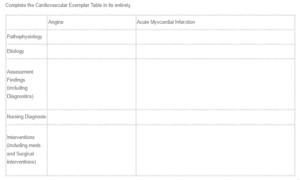
Comparison of Cardiovascular Exemplars
Complete the Cardiovascular Exemplar Table in its entirety.
| Angina | Acute Myocardial Infarction | |
| Pathophysiology | ||
| Etiology | ||
| Assessment Findings (including Diagnostics) | ||
| Nursing Diagnosis | ||
| Interventions (including meds and Surgical interventions) |
 Complete the order form and upload all of your files, including any instructions, rubrics, or other materials provided by your instructor.
 Complete the order payment after filling in the order form. We’ll receive your order and assign it to a writer.
 The assigned writer will complete your paper and forward it to our Editing Team for review and approval.
 Once approved by the editor, the completed paper will be uploaded to your account for you to download, review and approve.