
Culture Project-Male and female Caregivers, Communication Style, Space Orientation, Time Orientation, and Verbal Communication
As care approaches tend towards person-centered care, there is a growing need for cultural awareness and cultural competence in care processes. Integration of culturally competent care into the clinical setting is, in this aspect, warranted because of its significance in enhancing patient experiences. Healthcare providers are implored to demonstrate cultural awareness in their care provision processes. This paper highlights various cultural aspects of Puerto Rican culture, emphasizing their communication style, space and time orientation, verbal communication, and perception of male and female caregivers.
Male/Female Caregivers
The societal perception of gender-based caregiving roles differs across cultures. Caregiving roles among Puerto Ricans remain a predominantly feminine activity. Women are involved in the majority of caregiving roles among families of Puerto Rican culture. This points to the gender stereotype that remains rooted in this culture, as well as other Hispanic cultures that liken women to better caregiving. Caregiving roles in this regard entail bearing the physical and emotional burden of the affected family member. Women in these societies are responsible for lessening the physical and emotional liabilities of the affected member of the family (Balbim et al., 2019). In the Puerto Rican culture, daughters assume the caregiving role to the older family members, providing them with the necessary care and a sense of utility.
Communication Style
Culture defines, in part, communication styles and interpersonal relations. The Puerto Rican culture is significant in friendliness and warmth during interpersonal relations. Individuals from this culture utilize hand gestures and other body movements in their routine conversations. Hugging, kissing, handshaking, holding hands, patting, and embracing are common features of communication among members of this culture (Lafond, 2019). They also do not interrupt each other during conversations. Titles such as “senor,” “Professor,” and others often precede an individual name during a conversation as a sign of respect for the person.
Verbal Communication
The Puerto Rican culture is a blend of Spanish, African, and indigenous cultures. Spanish is the most dominant language in most Puerto Rican societies. Puerto Ricans maintain respect and politeness in their conversations. They are often expressive and emotional but maintain calm whenever one is talking. They rarely interrupt each other during conversations. Delicate information is often handled bluntly, as they always try to remain respectful and polite in their conversations (Matsuda et al., 2022). In this regard, long-winded and indirect approaches are used to avoid aggravating the other partner.
Space Orientation
Space orientation and socialization practices differ across cultures. Among Puerto Ricans, observation of personal space is a non-issue, as Puerto Ricans tend to stand closer to each other during conversations. Patting and touching during conversation are also common among persons of similar sex among members of this group (Lafond, 2019). Maintaining longer distances during a conversation is often regarded as being unfriendly across this culture. Eye contact is often appreciated as it is often perceived as a sign of respect and attentiveness.
Time Orientation
Unlike the American and European cultures that are strict on time, the Puerto Rican culture, like other Hispanic cultures, is often relaxed on time. Not adherent to timelines is an expected and allowed behavior among members of this culture. Lateness among members of this culture is slowly becoming a norm, with the term “Puerto Rican Time” coiled to suggest their tendency towards not being punctual. Notwithstanding, many people in Puerto Rico are time-savvy and aware of the significance of punctuality and keeping time.
References
Balbim, G. M., Magallanes, M., Marques, I. G., Ciruelas, K., Aguiñaga, S., Guzman, J., & Marquez, D. X. (2019). Sources of caregiving burden in middle-aged and older Latino caregivers. Journal of Geriatric Psychiatry and Neurology, 33(4), 185–194. https://doi.org/10.1177/0891988719874119.
Lafond, G. (2019). A study of communication and Hispanic cultural values within the family. DigitalCommons@URI. Retrieved November 3, 2022, from https://digitalcommons.uri.edu/srhonorsprog/712/.
Matsuda, Y., DeBastiani, S. D., Thalasinos, R. D., Ferranti, D., Norris, A. E., & De Santis, J. P. (2022). Cultural influences on Hispanic mother-daughter communication about sex. Journal of Transcultural Nursing, 33(3), 355–362. https://doi.org/10.1177/10436596221083030.
ORDER A PLAGIARISM-FREE PAPER HERE
We’ll write everything from scratch
Question 
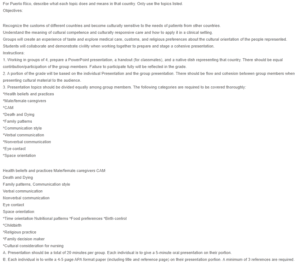
Culture Project
For Puerto Rico, describe what each topic does and means in that country. Only use the topics listed.
Objectives:
Recognize the customs of different countries and become culturally sensitive to the needs of patients from other countries.
Understand the meaning of cultural competence and culturally responsive care and how to apply it in a clinical setting.
Groups will create an experience of taste and explore medical care, customs, and religious preferences about the cultural orientation of the people represented.
Students will collaborate and demonstrate civility when working together to prepare and stage a cohesive presentation.
Instructions:
1. Working in groups of 4, prepare a PowerPoint presentation, a handout (for classmates), and a native dish representing that country. There should be equal contribution/participation of the group members. Failure to participate fully will be reflected in the grade.
2. A portion of the grade will be based on the individual Presentation and the group presentation. There should be flow and cohesion between group members when presenting cultural material to the audience.
3. Presentation topics should be divided equally among group members. The following categories are required to be covered thoroughly:
*Health beliefs and practices
*Male/female caregivers
*CAM
*Death and Dying
*Family patterns
*Communication style
*Verbal communication
*Nonverbal communication
*Eye contact
*Space orientation
Health beliefs and practices Male/female caregivers CAM
Death and Dying
Family patterns, Communication style
Verbal communication
Nonverbal communication
Eye contact
Space orientation
*Time orientation Nutritional patterns *Food preferences *Birth control
*Childbirth
*Religious practice
*Family decision maker
*Cultural consideration for nursing
A. Presentation should be a total of 20 minutes per group. Each individual is to give a 5-minute oral presentation on their portion.
B. Each individual is to write a 4-5 page APA format paper (including title and reference page) on their presentation portion. A minimum of 3 references are required.
C. Each group will provide some form of handout for classmates. This may be a brochure, quiz, crossword puzzle, etc. D. Each group will prepare a dish representing your country. Please provide the recipe next to the dish. This will protect classmates with allergies (nuts, seafood, etc). The instructor will provide bottled water, plates, napkins, and plastic ware. E. An outline of the group presentation should be given to the instructor before the Presentation begins.
** BE CREATIVE!!! You can wear costumes (appropriate), use props, etc. Engage the class and get them involved. Make this project fun and interesting.
 Complete the order form and upload all of your files, including any instructions, rubrics, or other materials provided by your instructor.
 Complete the order payment after filling in the order form. We’ll receive your order and assign it to a writer.
 The assigned writer will complete your paper and forward it to our Editing Team for review and approval.
 Once approved by the editor, the completed paper will be uploaded to your account for you to download, review and approve.