
Designing a Care Map
| Assessment and Data Collection | Three NANDA-I Approved Nursing Diagnosis | One Smart Goal for EACH Nursing Diagnosis | Two Nursing Interventions with Rationale for EACH Nursing Diagnosis |
| Disease Process:
A fracture is a complete or partial discontinuity of bone structure. Tibiofibular fractures occur due to low-energy or high-energy impact (Wu et al., 2021). Following injury, inflammation occurs, and the process of bone healing begins. Cellular proliferation occurs, followed by callus formation and ossification. Mature bone remodeling is the final step.
Common Labwork/Diagnostics: Physical examination CBC Electrolyte and creatinine levels Blood glucose levels Coagulation profile Blood group and cross-matching Toxicology screen X-ray of the affected limb
Assessment Data (consider subjective, objective, and health history):
Subjective Site of the fracture The severity of pain. Relieving and exacerbating factors of pain. Symptoms associated with pain. Itchiness under the cast.
Objective 78-year-old male, Right tibiofibular fracture, Right long leg cast, It uses a hanger to scratch the skin under the cast, Sits for long periods with the leg in a dependent position, He gets up without help, Hops on one leg without crutches. |
Nursing Diagnosis:
Risk for falls related to right tibia and fibula as evidenced by hopping to the bathroom and walking without crutches (Canuto et al., 2020)
Nursing Diagnosis: Deficient knowledge related to lack of information, as evidenced by sitting on the sides of the bed for long periods with the affected limb in a dependent position. (Assis et al., 2018)
Nursing Diagnosis Impaired skin integrity about a long leg cast, as evidenced by the patient using a hanger to scratch the skin under the cast. |
SMART Goal:
The patient will keep the fracture fixed and aligned.
SMART Goal: The patient will express the comprehension of their illness, outlook, and potential consequences.
SMART Goal: Physical examination of the skin for the integrity of circulation. |
1. Intervention: Maintain limb rest as indicated. Proper positioning of the fractured limb (Ferreira et al., 2022).
Rationale: Prevents irrational movement and alignment disturbance.
2. Intervention: Follow-up right lower limb x-rays. Rationale: Monitors commencement of callus formation and healing process. Furthermore, assess the need for therapy adjustment.
1. Intervention: Review disease process and expected outcomes. Rationale: It gives the patient the ability to make an informed decision. 2. Intervention: Reiterate the recommended ambulation and mobility techniques. Rationale: Inadequate usage of ambulatory equipment could result in further injury and a delay in healing.
1. Intervention: Massaging skin and placing soft padding on bony prominences. Rationale: Reduces pressure on vulnerable areas and decreases the chance of skin abrasions and disintegration.
2. Intervention: Frequent repositioning of the fractured limb. Rationale: Reduces persistent pressure on the same regions and lowers the chance of skin disintegration. |
References
Assis, G. L. C. D., Sousa, C. S., Turrini, R. N. T., Poveda, V. D. B., & Silva, R. D. C. G. (2018). Proposal of nursing diagnoses, outcomes, and interventions for postoperative orthognathic surgery patients. Revista da Escola de Enfermagem da USP, 52. https://doi.org/10.1590/S1980-220X2017025303321.
Canuto, C. P. D. A. S., Oliveira, L. P. B. A. D., Medeiros, M. R. D. S., & Barros, W. C. T. D. S. (2020). Safety of hospitalized older adult patients: an analysis of the risk of falls. Revista da Escola de Enfermagem da USP, 54. https://doi.org/10.1590/S1980-220X2018054003613.
Ferreira, R. C., Moorhead, S. A., Zuchatti, B. V., Begnami, N. E. D. S., Ribeiro, E., Carvalho, L. A. C., & Duran, E. C. M. (2022). Nursing outcomes for patients with multiple traumas and impaired physical mobility: An integrative review. International Journal Of Nursing Knowledge. https://doi.org/10.1111/2047-3095.12384.
Wu, L. P., Mayr, H. O., Cai, Q., Huan, Y. Q., Zhu, X. H., Chen, Y. Z., & Huang, X. Y. (2021). A New Three‐Dimensional Classification of Proximal Tibiofibular Fractures: A Multicenter Study. Orthopaedic Surgery, 13(8), 2442-2456. https://doi.org/10.1111/os.13161.
ORDER A PLAGIARISM-FREE PAPER HERE
We’ll write everything from scratch
Question 
Designing a Care Map
Purpose of Assignment
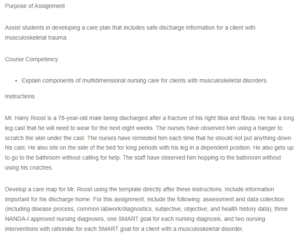
Assist students in developing a care plan that includes safe discharge information for a client with musculoskeletal trauma.
Course Competency
- Explain components of multidimensional nursing care for clients with musculoskeletal disorders.
Instructions
Mr. Harry Roost is a 78-year-old male being discharged after a fracture of his right tibia and fibula. He has a long leg cast that he will need to wear for the next eight weeks. The nurses have observed him using a hanger to scratch the skin under the cast. The nurses have reminded him each time that he should not put anything down his cast. He also sits on the side of the bed for long periods with his leg in a dependent position. He also gets up to go to the bathroom without calling for help. The staff have observed him hopping to the bathroom without using his crutches.
Develop a care map for Mr. Roost using the template directly after these instructions. Include information important for his discharge home. For this assignment, include the following: assessment and data collection (including disease process, common labwork/diagnostics, subjective, objective, and health history data), three NANDA-I approved nursing diagnoses, one SMART goal for each nursing diagnosis, and two nursing interventions with rationale for each SMART goal for a client with a musculoskeletal disorder.
 Complete the order form and upload all of your files, including any instructions, rubrics, or other materials provided by your instructor.
  Complete the order payment after filling in the order form. We’ll receive your order and assign it to a writer.
 The assigned writer will complete your paper and forward it to our Editing Team for review and approval.
 Once approved by the editor, the completed paper will be uploaded to your account for you to download, review and approve.