
The Right to Contraception Act
Legislation Grid and Testimony/Advocacy Statement
| Health-related Bill Name |
The Right to Contraception Act |
| Bill Number | H.R.8373
|
| Description | The Right to Contraception Act bill was introduced by house democrat representative Kathy E. Manning of the Sixth District of North Carolina and cosponsored by 145 other members of the House (“H.R.8373 – Right to Contraception Act”, 2022). The bill has been under discussion in the House Committee of Energy and Commerce. The bill establishes statutory protection of an individual’s right to knowledge of contraception and obliges healthcare providers to provide this information to anyone who needs it. This bill of parliament eliminates all impediments to access to contraception and related information by prohibiting measures that have initially existed on access to contraception and related information.
|
| Federal or State? | Federal |
| Legislative Intent | The legislative intent of this proposal is to establish statutory protection for the right to access contraception and information related to contraception. This provision aims to give individuals the right to knowledge of contraception and obliges healthcare providers to provide this information to anyone who needs it. This bill of parliament eliminates all impediments to access to contraception and related information by prohibiting measures that have initially existed on access to contraception and related information. |
| Proponents/ Opponents | Proponents:
Kathy E. Manning, 145 cosponsors, and 77 other house members. |
| Opponents:
One hundred ninety-five house members, mainly Republican house representatives. |
|
| Target Population | The proposed bill on contraception targets Americans of childbearing age who wish to access contraception and information on contraceptives and healthcare providers. The bill also targets healthcare providers because of their knowledge of contraception. They are also directly involved in issuing contraception to their clients. This proposed bill requires them to facilitate access to contraception and information on contraception to their clients unless this provision violates the provider’s or patient’s statutory rights.
|
| Status of the bill (Is it in hearings or committees?) | The bill was passed in the House on 7 July after a roll call in which the proponents emerged the winners with 228 votes. It was received in the Senate the same day. It is now scheduled for the first hearing in the Senate. |
| General Notes/Comments
|
Research findings reveal that access to contraception and information related to contraception has been a challenge to many Americans (Britton et al., 2020). The Kathy Manning bill on contraception rights targets all Americans who have been having challenges accessing this information. This constituent is mainly composed of American males and females of childbearing ages and those of ethnic minority groups who are traditionally disproportionately impacted by low education levels and low income. Access to contraception is often a challenge to these groups. These groups are also less knowledgeable about contraception. |
As the healthcare landscape continues to evolve and the need for changes in care operationalization becomes more apparent, nurses are implored to assume more active roles in these changes. Nursing advocacy is one of the fundamental nursing roles. As healthcare advocates, they facilitate communication between healthcare team members and voice specific concerns in healthcare that may enhance care operationalization. This paper outlines a healthcare-related bill proposal that requires nursing advocacy roles.
Do you need an unpublished edition of ” The Right To Contraception Act “ ? Get in touch with us.
Legislation Testimony/ Advocacy Statement
The Right to Contraception Act bill should be passed. WHO recognizes contraceptives as integral to sexual and reproductive health and that access to contraception advances human rights to liberty, education, work, and expression (WHO, 2022). In the U.S., traditional barriers to access to contraceptives exist, such as affordability, stigma, and lack of access to contraceptive services. These barriers disproportionately impact communities traditionally affected by health disparities and poor access to care, such as Black communities and indigenous groups (Swan, 2021). There has been a gap in legislation and policy to address these challenges adequately. Notwithstanding, all Americans deserve the right to access to contraception and information related to contraception, and the bill should, therefore, be passed.
Traditional barriers to access to contraception have often been associated with low income and poor education. Low-income earners sometimes find it difficult to afford contraception. On the other hand, low education levels have been linked with health illiteracy(Troutman et al., 2020). These individuals lack basic knowledge of contraception and facts on its use. This legislation seeks to eliminate barriers related to access to information that would have otherwise affected persons with low education and also enhance its access to all Americans. This bill targets persons of childbearing age as they are most likely to require the use of contraceptives. It also targets men, women, and members of the LGBTQ society who may find the use of contraceptives important.
Opponents of the bill ought to recognize the fundamental right of choice, liberty, life, education, and work that all Americans deserve. They should bear in mind that unintended pregnancies rob many Americans of their work, education, and life. They should also recognize that most American women of childbearing age are at increased risk of unintended pregnancies and its consequence of lost dignity, potential loss of work, interruptions or loss of education, and even loss of life. They should also acknowledge that contraceptives are safe and integral to sexual and reproductive health (Britton et al., 2020). For these reasons, they should be considerate and reconsider their stance on the right to contraception.
The Right to Contraception Act, conceived by Kathy E. Manning, is important legislation in sexual and reproductive health. This proposed bill will eliminate restrictive factors to contraception access and thereby make contraception and contraception-related information available to all Americans. Having passed the House and now scheduled for hearing in the Senate, this bill is one step from becoming law. Its benefits will be felt by many Americans who are traditionally disadvantaged by poor access to these services.
References
Britton, L., Alspaugh, A., Greene, M., & McLemore, M. (2020). An Evidence-Based Update on Contraception. AJN, American Journal Of Nursing, 120(2), 22-33. https://doi.org/10.1097/01.naj.0000654304.29632.a7
Contraception. Who. int. (2022). Retrieved 22 September 2022, from https://www.who.int/health-topics/contraception.
H.R.8373 – Right to Contraception Act. Congress.gov. (2022). Retrieved 22 September 2022, from https://www.congress.gov/bill/117th-congress/house-bill/8373/text?r=1&s=1.
Swan, L. (2021). The impact of U.S. policy on contraceptive access: a policy analysis. Reproductive Health, 18(1). https://doi.org/10.1186/s12978-021-01289-3
Troutman, M., Rafique, S., & Plowden, T. (2020). Are higher unintended pregnancy rates among minorities a result of disparate access to contraception? Contraception And Reproductive Medicine, 5(1). https://doi.org/10.1186/s40834-020-00118-5
ORDER A PLAGIARISM-FREE PAPER HERE
We’ll write everything from scratch
Question 
Assignment: Legislation Grid and Testimony/Advocacy Statement
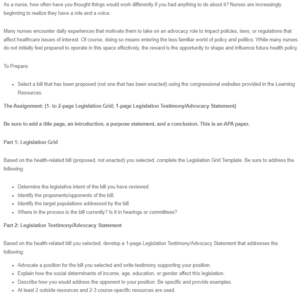
As a nurse, how often have you thought things would work differently if you had anything to do about it? Nurses are increasingly beginning to realize they have a role and a voice.
The Right to Contraception Act
Many nurses encounter daily experiences that motivate them to take on an advocacy role to impact policies, laws, or regulations that affect healthcare issues of interest. Of course, doing so means entering the less familiar world of policy and politics. While many nurses do not initially feel prepared to operate in this space effectively, the reward is the opportunity to shape and influence future health policy.
To Prepare:
- Select a bill that has been proposed (not one that has been enacted) using the congressional websites provided in the Learning Resources.
The Assignment: (1- to 2-page Legislation Grid; 1-page Legislation Testimony/Advocacy Statement)
Be sure to add a title page, an introduction, a purpose statement, and a conclusion. This is an APA paper.
Part 1: Legislation Grid
Based on the health-related bill (proposed, not enacted) you selected, complete the Legislation Grid Template. Be sure to address the following:
- Determine the legislative intent of the bill you have reviewed.
- Identify the proponents/opponents of the bill.
- Identify the target populations addressed by the bill.
- Where in the process is the bill currently? Is it in hearings or committees?
Part 2: Legislation Testimony/Advocacy Statement
Based on the health-related bill you selected, develop a 1-page Legislation Testimony/Advocacy Statement that addresses the following:
- Advocate a position for the bill you selected and write testimony supporting your position.
- Explain how the social determinants of income, age, education, or gender affect this legislation.
- Describe how you would address the opponent to your position. Be specific and provide examples.
- At least 2 outside resources and 2-3 course-specific resources are used.
 Complete the order form and upload all of your files, including any instructions, rubrics, or other materials provided by your instructor.
 Complete the order payment after filling in the order form. We’ll receive your order and assign it to a writer.
 The assigned writer will complete your paper and forward it to our Editing Team for review and approval.
 Once approved by the editor, the completed paper will be uploaded to your account for you to download, review and approve.