
Determining the Credibility of Evidence and Resources
The utilization of available evidence to improve practice has proven to have positive outcomes for patients, healthcare professionals, and healthcare organizations (Cleary-Holdforth et al., 2021). Developing evidence-based practice (EBP) competency and implementation of EBP by nurses requires understanding how to collect, process, and consistently implement evidence in clinical practice (Melnyk et al., 2021). This paper focuses on the application of evidence-based practice in the diagnosis of chronic pain syndrome. The paper will discuss the criteria to use in determining the credibility of resources to support an evidence-based diagnosis of the health issue, analyze the credibility and relevance of available evidence that can be used to support the diagnosis of chronic pain syndrome and the importance of credible evidence in an evidence-based practice model.
Hire our assignment writing services if your assignment is devastating you.
Diagnosis of Chronic Pain Syndrome
Chronic pain syndrome (CPS) describes pain that can persist from three months to several years. The diagnosis of CPS can be controversial due to the various views on the causes and nature of the pain. Both physical and mental causes can trigger chronic pain syndrome. The physical triggers of CPS are easily identifiable, such as arthritis, physical injuries, and medical conditions such as cancer. The mental triggers are thought to result from miscommunication between the nervous system. CPS can also result from learned responses due to occasional pain (Vlaeyen & Crombez, 2020). Additionally, there is a lot of physical and psychological comorbidity in CPS to make a conclusive diagnosis of patients suspected to have the health condition. Therefore, nurses need to base their diagnosis of CPS on available evidence to avoid misdiagnosis and risk compromising the safety and quality of care provided.
Criteria to Determine Credibility of Resources
The review of available evidence can help nurses to diagnose CPS conclusively. The sources of evidence and information include scholarly and research articles, websites, and existing guidelines. The sources must be credible and relevant enough to support conclusive diagnosis and the development of fitting care interventions for CPS. The main criteria for the credibility of the resources include authority, creditability, timeliness, currency, objectivity, audience, and verifiability of the resources to be used.
Authority and creditability of the sources to be used focus on the extent of the author’s knowledge of the subject covered and the authenticity of the claims. The authority and creditability of the resources may be determined by checking if the paper is peer-reviewed, confirming the references, and crediting cited authors. The timeliness and currency of the resources to be used focus on the current information. The sources must present the most updated diagnosis procedures for chronic pain. The objectivity and verifiability criteria determine whether the information given by the sources are facts or opinions and whether such claims can be verified. Lastly, the audience criteria focus on the purpose of the resources. Resources for professionals are more credible than resources for the general population.
Analysis of the Credibility and Relevance of Evidence for Diagnosis of Chronic Pain Syndrome
There is extensive research and websites focused on the diagnosis and management of the various types of chronic pain syndrome. The most credible and relevant resources for diagnosing CPS are those that provide authoritative and updated details on the etiopathogenetic processes of CPS, diagnostic and management procedures for CPS, and details on differential diagnostic procedures for CPS. For instance, the articles by Nicholas et al. (2019), Treede et al. (2019), and Mesaroli et al. (2021) have been published in the Pain Journal, a publication of the International Association for the Study of Pain. The articles by Nicholas et al. (2019) and Treede et al. (2019) present diagnostic information on the classification of chronic pain based on the International Association for the Study of Pain (IASP) classification of pain to improve the International Classification of Diseases (ICD-11) for the diagnosis of chronic pain. On the other hand, the article by Mesaroli et al. (2021) is a systematic review of available screening and diagnostic tools for complex regional pain syndrome (CRPS).
Further, the article by Bourgaize et al. (2018) was published in the peer-reviewed Journal of the Canadian Chiropractic Association. The article focuses on differential diagnosis and management of myofascial pain syndrome and fibromyalgia. All articles are within the currency criteria, and the authors have authority in the subject and work, do research, or are continuing their studies in related fields.
Credible Evidence and its Importance in an Evidence-based Practice Model
The Advancing Research and Clinical practice will aid the integration of evidence in the diagnosis and management of CPS through the Close Collaboration (ARCC) model. The ARCC is an EBP model that focuses on collaboration between personal and organizational elements to improve nursing care outcomes and nurse work experiences (Melnyk et al., 2021). ARCC supports the implementation of evidence into practice and provides evaluation approaches for EBP outcomes. However, the model can achieve notable results only if credible evidence is incorporated. Credible evidence provides details on current and accurate practices and procedures. It also helps nurses identify and navigate barriers to previous practices. In this case, incorporating credible evidence in the diagnosis of CPS will provide the nurses with clear information on diagnostic procedures, differentiation of chronic pain, and the development of appropriate treatment and interventions for chronic pain.
Conclusion
EBP improves nursing practices. However, outcomes of EBP, when implemented in nursing, are determined by the credibility of the resources used to support EBP. Nurses need to know how to select, evaluate, and determine the credibility of the resources for information used to inform their practice. Using credible resources for evidence improves the nurse’s knowledge of health conditions, hence better diagnosing and managing diseases.
References
Bourgaize, S., Newton, G., Kumbhare, D., & Srbely, J. (2018). A comparison of the clinical manifestation and pathophysiology of myofascial pain syndrome and fibromyalgia: implications for differential diagnosis and management. The Journal of the Canadian Chiropractic Association, 62(1), 26. /PMC/articles/PMC6160895/
Cleary-Holdforth, J., O’Mathúna, D., & Fineout-Overholt, E. (2021). Evidence-Based Practice Beliefs, Implementation, and Organizational Culture and Readiness for EBP Among Nurses, Midwives, Educators, and Students in the Republic of Ireland. Worldviews on Evidence-Based Nursing, 18(6), 379–388. https://doi.org/10.1111/WVN.12543
Melnyk, B. M., Tan, A., Hsieh, A. P., & Gallagher-Ford, L. (2021). Evidence-Based Practice Culture and Mentorship Predict EBP Implementation, Nurse Job Satisfaction, and Intent to Stay: Support for the ARCC© Model. Worldviews on Evidence-Based Nursing, 18(4), 272–281. https://doi.org/10.1111/WVN.12524
Mesaroli, G., Hundert, A., Birnie, K. A., Campbell, F., & Stinson, J. (2021). Screening and diagnostic tools for complex regional pain syndrome: a systematic review. Pain, 162(5), 1295. https://doi.org/10.1097/J.PAIN.0000000000002146
Nicholas, M., Vlaeyen, J. W. S., Rief, W., Barke, A., Aziz, Q., Benoliel, R., Cohen, M., Evers, S., Giamberardino, M. A., Goebel, A., Korwisi, B., Perrot, S., Svensson, P., Wang, S. J., & Treede, R. D. (2019). The IASP classification of chronic pain for ICD-11: Chronic primary pain. Pain, 160(1), 28–37. https://doi.org/10.1097/J.PAIN.0000000000001390
Treede, R. D., Rief, W., Barke, A., Aziz, Q., Bennett, M. I., Benoliel, R., Cohen, M., Evers, S., Finnerup, N. B., First, M. B., Giamberardino, M. A., Kaasa, S., Korwisi, B., Kosek, E., Lavand’Homme, P., Nicholas, M., Perrot, S., Scholz, J., Schug, S., … Wang, S. J. (2019). Chronic pain as a symptom or a disease: The IASP Classification of Chronic Pain for the International Classification of Diseases (ICD-11). Pain, 160(1), 19–27. https://doi.org/10.1097/J.PAIN.0000000000001384
Vlaeyen, J. W. S., & Crombez, G. (2020). Behavioral Conceptualization and Treatment of Chronic Pain. Https://Doi.Org/10.1146/Annurev-Clinpsy-050718-095744, 16, 187–212. https://doi.org/10.1146/ANNUREV-CLINPSY-050718-095744
ORDER A PLAGIARISM-FREE PAPER HERE
We’ll write everything from scratch
Question 
Develop a 2-4 page scholarly paper in which you describe a quality or safety issue or a chosen diagnosis, and then identify and analyze credible evidence that could be used as the basis for applying EBP to the problem.
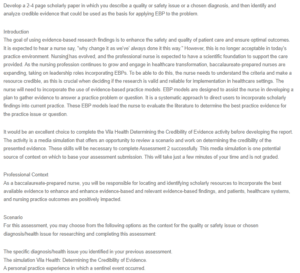
Determining the Credibility of Evidence and Resources
Introduction
The goal of using evidence-based research findings is to enhance the safety and quality of patient care and ensure optimal outcomes. It is expected to hear a nurse say, “why change it as we’ve’ always done it this way.” However, this is no longer acceptable in today’s practice environment. Nursing has evolved, and the professional nurse is expected to have a scientific foundation to support the care provided. As the nursing profession continues to grow and engage in healthcare transformation, baccalaureate-prepared nurses are expanding, taking on leadership roles incorporating EBPs. To be able to do this, the nurse needs to understand the criteria and make a resource credible, as this is crucial when deciding if the research is valid and reliable for implementation in healthcare settings. The nurse will need to incorporate the use of evidence-based practice models. EBP models are designed to assist the nurse in developing a plan to gather evidence to answer a practice problem or question. It is a systematic approach to direct users to incorporate scholarly findings into current practice. These EBP models lead the nurse to evaluate the literature to determine the best practice evidence for the practice issue or question.
It would be an excellent choice to complete the Vila Health Determining the Credibility of Evidence activity before developing the report. The activity is a media simulation that offers an opportunity to review a scenario and work on determining the credibility of the presented evidence. These skills will be necessary to complete Assessment 2 successfully. This media simulation is one potential source of context on which to base your assessment submission. This will take just a few minutes of your time and is not graded.
Professional Context
As a baccalaureate-prepared nurse, you will be responsible for locating and identifying scholarly resources to incorporate the best available evidence to enhance and enhance evidence-based and relevant evidence-based findings, and patients, healthcare systems, and nursing practice outcomes are positively impacted.
Scenario
For this assessment, you may choose from the following options as the context for the quality or safety issue or chosen diagnosis/health issue for researching and completing this assessment:
The specific diagnosis/health issue you identified in your previous assessment.
The simulation Vila Health: Determining the Credibility of Evidence.
A personal practice experience in which a sentinel event occurred.
Instructions
This analysis aims to understand better what constitutes the credibility of journal articles and websites. The role of the baccalaureate-prepared nurse in incorporating evidence-based research continues to grow in clinical practice. As quality improvement (QI) measures to reduce safety risks continue to be emphasized, the need for evidence-based models and templates is growing. This systematic approach to incorporating evidence-based findings allows nurses to make clinical and operational decisions based on the best available evidence. When the most up-to-date evidence-based findings are utilized, patient-centered care improves outcomes and enhances the patient experience.
Below is a quick review table of several well-known Evidence-Based Practice Models used to guide exploration:
Evidence-Based Practice Models
Iowa Model of Evidence-Based Practice
Stetler Model
Ottawa Model
PARiHS (Promoting Action on Research Implementation in Health Services) Model
ACE (Academic Center for Evidence-Based Practice) Star Model
ARCC (Advancing Research and Clinical Practice Through Close Collaboration) Mode
John Hopkins Model
KTA (Knowledge-to-Action) Model
For this assessment:
Explain the criteria that should be used when determining the credibility of journal articles and websites.
Support conditions with references to the literature or research articles that describe criteria that should be used to determine credibility.
Your identification and determination of credibility should be done within the context of your chosen scenario for this assessment. For example, if you decide to use the provided Vila Health scenario, your initial identification of resources should be of resources that will best help address the presented issue. However, suppose you are locating resources to help provide evidence-based care for the diagnosis/health care issue you identified in the first assessment. In that case, you may want to begin your literature and evidence search from the databases that were placed. Any of the three scenario options are acceptable. So, pick the one that most interests you.
Be sure to address the following in this assessment, corresponding to the grading criteria in the scoring guide. Please study the scoring guide carefully to know what the distinguished score is.
Describe a quality or safety issue or a chosen diagnosis that could benefit from an evidence-based approach.
Explain criteria when determining the credibility of resources such as journal articles and websites.
Analyze the credibility and relevance of evidence and resources within a quality or safety issue or a chosen diagnosis.
You select the specific region to address the issue in your chosen scenario.
Identify the Evidence-Based Practice model and explain the importance of incorporating credible evidence into the EBP model to address a quality or safety issue or a chosen diagnosis/health care issue. Review the literature below and select the appropriate model for your diagnosis/health care issue.
They are selecting a model for evidence-based practice changes. [PDF] and Evidence-Based Practice Models help explain the various evidence-based nursing models. https://connect.springerpub.com/content/book/978-0-8261-2759-4/back-matter/bmatter1
 Complete the order form and upload all of your files, including any instructions, rubrics, or other materials provided by your instructor.
 Complete the order payment after filling in the order form. We’ll receive your order and assign it to a writer.
 The assigned writer will complete your paper and forward it to our Editing Team for review and approval.
 Once approved by the editor, the completed paper will be uploaded to your account for you to download, review and approve.