
Indian Culture Self-Reflection
I grew up in a big family with my grandmother, parents, uncles and their wives, siblings whose boyfriends and husbands later joined, and now my nieces and nephews. My father and uncle make most of the rules and decisions in our family. My mother was mainly the voice of emphasis as she ran the family activities. Most research studies show that women in most cultures have the roles of raising children and doing housework (Gürsoy & Tanrıverdi, 2020). Accordingly, my mother mainly taught us house chores and personal hygiene.
While I grew up seeing my aunts being married off to arranged husbands, I thought I would leave my family to live alone when it was my time. However, living with my family created a stronger bond among us because my sisters and brothers became my friends, too. I even grew closer to my cousins, and the thought of leaving them meant turning my back on my life.
The women in my family provided dowry to their husbands. I saw this from my maternal grandmother, who owned a small business to provide for her family. Further, schooling with other children who hardly practiced our culture opened my heart to the world. I wanted to live independently because whenever I felt overwhelmed with emotions in my house, my sisters and mother immediately wanted to know the problem. Instead, I often wished to be alone in my room.
At school, I learn more about other cultures and appreciate some of the attributes that are not in my own culture. Shepherd et al. (2019) find that healthcare professionals from the USA Mid-Western area value pursuing and possessing cultural knowledge when working with a multicultural population. Despite being raised in Indian culture, my sisters and I have changed some of our cultural attributes. For instance, my mother no longer complains about my friends or whom I choose to date.
References
Gürsoy, M. Y., & Tanrıverdi, G. (2020). Evaluation of Violence against Elderly People of Different Cultures by Using the “Purnell Model for Cultural Competence.” Florence Nightingale journal of nursing, 28(1), 83.
Shepherd, S. M., Willis-Esqueda, C., Newton, D., Sivasubramaniam, D., & Paradies, Y. (2019). The challenge of cultural competence in the workplace: perspectives of healthcare providers. BMC Health Services Research, 19(1), 1-11.
ORDER A PLAGIARISM-FREE PAPER HERE
We’ll write everything from scratch
Question 
Indian Culture Self-Reflection
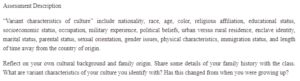
Assessment Description
“Variant characteristics of culture” include nationality, race, age, color, religious affiliation, educational status, socioeconomic status, occupation, military experience, political beliefs, urban versus rural residence, enclave identity, marital status, parental status, sexual orientation, gender issues, physical characteristics, immigration status, and length of time away from the country of origin.
Reflect on your own cultural background and family origin. Share some details of your family history with the class. What are variant characteristics of your culture you identify with? Has this changed from when you were growing up?
 Complete the order form and upload all of your files, including any instructions, rubrics, or other materials provided by your instructor.
 Complete the order payment after filling in the order form. We’ll receive your order and assign it to a writer.
 The assigned writer will complete your paper and forward it to our Editing Team for review and approval.
 Once approved by the editor, the completed paper will be uploaded to your account for you to download, review and approve.