
Bipolar I Disorder
Disturbances in the mood and normal functioning of an individual characterize bipolar disorders. Mania and depression are the key features of bipolar disorders (McIntyre et al., 2020). Both genetic and environmental factors have been linked to the disorder. This paper discusses various aspects of bipolar I disorder, including special considerations and pharmacological treatment approaches.
Are you interested in an unpublished edition on “Bipolar and Bipolar Disorders’ ? Get in touch with us.
Prevalence and Neurobiology
Bipolar I disorder has the exact prevalence among males, females, and various lifespan developmental stages. Data indicates that the prevalence of the disorder in the USA is approximately 2.8 percent in adults and 2.9 percent among adolescents (Psycom.net, 2022). The global prevalence of bipolar disorder is about 2.4 percent (Psycom.net, 2022). Globally, bipolar I disorder accounts for roughly 0.6 percent of the cases, whereas bipolar II accounts for approximately 0.4 percent of the cases (Psycom.net, 2022). In the USA, bipolar I disorder has a prevalence of about 1%, whereas bipolar II disorder has a prevalence of about 1.1% (Psycom.net, 2022). Furthermore, the likelihood of developing bipolar I disorder is approximately five to ten percent in individuals whose first-degree relatives have the disorder (Psycom.net, 2022).
Various neurotrophic factors, receptors, and second messengers play a vital role in the neurobiology of bipolar I disorder. Firstly, findings indicate that the brain-derived neurotrophic factor plays a significant role in bipolar disorder (Scaini et al., 2020). A decrease in the levels of a brain-derived neurotrophic factor increases the risk of developing bipolar disorder. Additionally, bipolar disorder is associated with decreased levels of tyrosine kinase-B receptors in the brain (Scaini et al., 2020). This receptor acts as a binding site for brain-derived neurotrophic factors. Secondly, the levels of neurotrophins 3 and 4 increase during the depressive phase, whereas they decrease during the manic phase of bipolar disorder (Scaini et al., 2020). Genes that code for voltage-gated calcium channel units and gamma-aminobutyric acid receptors have also been implicated in bipolar disorder. This is evidenced by the use of drugs that act on calcium channel units and gamma-aminobutyric acid receptors to manage bipolar disorder (Scaini et al., 2020).
Bipolar I versus Bipolar II
Bipolar I disorder is diagnosed when an individual experiences at least one episode of mania. The manic episodes alternate with episodes of major depression. According to the Diagnostic and Statistical Manual of Mental Disorders, fifth edition (DSM-5), mania should be diagnosed when the signs and symptoms persist for more than or equal to seven days (Truschel, 2020). Furthermore, the manifestations should be present for most of the day and should occur daily. Mania is diagnosed when an individual exhibits at least three manifestations highlighted in the DSM-5 TR criteria. These manifestations include grandiosity, a decrease in the need for sleep, distractibility, hyperactivity, embracing risky behaviors, and erratic or uncontrollably rushing thoughts (Truschel, 2020). These manifestations must significantly affect an individual’s behavior and impede their social life.
Truschel (2020) reports that according to the DSM-5 TR criteria, a major depressive episode must last for at least two weeks and have at least five of the stipulated symptoms. Firstly, the person is depressed almost daily for most of the day. Secondly, the person exhibits anhedonia. Thirdly, the person shows altered nutritional habits as evidenced by weight loss and an increase or loss of appetite (Truschel, 2020). Fourthly, the person is restless. Fifthly, the person has perpetual suicidal ideations (Truschel, 2020). Sixthly, the person becomes indecisive and is unable to concentrate. The other manifestations are fatigue and thoughts of guilt or inferiority.
On the other hand, bipolar II disorder is characterized by alternating episodes of hypomania and major depression. As aforementioned, an individual should have at least five of the stipulated symptoms for a major depressive episode to be diagnosed (Truschel, 2020). On the other hand, the symptoms of hypomania are less severe than those of manic episodes. Hypomania is characterized by manic symptoms that last for four consecutive days (Truschel, 2020).
Special Populations and Considerations
Healthcare providers should exercise caution when dealing with patients across different age groups and those with unique attributes. Firstly, the manifestations of mania and depression may not be differentiated accurately in children, unlike the adult population. As such, attention to detail should be embraced for an accurate, definitive diagnosis to be made. Children’s metabolic pathway is fully developed. This necessitates caution when calculating their doses and during drug selection.
Healthcare providers should be cautious when dealing with the perinatal population because patients’ gravid state may cause mood and behavioral changes. Additionally, a risk-benefit analysis should be conducted before initiating any pharmacological intervention. Teratogenic drugs and those with severe adverse events should be avoided. The pharmacokinetic and pharmacodynamics aspects play a crucial role when dealing with the elderly population (Thürmann, 2020). This population is likely to have other comorbidities. Healthcare providers should exploit various differential diagnoses before making a definitive diagnosis. Dosages should be modified to avoid the risk of toxicities (Thürmann, 2020). Furthermore, the possibility of drug interactions and polypharmacy should be evaluated.
Healthcare providers should embrace the principles of healthcare ethics when dealing with patients diagnosed with bipolar I disorder. They should ensure that all interventions promote the well-being of patients and avoid harming them. This is consistent with the ethical principles of beneficence and non-maleficence. Healthcare providers should offer non-discriminatory services and avoid prejudices and stereotypes. In addition, they should offer culturally congruent services. For example, language barriers can be eliminated by hiring interpreters.
Pharmacological Treatment Options
Various agents are used for the management of acute episodes, mixed episodes, and maintenance treatment. Acute manic episodes are controlled by mood stabilizers such as lithium valproate and carbamazepine (Yatham et al., 2018). These acute episodes can also be directed using antipsychotic medication such as risperidone, ziprasidone, quetiapine, chlorpromazine, aripiprazole and asenapine, and cariprazine (McIntyre et al., 2020). Benzodiazepines are the other class of drugs used to manage acute episodes. Examples of these agents include diazepam, lorazepam, and alprazolam (Yatham et al., 2018).
The aforementioned antipsychotic agents are also helpful in the management of mixed episodes and for the maintenance of treatment. Valproate and carbamazepine are examples of mood stabilizers used to manage mixed episodes, whereas lamotrigine is used in maintenance therapy (Yatham et al., 2018). Major depressive episodes are ordered using FDA-approved drugs such as cariprazine, lumateperone, quetiapine, lurasidone, and a regimen that combines olanzapine and fluoxetine (Yatham et al., 2018).
Side Effects, FDA Approvals, and Warnings
Benzodiazepines are associated with various adverse effects; these include sedation, drowsiness, respiratory depression, disorientation, asthenia, confusion, and suicidal ideations. Benzodiazepines are also associated with a high risk of addiction and abuse. They are contraindicated in patients with known hypersensitivity, acute narrow-angle glaucoma, and respiratory depression. Monitoring of complete blood count is recommended because they cause blood dyscrasias. Mood stabilizers such as lithium are associated with leukocytosis, hypothyroidism, confusion, headache, polyuria, and changes in the electrocardiogram (Yatham et al., 2018). They are contraindicated in the first trimester, kidney disease, known hypersensitivity, and the presence of cardiovascular diseases (Yatham et al., 2018). The electrocardiogram, thyroid function tests, kidney function, and complete blood count should be monitored (Yatham et al., 2018).
Antipsychotics are associated with extrapyramidal symptoms, headache, insomnia, nausea, constipation, drowsiness, restlessness, elevated liver enzymes, and decreased appetite. Antipsychotics such as cariprazine increase mortality rates in dementia-associated psychosis (Yatham et al., 2018). This is due to the risk of stroke and transient ischemic attacks in these patients. They are contraindicated in known hypersensitivity. Monitoring of plasma glucose levels and lipid profiles should be done because of the likelihood of hyperglycemia and altered lipid levels (Yatham et al., 2018).
Writing a Prescription
A properly written prescription should capture five main aspects. First, it should have the date of the issue, and two, patient identifiers such as the name, address, or date of birth (Kenny & Preuss, 2022). Third, the written prescription should identify the medication, its strength, dosage form, dosing frequency, and the route of administration. Fourth, it should indicate the quantity to be dispensed and the number of refills (Kenny & Preuss, 2022). It should also have prescriber identifiers such as the name or signature.
Example
Patient: Dorothy Walters. Patient: Abdul Isa
DOB: 24/06/2000 DOB:15/9/1998
Capsule Lorazepam 3mg Tablet Lithium 450 mg
Take 1 capsule PO qHS. Take 2 tablets of PO TDS for ten days.
Dispense 15 tablets. Dispense: 30 tablets.
Refill: none Refill: none
Prescriber: Abraham Isaac Date: 23/9/2022 Prescriber: Ruth Goad Date: 25/7/2022
Patient: Bland Chris
DOB: 26/5/1975
Tablet Lurasidone 20 mg
Take 1 tablet Per Day
Dispense: 30
Refill: none
DEA Number:1657332A Date: 20/1/2021
Conclusion
Bipolar I disorder has the exact prevalence among males, females, and various lifespan developmental stages. Brain-derived neurotrophic factors, neurotrophins 3 and 4, and genes that code for voltage-gated calcium channel units and gamma-aminobutyric acid receptors have been implicated in the neurobiology of bipolar I disorder. Antipsychotic agents, mood stabilizers, and benzodiazepines are used in the management of this disorder. Accurately and adequately written prescriptions avert the risk of medication errors.
References
Kenny, J. B., Preuss, V. C. (2022). Pharmacy Prescription Requirements. https://www.ncbi.nlm.nih.gov/books/NBK538424/
McIntyre, R. S., Berk, M., Brietzke, E., Goldstein, B. I., López-Jaramillo, C., Kessing, L. V., Malhi, G. S., Nierenberg, A. A., Rosenblat, J. D., Majeed, A., Vieta, E., Vinberg, M., Young, A. H., & Mansur, R. B. (2020). Bipolar disorders. The Lancet, 396(10265), 1841–1856. https://doi.org/10.1016/S0140-6736(20)31544-0
Psycom.net. (2021). Bipolar 1 Disorder Prevalence and Risks. https://pro.psycom.net/assessment-diagnosis-adherence/bipolar-disorder/bipolar-disorder-prevalence-and-risks
Scaini, G., Valvassori, S. S., Diaz, A. P., Lima, C. N., Benevenuto, D., Fries, G. R., & Quevedo, J. (2020). Neurobiology of bipolar disorders: A review of genetic components, signaling pathways, biochemical changes, and neuroimaging findings. Brazilian Journal of Psychiatry, 42(5), 536–551. https://doi.org/10.1590/1516-4446-2019-0732
Thürmann, P. A. (2020). Pharmacodynamics and pharmacokinetics in older adults. Current Opinion in Anesthesiology, 33(1), 109-113. https://doi.org/10.1097/ACO.0000000000000814
Truschel, J. (2020). Bipolar Definition and DSM-5 Diagnostic Criteria. https://www.psycom.net/bipolar-definition-dsm-5
Yatham, L. N., Kennedy, S. H., Parikh, S. V., Schaffer, A., Bond, D. J., Frey, B. N., Sharma, V., Goldstein, B. I., Rej, S., Beaulieu, S., Alda, M., MacQueen, G., Milev, R. V., Ravindran, A., O’Donovan, C., McIntosh, D., Lam, R. W., Vazquez, G., Kapczinski, F., … Berk, M. (2018). Canadian Network for Mood and Anxiety Treatments (CANMAT) and International Society for Bipolar Disorders (ISBD) 2018 guidelines for the management of patients with bipolar disorder. Bipolar Disorders, 20(2), 97–170. https://doi.org/10.1111/bdi.12609
ORDER A PLAGIARISM-FREE PAPER HERE
We’ll write everything from scratch
Question 
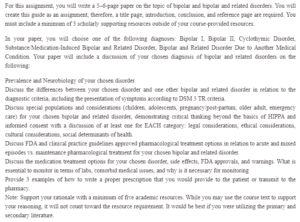
For this assignment, you will write a 5–6-page paper on the topic of bipolar and bipolar and related disorders. You will create this guide as an assignment; therefore, a title page, introduction, conclusion, and reference page are required. You must include a minimum of 3 scholarly supporting resources outside of your course-provided resources.
Bipolar I Disorder
In your paper, you will choose one of the following diagnoses: Bipolar I, Bipolar II, Cyclothymic Disorder, Substance/Medication-Induced Bipolar and Related Disorder, Bipolar and Related Disorder Due to Another Medical Condition. Your paper will include a discussion of your chosen diagnosis of bipolar and related disorders on the following:
Prevalence and Neurobiology of your selected disorder
Discuss the differences between your chosen disorder and one other bipolar and related disorder in relation to the diagnostic criteria, including the presentation of symptoms according to DSM 5 TR criteria.
Discuss special populations and considerations (children, adolescents, pregnancy/post-partum, older adult, emergency care) for your chosen bipolar and related disorder, demonstrating critical thinking beyond the basics of HIPPA and informed consent with a discussion of at least one for EACH category: legal considerations, ethical considerations, cultural considerations, social determinants of health.
Discuss FDA and clinical practice guidelines approved pharmacological treatment options in relation to acute and mixed episodes vs. maintenance pharmacological treatment for your chosen bipolar and related disorder.
Discuss the medication treatment options for your chosen disorder, side effects, FDA approvals, and warnings. What is essential to monitor in terms of labs, comorbid medical issues, and why is it necessary for monitoring
Provide 3 examples of how to write a proper prescription that you would provide to the patient or transmit to the pharmacy.
Note: Support your rationale with a minimum of five academic resources. While you may use the course text to support your reasoning, it will not count toward the resource requirement. It would be best if you were utilizing the primary and secondary literature.
 Complete the order form and upload all of your files, including any instructions, rubrics, or other materials provided by your instructor.
 Complete the order payment after filling in the order form. We’ll receive your order and assign it to a writer.
 The assigned writer will complete your paper and forward it to our Editing Team for review and approval.
 Once approved by the editor, the completed paper will be uploaded to your account for you to download, review and approve.