
Depressive Disorder Medication Guide
Introduction
Adolescents frequently suffer from the severe condition of depression. Depression has long-lasting consequences on a person’s emotions, thoughts, concept of self, behaviors, interpersonal relationships, bodily functions, level of satisfaction at work, and quality of life. It is a typical psychiatric condition that frequently affects adolescents and is ranked as the fourth most prevalent cause of disability and premature death globally (Davaasambuu et al., 2019). Depression is a significant illness that seriously impairs thoughts, makes it challenging to cope with situations, and leaves a person depressed most of the time. Debilitating feelings of melancholy and low self-worth can persist for weeks, months, or even longer for some.
Get in touch with us at eminencepapers.com for any assistance. We offer excellent Services.
Causes and Symptoms
Different factors cause depressive disorders. For instance, changes in brain chemistry, genetics, and personality predispose to depressive disorders. Changes in brain hormone levels can cause depression (Perrotta, 2019). Genetically, if a first-degree relative has depression, an individual is likely to get depression. Some personality traits, such as quickly getting anxious, predispose an individual to depression. Additional factors that can lead to depression are stressful life events such as isolation or death of a loved one, medical conditions such as cancer, and alcohol intake or use of recreational drugs. The symptoms of depressive disorders are depressed mood most of the day, reduced attentiveness to daily activities, unintentional weight loss, sleep disturbance, restlessness, fatigue, feelings of insignificance, decreased concentration, frequent thoughts of death, suicidal ideation, or suicidal attempts.
Diagnosis
If the following criteria are met, an adolescent is diagnosed with clinical depression: Five or even more symptoms are present over two weeks, indicating a change compared to prior functioning. A depressed mood or a lack of interest must be one of the symptoms (Tolentino & Schmidt, 2018). The symptoms impair social, professional, and other critical areas of functioning. Furthermore, the symptoms cause individuals significant distress. The occurrence of the symptoms cannot be credited to drug or substance use. Adolescents are vulnerable because major depressive disorder is the most common mental illness in their age group (Mullen, 2018). With the onset of puberty comes adolescence, a period during which a variety of biological factors, including heredity, puberty strain, and cognitive function changes, might make a person more susceptible to depression.
Medication Treatment Options and Considerations
FDA-approved medications for major depressive disorder in adolescents are escitalopram and fluoxetine. The benefits of using fluoxetine are improved mood, increased energy levels, and better sleeping patterns (Wang, 2022), while the risk includes increased suicidal thoughts. On the other hand, side effects include nausea, excessive sweating, anxiety, headache, fatigue, and tremors. Consistently, escitalopram improves mood and reduces anxiety (Wang et al., 2022), while the risk is an increased risk of suicide. Its side effects include nausea, diarrhea, exhaustion, change in sleeping patterns, and headaches. When prescribing medication, it is essential to consider the risks, benefits, and side effects.
Monitoring
A comprehensive evaluation of depression and suicide risk should be done at the onset of treatment with fluoxetine. Through the course of therapy, serum concentrations should be monitored. It will help to assess potential toxicity and patient compliance with treatment (Hazell, 2021). For escitalopram, the syndrome of inappropriate antidiuretic hormone secretion (SIADH) and hyponatremia-related fluid-electrolyte imbalance should be monitored (Hazell, 2021)—increased water retention brought on by SIADH results in comparatively low sodium content.
Legal, Ethical, and Cultural Considerations
The treatment of teenagers in the health care system poses essential legal, ethical, and cultural questions, for instance, patient permission for treatment, the confidentiality of conversations and records, and payment for services (Giano, Anderson, & Schreffler, 2020). The law affords teenagers numerous opportunities to consent to their treatment and offers substantial confidentiality protections. It’s crucial to keep cultural considerations in mind when working with depressed young people. Cultural background significantly affects how people perceive and react to emotional discomfort.
Follow-up
One can follow up at Harmony United Psychiatric Care. They carry out various evaluations, for example, psychiatric, psychological, developmental, and educational testing. Treatment intervention strategies include interpersonal therapy, family counseling, applied behavior analysis, and capacity building. Follow-up can also be done with any psychotherapists within the area. The therapists can be reached through BetterHelp. BetterHelp is a therapy platform that makes therapists easily accessible.
Proper Prescription
Writing prescriptions is a crucial duty a healthcare provider performs when managing a patient. A prescription is a set of written directions for medications that are given to a patient. Inattention during the drafting of a prescription might result in errors, which can have a negative impact on the health of the patient. Adolescents with depressive disorders benefit from prescription drugs by living healthier, longer, and more meaningful lives. They support the halt and even eradication of chronic illnesses and urgent medical situations.
A proper prescription should include the patient’s biodata, the physician’s name, and signature. The medication dose, frequency, and route of administration should be indicated. The prescription should also contain dispensing instructions and the number of refills. The handwriting should be legible for easy identification and safety and to avoid confusion.
Conclusion
Depression is categorized as a mood disorder by the DSM-5. It asserts that if specific symptoms last for at least two weeks, a person has experienced a major depressive episode. Adolescents suffering from severe depression are likely to have harmful psychological health outcomes. It is essential to reduce the adverse effects that environmental factors have on teenagers’ well-being by reducing societal pressure and school-related anxiety and reinforcing personal connections. Healthcare providers should build trusting connections with their adolescent patients while maintaining confidentiality and respecting their feelings and ideas.
References
Giano, Z., Anderson, M., Shreffler, K. M., Cox Jr, R. B., Merten, M. J., & Gallus, K. L. (2020). Immigration-related arrest, parental documentation status, and depressive symptoms among early adolescent Latinos. Cultural diversity and ethnic minority psychology, 26(3), 318. https://doi.org/10.1037/cdp0000299
Davaasambuu, S., Phillip, H., Ravindran, A., & Szatmari, P. (2019). A scoping review of evidence-based interventions for adolescents with depression and suicide-related behaviors in low and middle-income countries. Community Mental Health Journal, 55(6), 954-972. https://doi.org/10.1007/s10597-019-00420-w
Hazell, P. (2021). Updates in treatment of depression in children and adolescents. Current Opinion in Psychiatry, 34(6), 593-599. https://doi.org/10.1097/YCO.0000000000000749
Mullen, S. (2018). Major depressive disorder in children and adolescents. Mental Health Clinician, 8(6), 275-283. https://doi.org/10.9740/mhc.2018.11.275
Perrotta, G. (2019). Depressive disorders: Definitions, contexts, differential diagnosis, neural correlates, and clinical strategies. Archives of Depression and Anxiety, 5(2), 9-33. https://doi.org/10.17352/2455-5460.000038
Tolentino, J. C., & Schmidt, S. L. (2018). DSM-5 criteria and depression severity: implications for clinical practice. Frontiers in psychiatry, 9, 450. https://doi.org/10.3389/fpsyt.2018.00450
Wang, E. (2022). The Controversy Over the Use of Prozac Because of Side Effects. In 2021 International Conference on Public Art and Human Development (ICPAHD 2021) (pp. 128-132). Atlantis Press. https://dx.doi.org/10.2991/assehr.k.220110.025
Wang, Z., Li, H., Kang, Y., Liu, Y., Shan, L., & Wang, F. (2022). Risks of Digestive System Side-Effects of Selective Serotonin Reuptake Inhibitors in Patients with Depression: A Network Meta-Analysis. Therapeutics and Clinical Risk Management, 18, 799. https://doi.org/10.2147%2FTCRM.S363404
ORDER A PLAGIARISM-FREE PAPER HERE
We’ll write everything from scratch
Question 
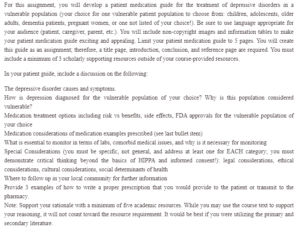
For this assignment, you will develop a patient medication guide for the treatment of depressive disorders in a vulnerable population (your choice for one vulnerable patient population to choose from: children, adolescents, older adults, dementia patients, pregnant women, or one not listed of your choice!). Be sure to use language appropriate for your audience (patient, caregiver, parent, etc.). You will include non-copyright images and information tables to make your patient medication guide exciting and appealing. Limit your patient medication guide to 5 pages. You will create this guide as an assignment; therefore, a title page, introduction, conclusion, and reference page are required. You must include a minimum of 3 scholarly supporting resources outside of your course-provided resources.
Depressive Disorder Medication Guide
In your patient guide, include a discussion on the following:
The depressive disorder causes and symptoms.
How is depression diagnosed for the vulnerable population of your choice? Why is this population considered vulnerable?
Medication treatment options including risk vs benefits, side effects, FDA approvals for the vulnerable population of your choice
Medication considerations of medication examples prescribed (see last bullet item)
What is essential to monitor in terms of labs, comorbid medical issues, and why is it necessary for monitoring
Special Considerations (you must be specific, not general, and address at least one for EACH category; you must demonstrate critical thinking beyond the basics of HIPPA and informed consent!): legal considerations, ethical considerations, cultural considerations, social determinants of health
Where to follow up in your local community for further information
Provide 3 examples of how to write a proper prescription that you would provide to the patient or transmit to the pharmacy.
Note: Support your rationale with a minimum of five academic resources. While you may use the course text to support your reasoning, it will not count toward the resource requirement. It would be best if you were utilizing the primary and secondary literature.
 Complete the order form and upload all of your files, including any instructions, rubrics, or other materials provided by your instructor.
  Complete the order payment after filling in the order form. We’ll receive your order and assign it to a writer.
 The assigned writer will complete your paper and forward it to our Editing Team for review and approval.
 Once approved by the editor, the completed paper will be uploaded to your account for you to download, review and approve.