
Rheumatoid Arthritis
Pathophysiology of Rheumatoid Arthritis
According to Rocha et al. (2019), rheumatoid arthritis is a systemic inflammatory disease characterized by joint destruction and synovitis. The etiology of the disease remains unknown. Genetic factors play a significant role, but insufficient evidence suggests how the immune insult is triggered. The main features of RA are inflammation and often in the synovium. Hyperplasticity of the synovial membrane is from the increased amount of synoviocytes infiltrated by the inflammatory and immune cells, specifically the dendritic and plasma cells and the T and B lymphocytes. An increased number of cytokines also play a significant role in synovial inflammation perpetuation. Chronic inflammation is persistent, and so is the destruction of the joints (Rocha et al., 2019).
Treatment of Rheumatoid Arthritis
A patient may be recommended to do some exercises by an occupational or physical therapist to aid in keeping the joints flexible. Additionally, the therapist can show the patient ways of carrying out ADLs in a less painful way (Hernández-Hernández & Díaz-González, 2017). If medications are ineffective in slowing or preventing joint damage, the physician may recommend surgery to repair the joints. Surgery can help a patient regain use of the joints, improve function, and remove pain (Atzeni et al., 2017). The four possible surgeries include total joint replacement, joint fusion, tendon repair, and synovectomy.
Another option is taking prescribed medication based on the symptoms’ severity and the disease duration. NSAIDs are prescribed to reduce inflammation and relieve pain. Steroids slow down damage to the joint and reduce inflammation. Conventional DMARDs slow the progression of damage to the joints and other tissues (Abbasi et al., 2019).
Summary of the Interview
The patient is a 65-year-old African-American female who has rheumatoid arthritis. She said that the diagnosis was given to her approximately four years ago. Subsequently, she has had to live with the pain and numbness. She said the biggest hurdle is climbing a flight of stairs, which causes her knees to experience excruciating pain. The pain is more intense when she gets up from a sitting position.
RA has changed the patient’s life, first psychologically and secondly physically. She said that she never imagined that she would age so painfully. She had always been athletic throughout her school and young adult life. She feels the illness has deprived her of her life. As she described, the pain was excruciating, especially during the cold season (winter). Although she can still carry out her daily activities, she needs help with some activities. For example, the patient said that she cannot open her lids because her knuckles hurt; she cannot tie anything tightly; she cannot hold a pen or type for more than an hour on her computer, among other things.
The patient said that she has been on NSAIDs on and off. She takes NSAIDs when the pain is unbearable. She was also prescribed Trexall and folic acid but says she has not experienced any tangible changes. The patient said that she takes walks to help in making her knees and ankles more flexible. After getting home, she said her ankle and knees hurt even more, but the pain reduced as she rested. The patient said that she experienced nausea and diarrhea for three days after starting her Trexall prescription. These side effects have subsided and will often disappear and re-emerge.
The patient was distressed when answering the question. She said the infection has caused her right knee to swell and become warm and tender. The knee is partially mobile, and she feels pain when walking from a sitting position. She is unable to climb the stairs, as mentioned earlier. The patient also said that she had started experiencing some pain in her right elbow and was afraid the other elbow would start painting as well. A similar joint on the other side of her body would follow suit whenever one joint started painting.
Rheumatoid arthritis has not been an easy diagnosis for the patient. She has had to endure pain in the middle of the night, pain when walking, and feels like she is constantly in pain. The patient said that the illness had been a source of emotional pain because she likes to be active and has always been active. She said that she likes being independent, but at the rate at which the pain is progressing in her body, she is afraid of losing her independence, and that thought in itself is painful. The patient admitted that she cries a lot, whether or not she is in excessive pain. She said that she cries for herself and the thought that she has an illness that is depriving her of enjoying her sunset years. I asked her whether she had sought any counseling therapy to help her cope with the disease, to which she answered negatively.
When asked, the patient said she had not tried any Eastern medicine as she believed that her fate with pain was sealed. She did not believe anything could make the pain any better, and therefore, she stopped searching for alternatives and resigned to her pain. I recommended that she try acupuncture as I knew of a former patient who did the same and received considerable relief from her illness.
References
Abbasi, M., Mousavi, M. J., Jamalzehi, S., Alimohammadi, R., Bezvan, M. H., Mohammadi, H., & Aslani, S. (2019). Strategies toward rheumatoid arthritis therapy: the old and the new. Journal of cellular physiology, 234(7), 10018-10031.
Atzeni, F., Masala, I. F., Di Franco, M., & Sarzi-Puttini, P. (2017). Infections in rheumatoid arthritis. Current opinion in rheumatology, 29(4), 323-330.
Hernández-Hernández, M. V., & Díaz-González, F. (2017). Role of physical activity in the management and assessment of rheumatoid arthritis patients. Reumatología Clínica (English Edition), 13(4), 214-220.
Rocha, S. D. B., Baldo, D. C., & Andrade, L. E. C. (2019). Clinical and pathophysiologic relevance of autoantibodies in rheumatoid arthritis. Advances in Rheumatology, 59.
ORDER A PLAGIARISM-FREE PAPER HERE
We’ll write everything from scratch
Question 
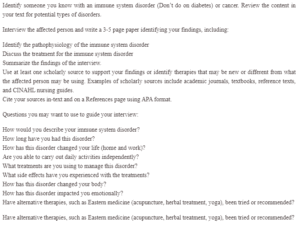
Identify someone you know with an immune system disorder (Don’t do on diabetes) or cancer. Review the content in your text for potential types of disorders.
Rheumatoid Arthritis
Interview the affected person and write a 3-5 page paper identifying your findings, including:
Identify the pathophysiology of the immune system disorder
Discuss the treatment for the immune system disorder
Summarize the findings of the interview.
Use at least one scholarly source to support your findings or identify therapies that may be new or different from what the affected person may be using. Examples of scholarly sources include academic journals, textbooks, reference texts, and CINAHL nursing guides.
Cite your sources in-text and on a References page using APA format.
Questions you may want to use to guide your interview:
How would you describe your immune system disorder?
How long have you had this disorder?
How has this disorder changed your life (home and work)?
Are you able to carry out daily activities independently?
What treatments are you using to manage this disorder?
What side effects have you experienced with the treatments?
How has this disorder changed your body?
How has this disorder impacted you emotionally?
Have alternative therapies, such as Eastern medicine (acupuncture, herbal treatment, yoga), been tried or recommended?
Have alternative therapies, such as Eastern medicine (acupuncture, herbal treatment, yoga), been tried or recommended?
 Complete the order form and upload all of your files, including any instructions, rubrics, or other materials provided by your instructor.
 Complete the order payment after filling in the order form. We’ll receive your order and assign it to a writer.
 The assigned writer will complete your paper and forward it to our Editing Team for review and approval.
 Once approved by the editor, the completed paper will be uploaded to your account for you to download, review and approve.