
Nursing Informatics in Healthcare
The efficiency and effectiveness of nursing care, as well as general healthcare practice, are heavily dependent on the flow of information among the healthcare providers as well as from the patients. It is, therefore, necessary that the flow of health information maintain accuracy and be fast. Nursing informatics ensures that data, information, or knowledge within nursing practice maintains the required accuracy and easily flows from one point to another. The evolution of technology and the need for effective and efficient care underpins the necessity and significance of this nursing specialty. This paper seeks to make a detailed analysis of nursing informatics and its necessity in nursing practice.
Nursing informatics is one of the evolving nursing specialties in current nursing professional practice. Nursing informatics is a field that integrates the science of nursing with other analytical and information sciences intending to identify, define, manage, and communicate data, information, and knowledge related to the practices of a nurse (Collins, Yen, Phillips & Kennedy, 2017). As a nursing specialty, nursing informatics does require a particular set of professional qualifications, with the minimum being a bachelor’s certificate in nursing. A master’s degree in nursing may also grant an individual an opportunity to venture into this field. Other additional skills that may be necessary include project management skills, data maintenance and analysis affinity, work experience as a clinical nurse, and good interpersonal skills, among others.
The vastness of the nursing informatics specialty presents it with several roles and responsibilities. These responsibilities aim to improve the efficiency of nursing practice by enhancing the documentation of nursing practice and enabling the utilization of this data towards accurate submission and optimization of care. Implementation of newer technologies in healthcare remains to be a vital role for nursing informaticists. The evolution of new technologies in healthcare has provided significant benefits in the general healthcare delivery processes, with systems such as electronic health records providing enhanced efficiency in data sharing (Mankiena, 2021). Nursing practice should thus integrate these technologies to maintain the effectiveness and efficiency of the care process.
Nursing informaticists are also tasked with validating the available patient and healthcare data. The significance of data validation in ensuring evidence-based clinical decision-making underpins its significance. This maintains utmost criticality since healthcare data are often high-volume and varied. Healthcare data are also needed to flow fast and freely for the general efficiency of the healthcare delivery system (Mankiena, 2021). Nurse informaticists are thus required to provide checks on these data and to constantly ensure that information getting to the end user maintains accuracy.
Additionally, a nursing informaticist is responsible for understanding the mechanisms behind the specific aspects of nursing practice and ensuring that this knowledge is shared with the individual nurses to improve the care process. Whereas nursing training imparts evidence-based knowledge required in nursing practice, this training often requires constant updates, and individual nurses are often encouraged to update their knowledge base for care optimization. Nursing informaticists aim to bridge this gap by communicating the why behind nursing practices promptly.
Several healthcare organizations have adopted nursing informatics. These organizations include but are not limited to the American Nursing Informatics Association, the International Medical Informatics Association, and the Healthcare Information and Management Systems Society. Various state hospitals have also adopted nursing informatics by including nurse informaticists in their operational personnel. Their significance within these organizations has been great, with an account of enhanced efficiency and effectiveness as well as optimal patient outcomes. Their significance has been evident in various clinical details such as patient handling, faster delivery and communication of medical data, and better utilization (Archibald & Barnard, 2017). With nurse informaticists operational, provider-related healthcare issues have tremendously declined.
Nurse informaticists maintain regular interaction with other healthcare providers. However, their significance within the healthcare team means their presence in routine hospital operations is critical. They remain standard features in-hospital training programs, a platform they utilize in passing their expertise and knowledge to the other nurses. They are also involved in information and data passage to other healthcare providers. Nursing informaticists act as essential bridges between various levels of healthcare providers and between the patients and the healthcare providers (Archibald & Barnard, 2017). They, therefore, have to communicate their knowledge frequently to other nurses and other healthcare providers.
Integration of technology in healthcare has optimized the care processes. Nurses are an essential facet of the general healthcare delivery process. Their high contact time with the patient makes them particularly important in healthcare delivery and ensuring quality and safety. The engagement of nurses in healthcare technology is thus essential in ensuring this. This engagement provides utter significance in patient care by ensuring that patient data collection, documentation, and analysis are automated and electronic, thus reducing information loss during the relay processes. These automated systems also act as a basis for information checks, which nurses can not only outsource for information but also utilize in checking errors that may have occurred during the care process.
According to the Health Insurance Portability and Accountability Act (HIPAA), healthcare data should be handled with absolute privacy and confidentiality. Patients, therefore, maintain absolute authority over their health information, and their permission is often required in the decision-making regarding their health (Chen & Benusa, 2017). Nurses, being part of the healthcare provision team, are required to safeguard this data and not use this information maliciously. With the evolution of electronic systems of data collection and documentation, the engagement of nurses in healthcare technology will ensure that they understand these systems and how to use them. In this regard, they will be able to safeguard patients’ data by ensuring that they are not tools for leaking patient information, thus ensuring that the security, privacy, and confidentiality of patients’ information are protected.
The efficient delivery of healthcare provisions depends on the free flow of information from one point to another. Electronic systems such as electronic health records are targeted at decreasing the downtime of information passage from the patient and among the healthcare providers. Nurses, being part of this team, need to have a better understanding of these systems. It is, therefore, important that nurses are engaged fully in healthcare technology to ensure that they maintain this free flow of information. Nurse engagement in technology also significantly decreases the general cost of healthcare provision and realizes a return on investments. Data relay is a considerable determinant in cost-effectiveness. Delays in data relay often lead to losses translatable to monetary losses. Nurse engagement in healthcare technology considerably lowers these losses by enhancing the efficiency of this data relay. Nurse engagements in healthcare technology thus maintain cost-effectiveness and realize its return on investment.
With the evolution of the nursing informatics specialty, their inclusion in the healthcare delivery teams confers dual impacts on the team. Their significance to the team in data handling makes it broadens its potential as a lucrative opportunity for professional nurses. This is further reinforced by the increasing integration of technology in healthcare. Conversely, it has provided considerable challenges to healthcare delivery teams. These challenges stretch from the vacuum attributed to their scarcity in the general healthcare delivery processes to the difficulty in integrating this specialty into the interdisciplinary team. This is because the traditional healthcare delivery teams did not have this field.
In this regard, efforts should be made to integrate this specialty into the interdisciplinary team. This will require a paradigm shift that involves a collaboration of all members of the healthcare team as well as their affinity towards technology adoption. With technological integrations, each team member can read from the same script and thus enhance care provisions to realize better quality and, consequently, positive patient outcomes.
The significance of nursing informatics in the general nursing practice is evident. As highlighted above, nursing informatics will offer a unique tool for the identification, management, and communication of health data to nurses. The significance of nurse informaticists will also be evident in the invalidation of data to ensure that data utilizable in clinical decisions maintains accuracy. They will also be important in knowledge communication to nurse practitioners, thus ensuring that nurses are not only up to date with current technologies and knowledge but also use evidence-based knowledge in their core processes. This facility should, therefore, consider nursing informatics faculty as an opportunity to enhance clinical outcomes.
References
Archibald, M., & Barnard, A. (2017). Futurism in nursing: Technology, robotics and the fundamentals of care. Journal Of Clinical Nursing, 27(11-12), 2473-2480. DOI: 10.1111/jocn.14081
Chen, J., & Benusa, A. (2017). HIPAA security compliance challenges: The case for small healthcare providers. International Journal Of Healthcare Management, 10(2), 135-146. DOI: 10.1080/20479700.2016.1270875
Collins, S., Yen, P., Phillips, A., & Kennedy, M. (2017). Nursing Informatics Competency Assessment for the Nurse Leader. JONA: The Journal Of Nursing Administration, 47(4), 212-218. DOI: 10.1097/nna.0000000000000467
Mankiena, C. (2021). A Nurse Informaticist: 3 Essential Responsibilities. Retrieved 10 October 2021, from https://www.healthcatalyst.com/insights/nurse-informaticist-3-essential-responsibilities/
ORDER A PLAGIARISM-FREE PAPER HERE
We’ll write everything from scratch
Question 
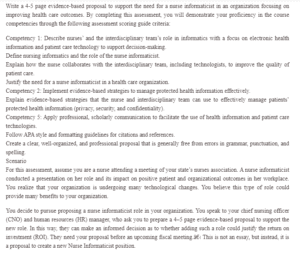
Write a 4-5 page evidence-based proposal to support the need for a nurse informaticist in an organization focusing on improving health care outcomes. By completing this assessment, you will demonstrate your proficiency in the course competencies through the following assessment scoring guide criteria:
Nursing Informatics in Healthcare
Competency 1: Describe nurses’ and the interdisciplinary team’s role in informatics with a focus on electronic health information and patient care technology to support decision-making.
Define nursing informatics and the role of the nurse informaticist.
Explain how the nurse collaborates with the interdisciplinary team, including technologists, to improve the quality of patient care.
Justify the need for a nurse informaticist in a health care organization.
Competency 2: Implement evidence-based strategies to manage protected health information effectively.
Explain evidence-based strategies that the nurse and interdisciplinary team can use to effectively manage patients’ protected health information (privacy, security, and confidentiality).
Competency 5: Apply professional, scholarly communication to facilitate the use of health information and patient care technologies.
Follow APA style and formatting guidelines for citations and references.
Create a clear, well-organized, and professional proposal that is generally free from errors in grammar, punctuation, and spelling.
Scenario
For this assessment, assume you are a nurse attending a meeting of your state’s nurses association. A nurse informaticist conducted a presentation on her role and its impact on positive patient and organizational outcomes in her workplace. You realize that your organization is undergoing many technological changes. You believe this type of role could provide many benefits to your organization.
You decide to pursue proposing a nurse informaticist role in your organization. You speak to your chief nursing officer (CNO) and human resources (HR) manager, who ask you to prepare a 4–5 page evidence-based proposal to support the new role. In this way, they can make an informed decision as to whether adding such a role could justify the return on investment (ROI). They need your proposal before an upcoming fiscal meeting.​ This is not an essay, but instead, it is a proposal to create a new Nurse Informaticist position.
Preparation
To successfully prepare for this assessment, you will need to complete these preparatory activities:
Review assessment resources and activities.
Conduct independent research on the nursing knowledge and skills necessary to interact with health information and patient care technology.
Focus your research on current resources available through peer-reviewed articles, professional websites, government websites, professional blogs, wikis, job boards, etc.
Consult the BSN Program Library Research Guide to help identify scholarly and authoritative sources.
Interview peers in your network who are considered information technology experts.
Ask them about how information technology advances are impacting patient care at the bedside, at the organizational level, and beyond.
Proposal Format
The chief nursing officer (CNO) and human resources (HR) manager have asked you to include the following headings in your proposal and to be sure to address the bullets following each heading:
Nursing Informatics and the Nurse Informaticist
What is nursing informatics?
What is the role of the nurse informaticist?
Nurse Informaticists and Other Health Care Organizations
What is the experience of other healthcare organizations with nurse informaticists?
How do these nurse informaticists interact with the rest of the nursing staff and the interdisciplinary team?
Impact of Full Nurse Engagement in Health Care Technology
How does fully engaging nurses in health care technology impact:
Patient care?
Protected health information (security, privacy, and confidentiality)?
Workflow?
Costs and return on investment?
Opportunities and Challenges
What are the opportunities and challenges for nurses and the interdisciplinary team with the addition of a nurse informaticist role?
How can the interdisciplinary team collaborate to improve quality care outcomes through technology?
Summary of Recommendations
What are 3 to 4 key takeaways from your proposal about the recommended nurse informaticist role that you want the CNO and the HR manager to remember?
 Complete the order form and upload all of your files, including any instructions, rubrics, or other materials provided by your instructor.
 Complete the order payment after filling in the order form. We’ll receive your order and assign it to a writer.
 The assigned writer will complete your paper and forward it to our Editing Team for review and approval.
 Once approved by the editor, the completed paper will be uploaded to your account for you to download, review and approve.