
Application of Concepts from Watson’s Theory of Caring
Nursing theories form the foundation of nursing science. All nursing interventions implemented by nurses must follow the theoretical foundations of nursing. The views offer a framework that guides nurses in their day-to-day practice. The theoretical framework of nursing theories suggests and directs nursing practice. They also teach nurses to handle any obstacles and barriers they may face when providing nursing care. There are three main categories of nursing theories. They include grand nursing theories, mid-range nursing theories, and nursing practice theories. The great nursing theories are broad and offer insights into nursing practice (Alligood, 2021). Mid-range nursing theories are simple and straightforward and guide nursing strategy protocols (Alligood, 2021). Practice-level approaches have limited scope and are used for specific nursing situations (Alligood, 2021). Common nursing theories include environmental theory, self-care deficit theory, and the theory of human caring.
Outcome of Nursing Practice that Can Be Improved
The rate of falls in geriatric patients aged sixty-five years and above is the nursing practice outcome selected. This healthcare outcome requires implementing a quality improvement project in hospitals to reduce the risk of falls. Hospital falls are the second leading cause of unintentional mortalities globally (de Souza et al., 2019). Patient falls negatively outcomes on patient safety and negatively impact the healthcare delivery industry. It increases mortality, increases hospitalization, and decreases the quality of life. Geriatric patients are particularly at a higher risk of suffering accidental falls. They are frail and have many chronic conditions, such as dementia, which reduce their cognition levels. The national benchmark for falls in the United States is a rate of 3.44 falls/1000 patients, with approximately 25% of falls being injurious (Venema et al., 2019). Hospital falls are expensive, and they cost the hospital financially. Hospital falls cost $ 7000 per injury, and it is one of the reasons why reimbursements are not done (Venema et al., 2019).
Clinical Nursing Theory
Concept A
Geriatric patients aged 65 years and above are debilitated. Due to old age, the human body undergoes physiological and anatomical deterioration. This puts these patients at risk of suffering from many healthcare conditions. They also suffer from chronic healthcare conditions such as hypertension, diabetes mellitus, stroke, and arthritis, among others. These patients also suffer from psychiatric illnesses. They may suffer from neurocognitive disorders such as Alzheimer’s and dementia. These conditions reduce the cognitive functioning of these patients, resulting in memory loss and lack of coordination (Tiwari et al., 2016). These symptoms increase the risk of geriatric patients falling, especially when ambulating around hospital rooms. This Concept will be measured by collecting data from self-reporting and incident reporting in hospitals.
Concept B
Risk assessment of falls among hospitalized patients indicated that geriatric patients aged sixty-five years and above are at higher risk of having unintentional falls in hospitals. This is even worse in healthcare facilities with many geriatric patients, such as nursing homes. Many risk assessment tools can be applied. The one that will be used for geriatric patients is St Thomas’s risk assessment tool. This tool has five components: a history of falls, visual impairment, agitation, transfer and mobility, and incontinence (Castellini et al., 2017). Geriatric patients will suffer from injuries during unintentional falls in hospitals. These injuries can result in healthcare complications such as stroke, concussion, fractures, and brain hemorrhage (de Souza et al., 2019). Risk for falls will be measured with evidence-based tools such as St. Thomas.
Proposition
The relationship between Concept A and Concept is direct proportionality. Concept An immediate results in Concept B. Geriatric patients are Concept A while the risk of falls is Concept B. Geriatric patients are at a higher risk of falls. This is because of old age and issues related to old age, such as poor cognition and physical impairments. For research purposes, the independent variable is geriatric patients aged sixty-five years and above. The dependent variable is an unintentional fall episode in a hospital. The accidental fall episode is dependent since it occurs due to old age. Its occurrence depends on many aspects. Fall prevention strategies aim to reduce the rate of unintentional falls (dependent variable)
The clinical nursing theory developed for this paper is that the age of sixty-five years and above is a risk factor for unintentional falls in hospitals.
A Comparison of the Created Clinical Nursing Theory with Watson’s Theory of Human Caring
Watson’s theory of nursing outlines how nurses should care for patients. This theory focuses on humanistic nursing care and its integration into scientific nursing practice. This theory stresses health promotion, caring for the sick, disease prevention, and disease treatment (Pajnkihar et al., 2017). Watson noted that nursing practice is more than just a medical cure. Watson’s theory advocates for holistic nursing as the foundation of nursing care. By practicing holistic nursing, nurses can care for patients to promote growth and create an environment that considers patients’ preferences and needs (Pajnkihar et al., 2017).
Watson’s theory defined three meta paradigms in nursing, which are person, health, and nursing. A human being is a valued person who needs to be respected, nurtured, helped, and cared for (). This theory views human beings as fully functional. This theory defines health as a high level of mental, social, and physical functioning (Pajnkihar et al., 2017). Healthy individuals can maintain adaptive levels of daily functioning, have no illness, and make efforts to prevent infection. Nursing is defined as a profession of people and disease experience done by professionals, scientific and personal interactions (Pajnkihar et al., 2017). This theory also has ten caring needs that are important for nurses to address when caring for patients.
Watson’s theory can be compared to the view created for this paper. Nurses should implement evidence-based interventions to prevent falls. They should consider the needs of geriatric patients and know they are at risk of falls. This is their moral obligation. Many interventions can be implemented to prevent and reduce falls among geriatric patients. They include training nurses to identify patients at risk of falls and the use of alarms (Linehan & Linehan, 2018). These interventions will preserve safety and ensure the well-being of patients. This is in line with Watson’s theory of caring. Watson’s Caritas, which aligns with concept A in the created clinical nursing theory, is “promoting a supportive environment” (Pajnkihar et al., 2017).
Concept A states that in advanced old age, there is a deterioration of cognitive and physical function. Old age is also associated with complex health conditions, which increase their susceptibility to negative healthcare outcomes. Due to this fact, the healing environment should be supportive of geriatric patients aged sixty-five years and above. Any rugs that may cause falls to elderly patients should be removed in hospitals. The hospital floors should not be slippery, and proper lighting should be provided. This is a supportive environment that will reduce the risk of falls.
After comparing the created nursing theory and Watson’s view, it can be concluded that Watson’s approach can be applied to nursing science. This theory is compatible with nursing models and can be used in practical clinical situations. This scenario confirms that Watson’s caring theory guides interventions to prevent accidental falls in geriatric patients.
Discoveries Made and Impact on the Nursing Profession
During readings to complete this paper, it was discovered that there were nursing theories available to help nurses in their practice. This includes the environmentalist theory by Florence Nightingale and the caring theory by Jean Watson. These theories impact the nursing profession since they can guide evidence-based practice (EBP) in nursing. EBP uses approaches to help in implementing nursing interventions. The interventions are driven by clinical evidence and theoretical frameworks of theories like Watson’s theory. The other discovery is nursing is a profession that not only cures but also cares. This is supported by the ten Caritas processes in the idea of human caring. Nurses should serve as advocates for patients and be selfless in their actions. Questions that require further research are whether nursing theories guide evidence-based practice. Research should be done to determine if nursing theories can be applied in evidence-based practice.
Conclusion
Nursing theories are critical in nursing practice. These theories can guide nurses in their day-to-day clinical practice. They can help nurses to implement evidence-based practices. Accidental patient falls is a clinical issue that can be mitigated using nursing theories. A theory that can be applied is Watson’s theory of caring. This theory is compatible and practical and can be used to solve clinical problems in the nursing practice. The ten Caritas processes are critical in guiding nurses to implement holistic nursing care.
References
Alligood, M. R. (2021). Nursing theorists and their work E-book. Elsevier Health Sciences.
Castellini, G., Demarchi, A., Lanzoni, M., & Castaldi, S. (2017). Fall prevention: Is the stratify tool the right instrument for Italian hospital inpatients? A retrospective observational study. BMC Health Services Research, 17(1). https://doi.org/10.1186/s12913-017-2583-7
de Souza, A. B., Röhsig, V., Maestri, R. N., Mutlaq, M. F. P., Lorenzini, E., Alves, B. M., … & Gatto, D. C. (2019). In hospital falls of a large hospital. BMC research notes, 12(1), 1-3. https://doi.org/10.1186/s13104-019-4318-9
Linehan, J., & Linehan, J. (2018). Fall prevention in long-term care using purposeful hourly rounding. Journal of the American Medical Directors Association, 19(3), B17. https://doi.org/10.1016/j.jamda.2017.12.056
Pajnkihar, M., Štiglic, G., & Vrbnjak, D. (2017). The Concept of Watson’s Curative Factors in Nursing and Their (dis) Harmony with Patient Satisfaction. PeerJ, 5, e2940. https://doi.org/10.7717/peerj.2940
Tiwari, S., Pandey, N., & Singh, V. (2016). Epidemiology of neurocognitive disorders in elderly and its management with special reference to dementia: An overview. Journal of Geriatric Mental Health, 3(1), 6. https://doi.org/10.4103/2348-9995.181909
Venema, D. M., Skinner, A. M., Nailon, R., Conley, D., High, R., & Jones, K. J. (2019). Patient and system factors associated with unassisted and injurious falls in hospitals: An observational study. BMC Geriatrics, 19(1). https://doi.org/10.1186/s12877-019-1368-8
ORDER A PLAGIARISM-FREE PAPER HERE
We’ll write everything from scratch
Question 
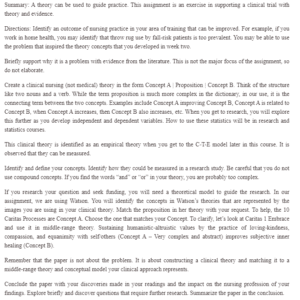
Summary: A theory can be used to guide practice. This assignment is an exercise in supporting a clinical trial with theory and evidence.
Application of Concepts from Watson’s Theory of Caring
Directions: Identify an outcome of nursing practice in your area of training that can be improved. For example, if you work in home health, you may identify that throw rug use by fall-risk patients is too prevalent. You may be able to use the problem that inspired the theory concepts that you developed in week two.
Briefly support why it is a problem with evidence from the literature. This is not the major focus of the assignment, so do not elaborate.
Create a clinical nursing (not medical) theory in the form Concept A | Proposition | Concept B. Think of the structure like two nouns and a verb. While the term proposition is much more complex in the dictionary, in our use, it is the connecting term between the two concepts. Examples include Concept A improving Concept B, Concept A is related to Concept B, when Concept A increases, then Concept B also increases, etc. When you get to research, you will explore this further as you develop independent and dependent variables. How to use these statistics will be in research and statistics courses.
This clinical theory is identified as an empirical theory when you get to the C-T-E model later in this course. It is observed that they can be measured.
Identify and define your concepts. Identify how they could be measured in a research study. Be careful that you do not use compound concepts. If you find the words “and” or “or” in your theory, you are probably too complex.
If you research your question and seek funding, you will need a theoretical model to guide the research. In our assignment, we are using Watson. You will identify the concepts in Watson’s theories that are represented by the images you are using in your clinical theory. Match the proposition in her theory with your request. To help, the 10 Caritas Processes are Concept A. Choose the one that matches your Concept. To clarify, let’s look at Caritas 1 Embrace and use it in middle-range theory. Sustaining humanistic-altruistic values by the practice of loving-kindness, compassion, and equanimity with self/others (Concept A – Very complex and abstract) improves subjective inner healing (Concept B).
Remember that the paper is not about the problem. It is about constructing a clinical theory and matching it to a middle-range theory and conceptual model your clinical approach represents.
Conclude the paper with your discoveries made in your readings and the impact on the nursing profession of your findings. Explore briefly and discover questions that require further research. Summarize the paper in the conclusion.
 Complete the order form and upload all of your files, including any instructions, rubrics, or other materials provided by your instructor.
 Complete the order payment after filling in the order form. We’ll receive your order and assign it to a writer.
 The assigned writer will complete your paper and forward it to our Editing Team for review and approval.
 Once approved by the editor, the completed paper will be uploaded to your account for you to download, review and approve.