
Lifespan Management
Lifespan is defined as the average length of days that a person lives under specific circumstances and environment. Okan et al. (2019) point out that it is imperative to note that a human being can live to a possible number of 95 years, though some have gone to be as old as 100+ years. At one point, a person can live believing they are in good health, especially in the youth years. However, the existence of humans is dependent on the knowledge they have of preventable diseases and the skills they need to prevent the said diseases. When the lifespan of a person is interrupted by illness, lifespan management comes into play.
Lifespan management is a relatively new concept in sustaining health through innovation. It aims at improving an individual’s life and, more so, those who are aging and who require personal assistants to carry out activities of daily living or have a poor account of frequent and substantial interactions with the healthcare system (Okan, 2019). It is possible to carry out lifespan management at home or through the help of a healthcare professional. While most people assume that they will enter into old age while significantly healthy, it is not always the case. Treating and managing a chronic illness that comes later in one’s life is important in improving the person’s quality of life. Healthcare access should be easy for such a person, and educating the community on the need for preventive care is critical as well.
History of Lifespan Management
The past century was characterized by an increase in life expectancy through the different age ranges. Life expectancy refers to the number of years a person is expected to live. This increased the number of people who lived to old age and lived longer in their more senior years. Life expectancy will likely increase in older generations. Still, life expectancy at birth is not expected to go beyond 95 years unless innovation supports man’s ability to delay the process of aging (Woolf & Shoemaker, 2019). Morbidity compression refers to the theory that most chronic illnesses occur late in life. Much morbidity compression is yet to be experienced as the onset age of most health issues has not increased in a significant way. For example, in the last few decades, the prevalence of dementia and physical disability has reduced. Prevalence rate refers to the proportion of persons in a population who have a particular disease. Simultaneously, disease prevalence has significantly increased mainly due to treatment that prolongs the life of persons living with the disease. Expanding the health or morbidity compression will require a delay in aging to be achieved or a delay in the physiological changes that cause disability and disease (Woolf & Shoemaker, 2019). Dong et al. (2016) add that although morbidity compression and moving the life expectancy to over 95 years can be an uphill task that needs scientific research of high magnitude, in the US, increasing life expectancy and improving health can be achieved with changes in policy that minimize disparities in socioeconomic status, lifestyle changes, and behavioral changes which will allow the country to reach the life and health expectancy desired.
Mentality and Philosophy of Aging
People are not, according to the Association of American Psychologists (AAP), conscious about living for many years. Still, they are aware that they would want to live happily and peacefully while here. People will tend not to concentrate on the strategies to reach their maximum number of years. Nonetheless, people do not focus much on ways of living according to the possibility of living out the many years they can live. This is evident in the rate at which preventable diseases are increasing by the day. A preventable disease can be avoided under the right circumstances. Chronic diseases are those that go on for a year or more and need monitoring and treatment. Conditions such as obesity, diabetes, heart disease, and cancers related to tobacco use are just some of the preventable diseases that can be curtailed by living consciously based on one’s good health strategies (Langley, 2021). Thus, it becomes crucial that people are educated on the possible number of years that they can live and implement health-promoting strategies in their daily lives. If people are already suffering from chronic diseases, they still need to be educated on techniques to improve their quality of life through lifespan management.
Culture and Lifespan Management
Culture refers to a way of life for a given group of people. Culture plays a significant role in the human development context in understanding that development calls for one to be able to identify the development features that are based on culture. Culture includes ideas on what one ought to strive for, right and wrong, and what to speak, eat, and value, among others. Culture teaches a person how to live in a society and allows them to advance from one generation to another. Culture is learned from family, friends, media, churches, and schools. The type of values and traditions evolving within a specific culture aid the members to function within a society and also enable people to value the same community they live in (Kagitcibasi, 2017). When a person is under lifespan management, culture will play a role. For example, for Hispanic families, taking care of an older adult with or without illness at home is considered being loyal to the family. On the other hand, a white family can very well take their loved one to a nursing home for care management, and this would be considered logical and an appropriate thing to do.
Changes to Services and Industry
The last few years have seen an increase in growth of the longevity industry from one that was neglected and underfunded in the R&D domain into its current giant industry. Currently, the extreme diversification and growth trajectory is beyond imagination, as exemplified by the fact that longevity has become a topic of interest embraced by financial media brands and businesses, investment banks, and even politicians and policies. Longevity of life refers to the capability of a person to live past the average age of death. Personalized, precision, preventive, participatory (4P) medicine comprises the leading edge in advanced biomedical science and is already in use in real-world practical use and implementation. The 4Ps represent the continuous shift from the one-size-fits-all treatment using blockbuster drugs and lean more toward the increased 4Ps therapies that are customized to individual patients (Arking, 2019). Currently, lifespan management is closely linked to the longevity industry, which is composed of advanced approaches in biomedical science to understanding the mechanism of aging and creating therapeutics that work on aging directly to slow down the process at the source.
References
Arking, R. (2019). Biology of Longevity and Aging: Pathways and Prospects. Oxford University Press, USA.
Dong, X., Milholland, B., & Vijg, J. (2016). Evidence for a limit to human lifespan. Nature, 538(7624), 257-259.
Kagitcibasi, C. (2017). Family, self, and human development across cultures: Theory and applications. Routledge.
Langley-Evans, S. (2021). Nutrition, health, and disease: A lifespan approach. John Wiley & Sons.
Okan, O., Bauer, U., Levin-Zamir, D., Pinheiro, P., & Sørensen, K. (2019). International Handbook of Health Literacy: Research, practice, and policy across the lifespan (p. 764). Policy Press.
Woolf, S. H., & Schoomaker, H. (2019). Life expectancy and mortality rates in the United States, 1959-2017. Jama, 322(20), 1996-2016.
ORDER A PLAGIARISM-FREE PAPER HERE
We’ll write everything from scratch
Question 
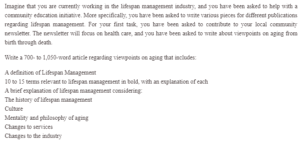
Imagine that you are currently working in the lifespan management industry, and you have been asked to help with a community education initiative. More specifically, you have been asked to write various pieces for different publications regarding lifespan management. For your first task, you have been asked to contribute to your local community newsletter. The newsletter will focus on health care, and you have been asked to write about viewpoints on aging from birth through death.
Lifespan Management
Write a 700- to 1,050-word article regarding viewpoints on aging that includes:
A definition of Lifespan Management
10 to 15 terms relevant to lifespan management in bold, with an explanation of each
A brief explanation of lifespan management considering:
The history of lifespan management
Culture
Mentality and philosophy of aging
Changes to services
Changes to the industry
 Complete the order form and upload all of your files, including any instructions, rubrics, or other materials provided by your instructor.
  Complete the order payment after filling in the order form. We’ll receive your order and assign it to a writer.
 The assigned writer will complete your paper and forward it to our Editing Team for review and approval.
 Once approved by the editor, the completed paper will be uploaded to your account for you to download, review and approve.