
Patient Drug Education
Hollie,
Thank you for sharing your post. In the different case scenarios, what comes out is that patient education is critical to avoid drug misuse, self-diagnosis, and abuse. Drug education is important. Understanding the impact of a drug is an invaluable strength for a patient. Knowing how a drug works in the body and the short- and long-term effects of drug abuse, as well as the possible risks that are involved, is the cornerstone of the prevention of abuse. Zoloft, for example, is a common antidepressant that is effective and safe. However, a person can misuse the medication or can overdose on the same. Research continues to offer experts in substance abuse additional material to help educate communities on the dangers of drug abuse, including illicit drug use. In 2015, 6.5 million Americans aged 12 years and above used controlled opioids non-medically, which was more than past use of heroin, cocaine, and hallucinogens (Schatman & Ziegler, 2017). The highest rise in deaths related to drug use occurred in 2016, with more than 20,000 persons dying from fentanyl and other related drugs (Schatman & Ziegler, 2017). Soon afterward, the CDC issued guidelines for an opioid prescription for use in controlling chronic pain outside of end-of-life care and cancer treatment (Schatman & Ziegler, 2017). As of 2018, newer information showed the real downside of opioids over-prescription for general pain relief. Our assignment writing help is at affordable prices to students of all academic levels and academic disciplines.
Consequently, physicians took other approaches to manage pain for patients. This is another reason why healthcare professionals need to educate patients on proper medication use (Blanco & Volkow, 2019). Drug education can be done using different formats, including advertising on media, classes, employee assistance programs, clinical and hospital training, infographics, community board meetings open to all, research papers, and wellness coaching.
References
Blanco, C., & Volkow, N. D. (2019). Management of opioid use disorder in the USA: present status and future directions. The Lancet, 393(10182), 1760-1772.
Schatman, M. E., & Ziegler, S. J. (2017). Pain management, prescription opioid mortality, and the CDC: is the devil in the data? Journal of pain research, 10, 2489.
ORDER A PLAGIARISM-FREE PAPER HERE
We’ll write everything from scratch
Question 
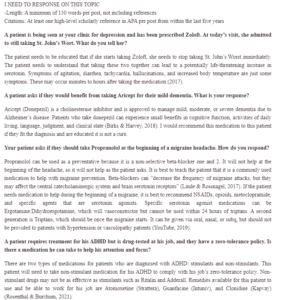
I NEED TO RESPONSE ON THIS TOPIC
-Length: A minimum of 150 words per post, not including references
Citations: At least one high-level scholarly reference in APA per post from within the last five years
Patient Drug Education
A patient is being seen at your clinic for depression and has been prescribed Zoloft. At today’s visit, she admitted to still taking St. John’s Wort. What do you tell her?
The patient needs to be educated that if she starts taking Zoloft, she needs to stop taking St. John’s Worst immediately. The patient needs to understand that taking these two together can lead to a potentially life-threatening increase in serotonin. Symptoms of agitation, diarrhea, tachycardia, hallucinations, and increased body temperature are just some symptoms. These may occur minutes to hours after taking the medication (2017).
A patient asks if they would benefit from taking Aricept for their mild dementia. What is your response?
Aricept (Donepezil) is a cholinesterase inhibitor and is approved to manage mild, moderate, or severe dementia due to Alzheimer’s disease. Patients who take donepezil can experience small benefits in cognitive function, activities of daily living, language, judgment, and clinical state (Birks & Harvey, 2018). I would recommend this medication to this patient if they fit the diagnosis and are educated it is not a cure.
Your patient asks if they should take Propranolol at the beginning of a migraine headache. How do you respond?
Propranolol can be used as a preventative because it is a non-selective beta-blocker one and 2. It will not help at the beginning of the headache, so it will not help as the patient asks. It is best to teach the patient that it is a commonly used medication to help with migraine prevention. Beta-blockers can “decrease the frequency of migraine attacks, but they may affect the central catecholaminergic system and brain serotonin receptors” (Linde & Rossnagel, 2017). If the patient needs medication to help during the beginning of a migraine, it is best to recommend NSAIDs, opioids, metoclopramide, and specific agents that are serotonin agonists. Specific serotonin agonist medications can be Ergotamine/Dihydroergotamine, which will vasoconstrictor but cannot be used within 24 hours of triptans. A second generation is Triptans, which should be once the migraine starts. It can be given via oral, nasal, or sub, but should not be provided to patients with hypertension or vasculopathy patients (YouTube, 2019).
A patient requires treatment for his ADHD but is drug-tested at his job, and they have a zero-tolerance policy. Is there a medication he can take to help his attention and focus?
There are two types of medications for patients who are diagnosed with ADHD: stimulants and non-stimulants. This patient will need to take non-stimulant medication for his ADHD to comply with his job’s zero-tolerance policy. Non-stimulant drugs may not be as effective as stimulants such as Ritalin and Adderall. Remedies available for this patient to use and be able to work for his job are Atomoxetine (Strattera), Guanfacine (Intuniv), and Clonidine (Kapvay) (Rosenthal & Burchum, 2021).
Atomoxetine is a medication used most often for patients who are unresponsive or intolerant to stimulants. It is important to teach the patient if taking Guanfacine that the side effects can be sleepiness, fatigue, and reduced blood pressure. Lowering blood pressure may make the most changes at the start of the medication regime and alterations. The patient should not abruptly stop this medication. ERE.R.lonidine is similar to guanfacine. Both drugs are used for hypertension but are also off-label ADHD and do not cause anorexia or insomnia. It is important when deciding what medication to prescribe this patient to take vital signs at each office visit (Rosenthal & Burchum, 2021).
What is the most commonly used dopaminergic drug used for Parkinson’s?
Levodopa is the first-line medication because it stimulates remaining nigrostriatal neurons by converting dopamine and activating the receptors. Patients who start Levodopa have about a 50% reduction in symptom severity. Once a patient’s symptoms have become more severe, they should begin Levodopa combined with a dopamine agonist. For many patients, symptoms may be controlled for around 2-5 years, and then a gradual or abrupt loss will occur. It is important to follow through with the patient’s symptoms and if side effects occur, such as drug-induced dyskinesias. If this happens, then Levodopa may need to be stopped, and then a dopamine agonist would need to be started (Rosenthal & Burchum, 2021).
Monoamine oxidase (MAO-B) inhibitors are given in early-stage or mild Parkinson’s disease. MAO-B medications are given to prevent dopamine breakdown. It is “used in newly diagnosed patients and for managing off times during levodopa therapy” (Rosenthal & Burchum, 2021). MAO-B inhibitor medications prescribed are Selegiline and Rasagiline.
What other disorders are many of the Antiepileptic drugs used for? Name 2 of the drugs.
Topiramate is a medication used for seizures, including generalized tonic-clonic and partial-onset seizures. It is used for patients diagnosed with Lennox-Gastaut syndrome, which is a disorder that causes seizures and developmental delays. Topiramate is also used to prevent migraine headaches, but not while one is present. Its function is to decrease abnormal excitement in the brain (2021).
Carbamazepine is an antiepileptic drug and is also used for bipolar disorder. It is used in patients who are refractory to lithium. It can also be used for patients with neuralgia pain associated with trigeminal and glossopharyngeal nerves. Carbamazepine is also known under four trade names: Carbatrol, Equetro, Epitol, and Tegretol (Rosenthal & Burchum, 2021).
References
Birks, J. S., & Harvey, R. J. (2018). Donepezil for dementia due to Alzheimer’s disease. Cochrane Database of Systematic Reviews. https://doi.org/10.1002/14651858.cd001190.pub3
Linde, K., & Rossnagel, K. (2017). Propranolol for migraine prevention. Cochrane Database of Systematic Reviews. https://doi.org/10.1002/14651858.cd003225.pub3
Rosenthal, L. D., & Burchum, J. R. (2021). Lehne’s pharmacotherapeutics for Advanced Practice nurses and physician assistants. Elsevier.
U.U.S.epartment of Health and Human Services. (2017, December). St. John’s Wort and Depression: In Depth. National Center for Complementary and Integrative Health. https://www.nccih.nih.gov/health/st-johns-wort-and-depression-in-depth.
U.U.S.ational Library of Medicine. (2021, January 23). Topiramate. MedlinePlus. https://medlineplus.gov/druginfo/meds/a697012.html.
YouTube. (2019). Usmle Pharmacology- Headaches. YouTube. https://www.youtube.com/watch?v=5s-j4RUxcCo.
 Complete the order form and upload all of your files, including any instructions, rubrics, or other materials provided by your instructor.
 Complete the order payment after filling in the order form. We’ll receive your order and assign it to a writer.
 The assigned writer will complete your paper and forward it to our Editing Team for review and approval.
 Once approved by the editor, the completed paper will be uploaded to your account for you to download, review and approve.