
The Impact of using Telehealth during the COVID-19 pandemic on Healthcare and Nursing

Hello, everyone, and welcome to today’s presentation on the use of Telehealth during the COVID-19 pandemic. Telehealth refers to using electronic information and telecommunication in health care to provide patient care. The exhibition will focus on the Impact of Telehealth during the COVID-19 pandemic on healthcare and nursing. As many people have seen, many healthcare organizations have switched to telecommunication and electronic information during the pandemic, which has affected the healthcare system. The presentation will focus on patient safety, quality of care, risk management, patient privacy and confidentiality, security of patient data, Impact on the population, ethical practices, compliance with legal mandates, and organizational infrastructure.

Here is an outline of the presentation. We will begin by discussing the use of Telehealth during the COVID-19 pandemic. Next, we’ll discuss the impacts of Telehealth on healthcare and nursing during the COVID-19 pandemic. Lastly, we’ll look at the issues concerning the application of Telehealth.
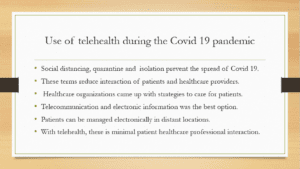
The COVID-19 virus was spreading rapidly, and the best strategies to prevent the spread of infection were keeping social distance, total lockdown, quarantine, and isolation. To abide by these preventive measures, the interaction was to be limited, especially in healthcare. Therefore, the need for caring for patients in their homes or with minimal interaction led many healthcare facilities to start using Telehealth. With Telehealth, healthcare organizations began using telecommunication and electronic information to communicate with patients, manage them, and monitor their progress. Between 2019 and 2020, there was a rapid increase in the use of Telehealth to work with patients during the pandemic, where telehealth visits increased by over 150% (Koonin et al., 2020). Telehealth was also used for communication among healthcare providers and thus had a great impact on healthcare and nursing.
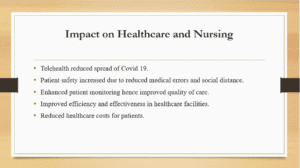
During the pandemic, Telehealth has had a lot of positive Impacts. Telehealth reduces interaction between patients and professionals, hence ensuring social distancing. Therefore, it reduced the spread of Covid 19, which reduced the cases. Through providing social distancing, vulnerable patients were safe from Covid 19. The system ensures accuracy and reduces medical errors, increasing patient safety (Caetano et al., 2020). The plans also monitor and evaluate the trends of patients’ condition, which help improve the quality of care. Telehealth improved communication among healthcare professionals and between patients and professionals, which improved effectiveness and efficiency in healthcare facilities. The cost of healthcare, especially for patients, has reduced since hospital admissions have been reduced.
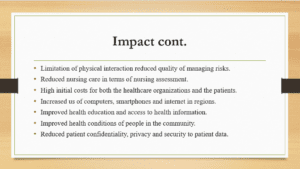
However, Telehealth had some negative impacts. It reduced nurse-patient interaction, essential in managing some risks and risky conditions. Nurses should be physically present to assess the needs and risks of the patient by taking both objective and subjective data. Telehealth prevents the collection of accurate data, which is essential in managing some conditions, such as cardiovascular conditions. Therefore, risk management of some conditions was poor—the quality of care of patients in distant areas that require physical contact with professionals is reduced. Technology increased the use of computers, smartphones, and the internet, which improved other aspects such as communication. There is also high initial cost, such as buying hardware, software, smartphones, and systems and hiring professionals. The patients also have to incur extra charges to purchase computers and smartphones and the internet to use the technology. The use of Telehealth improved access and sharing of health information among people, which improved the overall health of people in the community. The use of technology, however, reduced patient confidentiality, privacy, and security of data since the technology allows sharing of information. The technology is also prone to breaches, such as through cyber attacks.
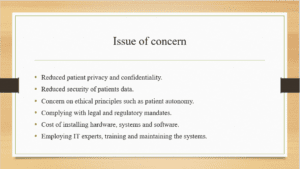
The major issue of concern with Telehealth is patient privacy, confidentiality, and data security. The technology involves the sharing of information among healthcare professionals and patients. Therefore, there is reduced privacy and confidentiality. Restriction of users and use of one-time passwords help ensure privacy and confidentiality. The system may also be hacked by cybercriminals, where important data may be stolen or altered. Ensuring the system is current and monitoring improves security (Caetano et al., 2020). The technology should also comply with ethical principles such as patient autonomy, where patients should consent before using or sharing certain information in the systems. The technology should meet legal requirements such as being safe for people and having a low cost. It is expensive to install the relevant infrastructure required for the technology. Many funds may also be used for hiring experts, training patients and professionals to use the technology, and maintaining the systems.

Here are some sources for further information on the use of Telehealth in healthcare. The authorities will give more details on the Impact of Telehealth in healthcare and nursing. The trends of Telehealth during the COVID-19 pandemic are also provided. From the sources, the benefits, opportunities, and challenges of Telehealth are well identified.
References
Badowski, D. M., Rossler, K. L., & Gill-Gembala, L. (2019). Telehealth simulation with motivational interviewing: Impact on learning and practice. Journal of Nursing Education, 58(4), 221-224. https://doi.org/10.3928/01484834-20190321-06
Caetano, R., Silva, A. B., Guedes, A. C. C. M., Paiva, C. C. N. D., Ribeiro, G. D. R., Santos, D. L., & Silva, R. M. D. (2020). Challenges and opportunities for telehealth during the COVID-19 pandemic: ideas on spaces and initiatives in the Brazilian context. Cadernos de Saúde Pública, 36, e00088920. https://doi.org/10.1590/0102-311X00088920
Koonin, L. M., Hoots, B., Tsang, C. A., Leroy, Z., Farris, K., Jolly, B., … & Harris, A. M. (2020). Trends in the use of telehealth during the emergence of the COVID-19 pandemic—United States, January–March 2020. Morbidity and Mortality Weekly Report, 69(43), 1595. doi: 10.15585/mmwr.mm6943a3
ORDER A PLAGIARISM-FREE PAPER HERE
We’ll write everything from scratch
Question 
Purpose
NR360 Information Systems in Healthcare RUA: Technology Presentation Guidelines
The Impact of using Telehealth during COVID-19 pandemic on Healthcare and Nursing
The purpose of this assignment is to (a) explore and present an information technology used in the healthcare system that supports the patient care experience and (b) develop the skills of team communication, collaboration, and production.
Course outcomes: This assignment enables the student to meet the following course outcomes:
CO 1: Describe patient‐care technologies as appropriate to address the needs of a diverse patient population. (PO 1)
CO 5: Identify patient care technologies, information systems, and communication devices that support safe nursing practice. (PO 5)
CO 6: Discuss the principles of data integrity, professional ethics, legal requirements related to data security, regulatory requirements, confidentiality, and the client’s right to privacy. (PO 6)
CO 8: Discuss the value of best evidence as a driving force to institute change in the delivery of nursing care. (PO 8)
Due date: Your faculty member will inform you when this assignment is due. The Late Assignment Policy applies to this assignment.
Total points possible: 240 points
Preparing the assignment
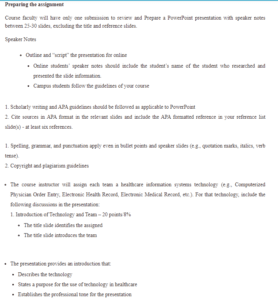
Course faculty will have only one submission to review and Prepare a PowerPoint presentation with speaker notes between 25‐30 slides, excluding the title and reference slides.
Speaker Notes
-
-
- Outline and “script” the presentation for online
- Online students’ speaker notes should include the student’s name of the student who researched and presented the slide information.
- Campus students follow the guidelines of your course
- Outline and “script” the presentation for online
-
- Scholarly writing and APA guidelines should be followed as applicable to PowerPoint
- Cite sources in APA format in the relevant slides and include the APA formatted reference in your reference list slide(s) ‐ at least six references.
- Spelling, grammar, and punctuation apply even in bullet points and speaker slides (e.g., quotation marks, italics, verb tense).
- Copyright and plagiarism guidelines
- The course instructor will assign each team a healthcare information systems technology (e.g., Computerized Physician Order Entry, Electronic Health Record, Electronic Medical Record, etc.). For that technology, include the following discussions in the presentation:
- Introduction of Technology and Team – 20 points/8%
- The title slide identifies the assigned
- The title slide introduces the team
- Introduction of Technology and Team – 20 points/8%
- The presentation provides an introduction that:
- Describes the technology
- States a purpose for the use of technology in healthcare
- Establishes the professional tone for the presentation
- History and Current Use – 30 points/14%
- Describe significant findings that prompted the development of the
- Discuss the history and current use of the technology in
- Describe three goals of this technology’s
- Impact on Healthcare and Nursing – 40 points/16%
- Discuss the Impact on professional nursing practice related to:
- Patient safety
- Quality of care measures/monitoring
- Risk management
- Privacy, confidentiality, and security of patient data
- Effect on population within the region
- Ethical practice
- Compliance with legal and regulatory mandates
- Organizational infrastructure and operations
- Support discussions with examples & data from current evidence-based
- Discuss the Impact on professional nursing practice related to:
- Three Advantages and Disadvantages – 40 points/16%
- Patient’s perspective (e.g., patient outcomes, safety, patient/family satisfaction)
- Nurse’s perspective (improves/hinders job efficiency/safety)
- Healthcare organization’s perspective (regulatory compliance, financial)
- Controversy, Issues, Challenges, and Regulatory Implications – 30 points/14%
- How might issues surrounding the chosen technology be addressed/solved?
- Provide statistically significant data or evidence to support your
- Summary – 20 points/8%
- Key points
- Discoveries/surprises
- Lessons learned by the team
- Team Project Evaluation – 40 points/16%
- Place & discuss the following questions and responses in the slides(s) following the summary slide and before the reference slide(s).
- How did the team function well? (e.g., team strengths, team balance)
- What problems did you have interacting as a team? (e.g., team weaknesses, outside challenges, technology)
- What actions would you recommend to future groups to help them interact, function, and collaborate successfully?
 Complete the order form and upload all of your files, including any instructions, rubrics, or other materials provided by your instructor.
 Complete the order payment after filling in the order form. We’ll receive your order and assign it to a writer.
 The assigned writer will complete your paper and forward it to our Editing Team for review and approval.
 Once approved by the editor, the completed paper will be uploaded to your account for you to download, review and approve.