
Literature Evaluation Table
The project topic for focus is the nursing shortage. Essential services provided by nurses make them important members of the healthcare team. However, deficiencies in nursing staff have been reported. It is estimated that 10 million more nurses are needed to solve the nursing shortage problem in the United States of America (Zhang et al., 2018). Shortages of nurses reduce the quality of services delivered to patients.
| Criteria | Article 1 | Article 2 | Article 3 | Article 4 |
| Author, Journal (Peer-Reviewed), and
Permalink or Working Link to Access Article
|
Abhicharttibutra, K., Kunaviktikul, W., Turale, S., Wichaikhum, O. A., & Srisuphan, W.
International Nursing Review https://doi.org/10.1111/inr.12257
|
Buerhaus, P. I., Skinner, L. E., Auerbach, D. I., & Staiger, D. O.
Journal of Nursing Regulation https://doi.org/10.1016/S2155-8256(17)30097-2 |
Drennan, V. M., & Ross, F.
British Medical Bulletin https://doi.org/10.1093/bmb/ldz014 |
Haryanto, M.
Orthopaedic Nursing |
| Article Title and Year Published
|
Analysis of a Government Policy to Address Nursing Shortage and Nursing Education Quality. (2017) | Four Challenges Facing the Nursing Workforce in the United States. (2017) | Global Nurse Shortages – The Facts, The Impact, and Action for Change. (2019) | Nursing shortage: Myth or fact? (2019) |
| Research Questions (Qualitative)/Hypothesis (Quantitative)
|
How did the Production and Development of Educational Management in Nursing (PIPDEMN) reach the government agenda?
What were the development processes of the PIPDEMN? How was the PIPDEMN implemented? |
Registered nurses will face four main problems in the next 20 years.
The challenges affect patient care safety. The problems include an aging task force and an increased number of retirees. |
What is known about current nurse workforces and shortages, and what can be done to forestall such shortages? | The nursing shortage is a global challenge. |
| Purposes/Aim of Study | The aim is to describe the policy-making processes in the first Thai government plan to increase nursing capacity and improve nursing education quality. | Describe the four significant challenges facing the nursing workforce and identify their implications.
To describe how the challenges can be solved. |
To establish the statistics about the global nursing shortage and the impact of the need and provide measures to mitigate the condition. | To determine the elements unique to the nursing shortage. |
| Design (Quantitative or Qualitative)
|
The design was a qualitative study. Interviews and document examination were done. | The design was a quantitative study. A descriptive research method was used to evaluate and describe the current status of nursing practice in the USA. | The design was a quantitative study. | Meta-analysis quantitative descriptive study. |
| Setting/Sample
|
The study setting is Thailand. The target population is informants who were initially involved in the policy-making process of the PIPDEMN. | The study setting is in the nursing workforce in the United States of America. | The article reviews published documents from international organizations with remits for nursing workforces, published reviews with forward citations, and critical author searches. | The article reviews data from published documents, such as the fact sheet of the American Association of Colleges of Nursing. |
| Methods: Intervention/Instruments
|
Purposive sampling and snowball sampling techniques were used to identify 28 key informants—data collection using interviews and examination of documents. | Both prospective and retrospective techniques were used. Case-control studies and cohort studies were used to collect data. | Both prospective and retrospective techniques were used. | Both prospective and retrospective techniques were used. |
| Analysis
|
Content analysis was used.
In-depth interviews were transcribed verbatim. Key informants modified transcripts. |
Descriptive analysis was used in data analysis. Data was presented as percentages and using graphs and tables. | Descriptive analysis was used in data analysis. Data is presented as percentages and using graphs and tables. | Meta-analysis.
Percentages used to represent data |
| Key Findings
|
Three phases are used to make policies: formulation, implementation, and modification. | The aging of the baby boomer generation, the shortage and uneven distribution of physicians, the accelerating rate of registered nurse retirements, and the uncertainty of health care reform. | A nine million shortage estimated in 2014 is predicted to decrease by two million by 2030, but disproportionality affects regions such as Africa.
|
A decline in nursing enrollment and Geography are the main factors contributing to the nursing shortage. |
| Recommendations
|
Nurses should actively inform the government about the nursing shortage problem by providing evidence.
Expanding nursing training institutions can be used to solve the problem of nursing shortage. |
Nurses should be actively involved in policy formulation to curb the nursing shortage.
Hospital patient care unit managers and human resource officers should be involved in identifying the causes of the main problems of the workforce and informing both the federal and state governments. |
Addressing nurse shortages requires a data-informed, country-specific model of the routes of supply and demand. It requires evidence-informed policy and resource allocation at national, sub-national, and organizational levels. | Congress to allocate funds to nursing training institutions.
Enhance the diversity of nurses. |
| Explanation of How the Article Supports EBP/Capstone Project
|
It suggests interventions to address the problem of nursing shortage. Nurses should be actively involved in policy formulation. Increasing the capacity of training institutions helps to address the issue. | It identifies the leading causes of nursing shortage, such as increased retirees.
It suggests mitigation strategies for the problem of the nursing shortage |
It describes the situation of nursing shortage globally. The causes of the nursing shortage are given.
Recommendations on how to address the shortage are also given. |
It identifies the current contributors to the nursing shortage. It provides suggestions for the mitigation of the nursing shortage. |
| Criteria | Article 5 | Article 6 | Article 7 | Article 8 |
| Author, Journal (Peer-Reviewed), and
Permalink or Working Link to Access Article
|
Marć, M., Bartosiewicz, A., Burzyńska, J., Chmiel, Z., & Januszewicz, P.
International Nursing Review |
Scheffler, R. M., & Arnold, D. R.
Health Economics, Policy, and Law |
Weaver, M. S., Wichman, B., Bach, S., Schroeder, D., Vail, C., Wichman, C., & MacFadyen, A
Journal of Hospice and Palliative Nursing |
Zhang, X., Tai, D., Pforsich, H., & Lin, V. W.
American Journal of Medical Quality, |
| Article Title and Year Published
|
A Nursing Shortage – A Prospect of Global and Local Policies. (2019) | Projecting Shortages and Surpluses of Doctors and Nurses in the OECD: What Looms Ahead. (2019) | Measuring the Impact of the Home Health Nursing Shortage on Family Caregivers of Children Receiving Palliative Care. (2018) | United States Registered Nurse Workforce Report Card and Shortage Forecast: A Revisit. (2018) |
| Research Questions (Qualitative)/Hypothesis (Quantitative)
|
To determine the causes of nursing shortages and the impact of existing policies. | The demand for doctors and nurses will increase by 2030, compounding the shortage. | The nursing shortage creates a burden of care for families whose children receive palliative care. | The demand for registered nurses will exceed the supply from 2016 to 2030. |
| Purposes/Aim of Study | The article addresses selected determinants of the nursing shortage in Poland and other countries in the face of employee aging. | To estimate the shortage and surplus of nurses and doctors in the Organization for Economic Cooperation and Development countries in the year 2030 | To investigate how the nursing shortage translates into a time, economic, and psychosocial impact on family caregivers of children with complex medical conditions receiving palliative care services. | To reevaluate registered nurse supply and demand from 2016 to 2030 using a previously published work forecast model and grading methodology with more recent workforce data. |
| Design (Type of Quantitative or Qualitative)
|
Meta-analysis quantitative descriptive study | Quantitative descriptive study | Quantitative descriptive study | Meta-analysis quantitative descriptive study |
| Setting/Sample
|
Meta-analysis of national listings and strategic documents for nursing policy in Poland and international reports. | The quantitative study took place in 32 OECD countries. | Families of children receiving inpatient pediatric palliative care consultation during admission. | Linear regression analysis of national listings of demand and supply of nurses in the 50 states of the USA. |
| Methods: Intervention/Instruments
|
Both prospective and retrospective techniques were used. | Retrospective and prospective techniques were used. | Survey instrument with 44 questions. | Use of current population survey. |
| Analysis
|
Meta-analysis.
Percentages used to represent data |
Descriptive analysis was used in data analysis. | Descriptive analysis using Excel and SPSS. Results are presented as percentages, means, and standard deviation. | Linear regression analysis. |
| Key Findings
|
The causes of the nursing shortage are multifaceted, with no single global or local measure of its nature. | Nearly 400,000 doctors across 32 OECD countries and about 2.5 million nurses shortage across 23 OECD countries in 2030. | Families do not receive their allocated nursing hours due to the nursing shortage. | Shortages will continue to grow across the USA between 2015 and 2030. This |
| Recommendations
|
Nursing policy recommendations include preparing and implementing national social security agendas into services provided by nurses. | Policies such as increasing the number and capacity of nursing training facilities will help address the current and future nursing shortage problem. | Provide scholarships and incentives to qualified nursing applicants.
Nursing assistants to receive additional training. |
Increase the number of nursing training facilities to accommodate all applicants. |
| Explanation of How the Article Supports EBP/Capstone
|
It identifies the causes of nursing shortage globally and proposes a policy to mitigate it. | It evaluates the current and future problems of the nursing shortage. It proposes a policy to address the issue. | It determines the effect of the nursing shortage on children and families receiving palliative care.
Proposes interventions to address the problem. |
It provides the future outcomes of the current problem of nursing shortage.
It suggests a policy for addressing the problem |
ORDER A PLAGIARISM-FREE PAPER HERE
We’ll write everything from scratch
Question 
Literature Evaluation Table
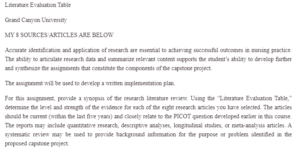
Literature Evaluation Table
Grand Canyon University
MY 8 SOURCES/ARTICLES ARE BELOW
Accurate identification and application of research are essential to achieving successful outcomes in nursing practice. The ability to articulate research data and summarize relevant content supports the student’s ability to develop further and synthesize the assignments that constitute the components of the capstone project.
The assignment will be used to develop a written implementation plan.
For this assignment, provide a synopsis of the research literature review. Using the “Literature Evaluation Table,” determine the level and strength of the evidence for each of the eight research articles you have selected. The articles should be current (within the last five years) and closely relate to the PICOT question developed earlier in this course. The reports may include quantitative research, descriptive analyses, longitudinal studies, or meta-analysis articles. A systematic review may be used to provide background information for the purpose or problem identified in the proposed capstone project.
 Complete the order form and upload all of your files, including any instructions, rubrics, or other materials provided by your instructor.
  Complete the order payment after filling in the order form. We’ll receive your order and assign it to a writer.
 The assigned writer will complete your paper and forward it to our Editing Team for review and approval.
 Once approved by the editor, the completed paper will be uploaded to your account for you to download, review and approve.