
Interprofessional Collaboration in Healthcare
This week was a success. I had a productive discussion with my preceptor on interprofessional collaboration in healthcare. Healthcare providers should work together to ensure that the best healthcare services are available to patients. Interprofessional partnership enhances knowledge sharing and provides an avenue for learning and expanding an individual’s knowledge base. It helps to prevent common mistakes in healthcare, such as misdiagnoses, drug interactions, and adverse drug reactions. All healthcare providers should work in concert when delivering patient care.
Interprofessional collaboration can be applied in managing diabetes mellitus to reduce complications associated with the disease. This was my area of focus last week when proposing new approaches in nursing practice. Physicians, nurses, pharmacists, and nutritionists should work in concert with the management of diabetics. Nutritionists should advise the patients on the importance of dietary modifications, the timing of meals, the composition of their meals, and their frequency when using insulin (Szafran et al., 2019). This helps to reduce post-prandial hyperglycemia and reduces the incidences of complications. Pharmacists should educate patients on the importance of compliance. They should give patients drug calendars to enhance compliance (Ray et al., 2020). Furthermore, they should demonstrate to patients how to administer drugs such as insulin.
Physicians and nurses should be involved actively in patient education. They should educate the patient on the disease process and the importance of lifestyle modification. They should perform regular checkups and follow-ups to identify patients with both microvascular and macrovascular complications. Early identification forms the basis of prompt management. When complications such as diabetic nephropathy are recognized and managed in their early stages, the prognosis becomes desirable. I completed my topic selection and approval process during the week.
References
Ray, S., Lokken, J., Whyte, C., Baumann, A., & Oldani, M. (2020). The Impact of a Pharmacist-Driven, Collaborative Practice on Diabetes Management in an Urban Underserved Population: A Mixed-Method Assessment. Journal of Interprofessional Care, 34(1), 27–35. https://doi.org/10.1080/13561820.2019.1633289
Szafran, O., Kennett, S. L., Bell, N. R., & Torti, J. M. I. (2019). Interprofessional Collaboration in Diabetes Care: Perceptions of Family Physicians Practicing in or Not In a Primary Health Care Team. BMC Family Practice, 20(1), 1–10. https://doi.org/10.1186/s12875-019-0932-9
ORDER A PLAGIARISM-FREE PAPER HERE
We’ll write everything from scratch
Question 
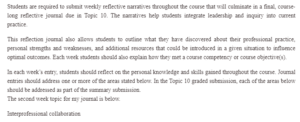
Students must submit weekly reflective narratives throughout the course, culminating in a final, course-long reflective journal due in Topic 10. The reports help students integrate leadership and inquiry into current practice.
Interprofessional Collaboration in Healthcare
This reflection journal also allows students to outline what they have discovered about their professional practice, personal strengths and weaknesses, and additional resources that could be introduced in a given situation to influence optimal outcomes. Students should also explain how they met a course competency or course objective(s) each week.
In each week’s entry, students should reflect on the personal knowledge and skills gained throughout the course. Journal entries should address one or more of the areas stated below. In the Topic 10 graded submission, each area below should be addressed as part of the summary submission.
The second-week topic for my journal is below.
Interprofessional collaboration
 Complete the order form and upload all of your files, including any instructions, rubrics, or other materials provided by your instructor.
 Complete the order payment after filling in the order form. We’ll receive your order and assign it to a writer.
 The assigned writer will complete your paper and forward it to our Editing Team for review and approval.
 Once approved by the editor, the completed paper will be uploaded to your account for you to download, review and approve.