
Maternity and Women Health
The patient visits the prenatal clinic to confirm a positive pregnancy test. The patient is not married and lacks a support system. She lacks health insurance and cannot afford to pay for prenatal care. She intends to keep the baby. She seeks to know the need for prenatal care when she can take care of herself. This paper identifies possible nursing diagnoses for the patient and expected outcomes.
The first nursing diagnosis is a lack of sufficient knowledge on the importance of prenatal care. This is evident based on the patient’s question. She does not consider prenatal care an essential service. She thinks that by taking good care of herself, she doesn’t need to attend prenatal care. The second nursing diagnosis the risk of development of maternal and fetal complications due to an inefficient support system. This is evidenced by the patient reporting that she is uninsured, earns a minimum wage, is unmarried, and is not ready to inform her partner of her intent to keep the baby.
Based on the diagnoses, various outcomes are expected. It is expected that by the end of the nurse-patient interaction, the patient will learn and appreciate the importance of prenatal care. The patient will be expected to understand the importance of support systems during pregnancy. Furthermore, the patient should be able to know different methods of family planning to avoid future predispositions to the risk of maternal and fetal complications. At the end of the interaction, it is expected that the patient will attend all prenatal clinics.
Prenatal care is essential for the well-being of the expectant woman and the fetus. It is recommended that all pregnant women should start prompt prenatal care. Different schedules for prenatal care exist depending on the trimester. Monthly visits are recommended in the first two trimesters (Moller et al., 2017). During the first two months of the third trimester, visits should take place after every two weeks. The last month of the third trimester requires weekly visits until the time of delivery.
Different services are offered during prenatal care. Nutritional services involve counseling and advice on a healthy diet and physical activity during pregnancy. Some of the recommendations include daily intake of folic acid and oral iron. Folic acid prevents fetal neural tube defects, while iron prevents anemia in the woman (Osterman & Martin, 2018). Vitamin and mineral supplementations are done based on the patient’s needs. Maternal services focus on testing for sexually transmitted diseases (STDs), hyperglycemia, substance use, and other conditions such as tuberculosis (Tunçalp et al., 2017). When an STD such as HIV/AIDS is diagnosed, appropriate measures are taken to prevent mother-to-child transmission.
Fetal monitoring using techniques such as ultrasound helps to detect any anomalies or the possibility of multiple pregnancies. This is important because it forms the basis for selecting the best method of delivery. Preventive services such as administration of tetanus toxoid and malaria prophylaxis are initiated during prenatal care (Tunçalp et al., 2017). Pregnancy-related problems such as nausea, vomiting, constipation, edema, back pain, and varicose veins are sufficiently managed during prenatal care (Osterman & Martin, 2018). Therefore, prenatal care should be sought by all pregnant women.
Support systems are important during pregnancy. Health insurance facilitates access to health care services such as prenatal care. An example is the Child Health Insurance Program in the United States of America, which caters to the needs of low-income women (Burton et al., 2018). In addition to insurance programs, pregnant women should seek emotional and spiritual support from counselors and the clergy. This helps to minimize the stress that may accompany the pregnancy.
The possible diagnoses from the patient’s case are ignorance of the importance of prenatal care and the risk of development of fetal and maternal complications due to a poor support system. Prenatal care helps to prevent the development of maternal and fetal complications. Having support systems such as health insurance helps to cater to the medical costs of the pregnant woman.
References.
Burton, R. A., Peters, R. A., & Devers, K. J. (2018). Perspectives on Implementing Quality Improvement Collaboratives Effectively: Qualitative Findings from the CHIPRA Quality Demonstration Grant Program. Joint Commission Journal on Quality and Patient Safety, 44(1), 12–22. https://doi.org/10.1016/j.jcjq.2017.08.004
Moller, A. B., Petzold, M., Chou, D., & Say, L. (2017). Early Antenatal Care Visit: A Systematic Analysis of Regional and Global Levels and Trends of Coverage From 1990 to 2013. The Lancet Global Health, 5(10), e977–e983. https://doi.org/10.1016/S2214-109X(17)30325-X
Osterman, M. J. K., & Martin, J. A. (2018). Timing and Adequacy of Prenatal Care in the United States, 2016. National Vital Statistics Reports, 67(3).
Tunçalp, Pena-Rosas, J. P., Lawrie, T., Bucagu, M., Oladapo, O. T., Portela, A., & Metin Gülmezoglu, A. (2017). WHO Recommendations on Antenatal Care for a Positive Pregnancy Experience—Going Beyond Survival. BJOG: An International Journal of Obstetrics and Gynaecology, 124(6), 860–862. https://doi.org/10.1111/1471-0528.14599
ORDER A PLAGIARISM-FREE PAPER HERE
We’ll write everything from scratch
Question 
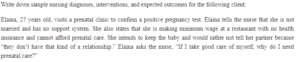
Write down sample nursing diagnoses, interventions, and expected outcomes for the following client:
Maternity and Women’s Health
Elaina, 27 years old, visits a prenatal clinic to confirm a positive pregnancy test. Elaina tells the nurse that she is not married and has no support system. She also states that she is making minimum wage at a restaurant with no health insurance and cannot afford prenatal care. She intends to keep the baby and would rather not tell her partner because “they don’t have that kind of a relationship.” Elaina asks the nurse, “If I take good care of myself, why do I need prenatal care?”
 Complete the order form and upload all of your files, including any instructions, rubrics, or other materials provided by your instructor.
 Complete the order payment after filling in the order form. We’ll receive your order and assign it to a writer.
 The assigned writer will complete your paper and forward it to our Editing Team for review and approval.
 Once approved by the editor, the completed paper will be uploaded to your account for you to download, review and approve.