
Framing Issues of Public Health, Law, and Policy
The significance of public health underpins its relevance in most governments’ agendas and health promotion strategies. However, public health is not just a government agenda and should be an individual responsibility. Integrative approaches involving the government and the communities yield far better outcomes. Public health is essential in ensuring that all community members are protected from infectious diseases and promotes the general welfare of the communities. The federal, state, and local governments play a crucial role. Their roles in public health assurance include but are not limited to verifying public health infrastructure, promoting the health of communities, and preventing the spread of infectious diseases, as described below.
Assurance of Adequate Public Health Infrastructure
Proper and adequate infrastructure is fundamental in ensuring the effective functioning of any healthcare system. This entails maintaining the essential capacity of the healthcare system to enable it to accommodate any member of the public that may seek its services—additionally, proper planning and policy formulation. Effective communication and community mobilization are critical components of public health assurance that can only be achieved via an integrative approach that draws stakeholders from all levels of government (Lomazzi, 2018). It is therefore necessary that all the levels of government work collaboratively towards the assurance of public health by ensuring all these.
Promotion of Healthy Communities and Healthy Behavior
This entails all activities and measures that improve health in a population. Such efforts include the engagement of the communities in amending policies, systems, and even the environment and are targeted towards preventing health hazards and promoting healthy living. Local and state governments are critical as they are strategically placed to carry out such changes (Byrne et al., 2016). They may also educate populations on the social determinants of health, the benefits of maintaining health and addressing various health disparities.
Preventing the Spread of Communicable Diseases
This entails putting down measures that curtail the transmission of infectious diseases. Such efforts include early detection of such conditions, adequate reporting, and implementation of various control measures. Such measures as quarantine and isolation may be necessary, especially if the disease-causing agents are easily transmissible. Whereas these measures are easily implementable by local and federal governments, widespread outbreaks may require government intervention (Memish et al., 2019). Implementing other preventive measures, such as vaccine utilization, are also components of disease prevention requiring federal government intervention.
Other roles of the governments in public health assurance include protection against environmental health hazards, preparation and response to health emergencies, and security of health services. However, there exist several challenges in public health, as described below.
Emerging and reemerging infectious diseases are of great concern to the public health system. Over the past decades’ contagious diseases have been seen to be of lesser significance to public health, and much attention has focused on other non-communicable diseases, such as heart disease, which has increasingly been claiming American lives. However, in the recent past, the public health landscape has been changing with the emergence of infectious diseases such as severe acute respiratory syndrome, HIV/AIDS, and even currently the SARS-COV-2 virus (Zumla & Hui, 2019). These diseases continue to claim many American lives and concern the government and the individual Americans. The emergence of antibiotic-resistant strains of bacteria is also of great concern to public health as it threatens to destroy all efforts to contain bacterial infections.
The increasing number of older adults is also of great concern to the governments. The growing numbers of the elderly have been attributed to a rising life expectancy against a static death rate. The implication of having a vast older population is using more funds towards initiatives ensuring their welfare (Howdon & Rice, 2018). Such initiatives as the development of nursing homes, long-term care, and availing medicines are critical for the welfare of these older populations but eat on the funds that would have otherwise been utilized for other sectors of the economy.
According to (Bronson et al., 2009), evidence policy entails three key domains: a process that enables the understanding of approaches to enhance the propensity to adopt a policy, content that identifies specific elements of the policy that are likely to be effective as well as the outcomes that document the potential impacts of the policy. Additionally, several actions exist that reinforce the evidence policy. Such activities include adequate preparation and communication of data, effective utilization of the existing analytical tools, policy surveillance, and evaluation of the outcomes with varied evidence. Three domains of evidence exist, according to Bronson et al., as described below.
The three domains postulated by Bronson are policy processing, policy content, and policy outcome. The policy process aims to understand the approaches that enhance the likelihood of adopting that policy. Recognition and identification of the key factors that inform the process are fundamental to this stage. Such factors as politics underpin the policy-making process and should be thoroughly considered. Additional factors such as government participant variations, jurisdictional boundaries, and administrative or legislative turnover are critical and should not be undermined.
Policy content is the second domain. It targets identifying specific policy elements that are more likely to be effective. This step utilizes qualitative and quantitative data to deduce the most appropriate policy intervention. The decision-making process as to which systematic reviews and other scientific research findings from relatable sources inform intervention to pick.
Policy outcomes aim to document the potential impact of the policy formulated therein. Understanding the effects of the policy in a given community is particularly important and forms a critical component of policy outcome evaluation. The evaluation process also seeks to determine the individual behavioral alterations attributable to the policy changes. The full extent of these changes can only be realized by initiating surveillance systems that track the expected policy-related endpoints.
Public health assurance is critical to the well-being of US citizens. The governments, both federal and state, have the responsibility to assure public health to Americans. Such responsibilities that promote public health include ensuring adequate public health infrastructure and preventing infectious diseases, among others. However, various challenges threaten the lives of Americans and the rest of the globe. Such challenges as the emergence and re-emergence of infectious diseases threaten to destroy all the government’s gains. Evidence-based policies are based on the three domains of the policy process, policy content, and policy outcome, as hypothesized by Bronson et al.
References
Byrne, D., Rolando, L., Aliyu, M., McGown, P., Connor, L., & Awalt, B. et al. (2016). Modifiable Healthy Lifestyle Behaviors: 10-Year Health Outcomes From a Health Promotion Program. American Journal Of Preventive Medicine, 51(6), 1027-1037. DOI: 10.1016/j.amepre.2016.09.012
Howdon, D., & Rice, N. (2018). Health care expenditures, age, proximity to death and morbidity: Implications for an aging population. Journal Of Health Economics, 57, 60-74. DOI: 10.1016/j.jhealeco.2017.11.001
Lomazzi, M. (2018). The Global Charter for the Public’s Health: role, functions, competencies, and education requirements. European Journal Of Public Health, 28(suppl_4). DOI: 10.1093/epub/cky212.184
Memish, Z., Steffen, R., White, P., Dar, O., Azhar, E., Sharma, A., & Zumla, A. (2019). Mass gatherings medicine: public health issues arising from mass gathering religious and sporting events. The Lancet, 393(10185), 2073-2084. DOI: 10.1016/s0140-6736(19)30501-x
Zumla, A., & Hui, D. (2019). Emerging and Reemerging Infectious Diseases: Global Overview. Infectious Disease Clinics Of North America, 33(4), xiii-xix. DOI: 10.1016/j.idc.2019.09.001
ORDER A PLAGIARISM-FREE PAPER HERE
We’ll write everything from scratch
Question 
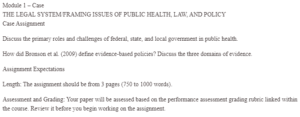
Module 1 – Case
THE LEGAL SYSTEM/FRAMING ISSUES OF PUBLIC HEALTH, LAW, AND POLICY
Case Assignment
Framing Issues of Public Health, Law, and Policy
Discuss the primary roles and challenges of federal, state, and local government in public health.
How did Bronson et al. (2009) define evidence-based policies? Discuss the three domains of evidence.
Assignment Expectations
Length: The assignment should be 3 pages (750 to 1000 words).
Assessment and Grading: Your paper will be assessed based on the performance assessment grading rubric linked within the course. Review it before you begin working on the assignment.
 Complete the order form and upload all of your files, including any instructions, rubrics, or other materials provided by your instructor.
  Complete the order payment after filling in the order form. We’ll receive your order and assign it to a writer.
 The assigned writer will complete your paper and forward it to our Editing Team for review and approval.
 Once approved by the editor, the completed paper will be uploaded to your account for you to download, review and approve.