
Cultural and Generational Diversity in the Workplace
The US demographics have been changing rapidly in the recent past. This change has been attributed to the entry of multiple cultures via immigration. The integration of these culturally diverse individuals into the US population has been evident in most workplaces, including healthcare provision centers. It is, therefore, necessary that healthcare providers showcase knowledge of as well as sensitivity to this diversity in their workplaces to promote efficiency in healthcare provision. This paper seeks to analyze how inclusiveness can be used as a strategy to promote positive clinical outcomes.
Inclusiveness in the healthcare setup entails the incorporation of all individuals regardless of their differences and valuing them for their contributions without looking at who they are. Differences can be in the form of ethnicity, culture, age, background, and religion, among others. Creating a culture of inclusivity means that everyone, regardless of their cultural affiliation and age, is capable of delivering quality to the workforce (Roberson, 2019). It is thus important for any organization to embrace the culture of inclusivity for maximum utilization of the talents and skills that are present within the organization.
In the healthcare setting, cultural and generational diversity has been evident. Various staff from different departments can differ in age and cultural affiliations (Sakdiyakorn & Wattanacharoensil, 2017). However, these diverse individuals have to come together to form a healthcare team that will provide health services to patients. Inclusivity in the team promotes a sense of belonging, value, sense of uniqueness, and confidence among the team members. Inclusivity also enhances communication between the members by eliminating barriers such as doubt, lack of faith, and perception bias that may hinder good communication (Tang et al., 2017). This enhances healthcare provision considerably as all the members can participate in the decision-making regarding the appropriateness of therapy delivered to patients, as well as enable the tapping of other innovative treatment modalities that can be utilized in the treatment process. The overall effect is an efficient, safe, and effective delivery of quality services to the patients.
The face of the health delivery system has changed its outlook accustomed to the presence of diverse cultures and ages. It is thus paramount for providers to know these diverse cultures and ages as well as develop strategies to integrate these changes into their routine operationalization. Inclusivity is a strategy that providers can utilize to enhance team building as well as efficiency in service provision. An inclusive workplace is where each member is incorporated into the system regardless of their differences. Inclusivity is necessary for safe and effective healthcare provision.
References
Roberson, Q. (2019). Diversity in the Workplace: A Review, Synthesis, and Future Research Agenda. Annual Review Of Organizational Psychology And Organizational Behavior, 6(1), 69-88. https://doi.org/10.1146/annurev-orgpsych-012218-015243
Sakdiyakorn, M., & Wattanacharoensil, W. (2017). Generational Diversity in the Workplace: A Systematic Review in the Hospitality Context. Cornell Hospitality Quarterly, 59(2), 135-159. https://doi.org/10.1177/1938965517730312
Tang, N., Zheng, X., & Chen, C. (2017). Managing Chinese diverse workforce: toward a theory of organizational inclusion. Nankai Business Review International, 8(1), 39-56. https://doi.org/10.1108/nbri-03-2016-0010
ORDER A PLAGIARISM-FREE PAPER HERE
We’ll write everything from scratch
Question 
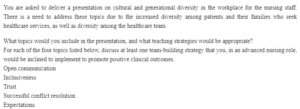
You are asked to deliver a presentation on cultural and generational diversity in the workplace for the nursing staff. There is a need to address these topics due to the increased diversity among patients and their families who seek healthcare services, as well as diversity among the healthcare team.
Cultural and Generational Diversity in the Workplace
What topics would you include in the presentation, and what teaching strategies would be appropriate?
For each of the four topics listed below, discuss at least one team-building strategy that you, in an advanced nursing role, would be inclined to implement to promote positive clinical outcomes.
Open communication
Inclusiveness
Trust
Successful conflict resolution
Expectations
 Complete the order form and upload all of your files, including any instructions, rubrics, or other materials provided by your instructor.
 Complete the order payment after filling in the order form. We’ll receive your order and assign it to a writer.
 The assigned writer will complete your paper and forward it to our Editing Team for review and approval.
 Once approved by the editor, the completed paper will be uploaded to your account for you to download, review and approve.