
Assessment of Aggregate
Youth in Florida have been reported as engaging in risky sexual behavior at rates higher than the national average (CDC, 2016). In this light, the need to address the situation at the grassroots level becomes critical. The proposed project will have its aggregate as the youth in Middle and High School in Miami Gardens and will assess the risky sexual behavior patterns in this cohort. The project aims to bring to light the reasons behind such recklessness and hopes to offer insight to the community, schools, and stakeholders on what needs to be done to alleviate the vice in the community. That said, in this paper, a summary of the findings following assessments on the environment, home, and family of the representative study population will be discussed. The strengths and weaknesses of the aggregate and the community will also be discussed.
Environment and Family Assessment
The environmental assessment was done at a local school and involved an open forum discussion with students aged 13 to 19 years. The students were given a questionnaire to fill in, which looked to assess the environment, in this case, the school, and how it is an enabler of risky sexual behavior. After the questionnaire session was over, the students were engaged in group discussions with the facilitator. The group was given prompt questions that directed the conversation on risky sexual behavior.
In assessing the home environment, the three students selected were given a questionnaire to assess the enablers in their home environments. The students were asked to answer the questions truthfully and anonymously. After filling out the questionnaires, the three students were given an opportunity to air their views and opinions based on the link between their home environment and their sexual behavior.
From the environmental assessment, the key enablers of risky sexual behavior were found to be peer pressure and low self-esteem. Students reported having multiple sexual partners in an attempt to appear cool and sexy. One student said that they were engaged in unprotected sex because they ‘trusted’ their partner and that it was the accepted belief that having unprotected sex meant the partners loved each other. Of interest to note was that one student pointed out that though they engaged in risky sexual behavior, they were coerced by their partner to do so. This amounts to sexual abuse, but the victim believes that reporting the matter would only cause her to be shunned, as other students already perceived that the victim was in a steady and happy relationship with their partner.
As regards the home environment analysis, the participants pointed out that their parents do not have very strict rules when it comes to dating. As the students got older, the parents seemed to be less restrictive and even appeared unconcerned by their children’s sexual and relationship lives. One of the students stated that the most her mother has told her regarding being sexually active was that she ‘should take care and not get pregnant while in school.’ The student felt that the mother was unconcerned about whether she contracted any STI or even HIV, with pregnancy seemingly being the ‘ultimate consequence’ of unprotected sexual behavior.
In assessing the family structures, it was noted that two of the students reported that they came from families where both parents were involved in caring for them. However, a common pattern was that the parents were reported as being too busy with work and also being detached from their children. The few minutes that parents had to bond with their children were spent catching up on school progress and never discussing the social life or relationships that the children may be engaged in at school. One student is from a single-parent family and reported that the mother was overly strict and seemed to monitor his every move. The student said that he opted to be rebellious and appeared to be proud of the fact that he could have sexual partners without the mother being aware. This rebellious attitude was also reported as being tiresome, as the student said that he often got tired of sneaking in and out of his home and would rather have an open and honest relationship with his mother and gain her approval.
The risk assessment showed that the most common ethnic or racial group in Miami Gardens that lives below the poverty line is Blacks, whom Hispanics and Whites follow. Employment in Miami Gardens declined by 1.6% between 2017 and 2018, leaving many people jobless and increasing the risk of homelessness, poverty, and crime. The crime rate at Miami Gardens is 47 for every 1,000 residents, making the city one of the unsafest places to live in the US. The chance of a person becoming a victim of property crime or violence is 1:21 (Data USA, n.d)
Strengths and Weaknesses Assessment
The aggregate community for this project is youth in Middle and High School. The focus of the project is on risky sexual behavior among the target population. The project will be carried out in Miami Gardens in Dade County, Florida. According to Census.gov, the total population of Miami Gardens City as of July 2019 was 110,001, of whom those that are 18 years and below are 24.4%. This makes the aggregate an important populace to study as they form a large percentage of the city’s population. The health and behavior of this population are of great significance and thus warrant studying. The percentage of teens who are sexually active in Miami, Dade County is 37.7% females and 43.0% males. Black teens are the most sexually active teens at 44.1%, Hispanic Latinos at 40.7%, and Whites at 33.3% (Census.gov, n.d). The poverty rate also follows a similar pattern for Blacks, Latinos, and Whites. When teens engage in risky sexual behavior, it often results in pregnancies and early motherhood, which in turn results in school dropouts and contributes to the poverty rates.
Health and Safety Risks for Aggregate
Risky sexual behavior can result in a myriad of problems, including teen pregnancies, school truancy and dropping out, drug and alcohol abuse, and the spread of sexually transmitted diseases. Secondary consequences include an increase in crime, a decline in population literacy, and an increase in poverty levels, as well as an increase in taxpayer burdens in the form of prison system funding and food stamps for the poor and homeless. Youth in Florida are more likely than any other state to experience STI, HIV, and AIDS diagnoses. Health equity, comprehensive sexual education, and access to contraceptives are necessary for the safety and health of Middle and High School students, the target population of this study (CDC, 2016). Based on the assessments, the youth who participated in the project are at risk for a number of things, including STIs and mental health diseases
Risk for STI
The aggregate that participated in the assessments are at risk of STI, including HIV infection. The participants gave various reasons for their risky sexual behaviors, including peer pressure, the need to keep up appearances, rebellion against parents, and continued non-consensual sexual relationships.
Risk of Pregnancies
When the students engage in risky sexual behavior, they risk getting pregnant, and this can result in the expectant mothers dropping out of school. Early pregnancies will also contribute to the single mothers’ statistics in the area and, subsequently, the high rates of poverty among single households.
Risk of Increased Crime Rates
When students engage in risky sexual behavior, and specifically when the trend is borne out of rebellion, it can culminate into criminal activity. A student who engages in patterns of sneaking out can very well engage in criminal activity with the false belief that their parents and, later in life, law enforcement cannot catch them. Also, a person who forces another to engage in unprotected sexual activity can very well become a sociopath and one who does not respect the rights of others.
Conclusion
The assessment revealed that the main contributors to risky sexual behavior among youth in middle and high school are peer pressure, deviance, and low self-esteem. Students need to be guided on ways to live healthier and safer lives by not giving in to risky sexual behavior. The purpose of the project, as mentioned in a different section of this assignment, is to assess which intervention the youth are likely to adhere to based on their own feedback.
References
Census, Gov. (n.d.). QuickFacts. Miami Gardens city, Florida. https://www.census.gov/quickfacts/fact/table/miamigardenscityflorida/PST045219
Centers for Disease Control & Prevention. (2016). Adolescent and school health: YRBSS results. http://www.cdc.gov/healthyyouth/data/yrbs/results.htm.
Data USA. (n.d.). Miami Gardens, FL. https://datausa.io/profile/geo/miami-gardens-fl/
ORDER A PLAGIARISM-FREE PAPER HERE
We’ll write everything from scratch
Question 
Assessment of Aggregate
Week 4 Project
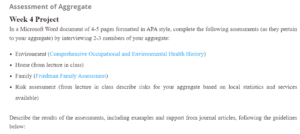
In a Microsoft Word document of 4-5 pages formatted in APA style, complete the following assessments (as they pertain to your aggregate) by interviewing 2-3 members of your aggregate:
- Environment (Comprehensive Occupational and Environmental Health History)
- Home (from lecture in class)
- Family (Friedman Family Assessment)
- Risk assessment (from lecture in class describe risks for your aggregate based on local statistics and services available)
Describe the results of the assessments, including examples and support from journal articles, following the guidelines below:
Assessment of Aggregate
Risk Assessment
- How Environment was Assessed
- How the Home was Assessed
- How the Family was Assessed
- Risk Assessment
Strengths and Weaknesses
- Strengths of Community
- Weaknesses of Community
- Strengths of Aggregate
- Weaknesses of Aggregate
- Health Risks of Aggregate Identified
On a separate references page, cite all sources using APA format. Helpful APA guides and resources are available in the South University Online Library. Below are guides that are located in the library and can be accessed and downloaded via the South University Online Citation Resources: APA Style page. The American Psychological Association website also provides detailed guidance on formatting, citations, and references at APA Style.
• APA Citation Helper
• APA Citations Quick Sheet
• APA-Style Formatting Guidelines for a Written Essay
• Basic Essay Template
Please note that the title and reference pages should not be included in the total page count of your paper.
The aggregate community for this project is youth in Middle and High School. The focus of the project is on risky behavior amongst the adolescent population. The project will be carried out in a private school with adolescents (teenagers), with an age ranging from 13 to 19 years of age. The names will be kept confidential due to parental supervisors and consent.
 Complete the order form and upload all of your files, including any instructions, rubrics, or other materials provided by your instructor.
  Complete the order payment after filling in the order form. We’ll receive your order and assign it to a writer.
 The assigned writer will complete your paper and forward it to our Editing Team for review and approval.
 Once approved by the editor, the completed paper will be uploaded to your account for you to download, review and approve.