
Writing an Abstract – Intensive Care Unit Associated Venous Thromboembolisms
Background: Intensive care unit (ICU) -associated venous thromboembolisms are a problem of concern globally. CDC.gov (2022) reports that about 900,000 cases of venous thromboembolism are reported in the USA annually. Furthermore, at least 60,000 deaths result from venous thromboembolism annually (CDC.gov, 2022). According to Li et al. (2022), the incidence of venous thromboembolism (VTE) in ICUs is about 30.4 percent. This study aims to evaluate VTE prophylaxis’s impact on the incidence of ICU venous thromboembolism. Also, the study will evaluate the relevance of ultrasound screening and risk stratification in mitigating venous thromboembolism. Methods: The study will use an observational study design. The inclusion criteria will entail all COVID-19 patients admitted to the hospital’s intensive care unit. The study will target patients receiving venous thromboembolism prophylaxis and those who are not receiving VTE prophylaxis. Data will be collected from patients’ medical records. Statistical methods will be used to analyze data. Findings: It is expected that VTE prophylaxis will reduce the incidence of VTE in the ICU. Furthermore, there will be enhanced venous thromboembolism risk stratification. Conclusion: VTE prophylaxis is desirable because it protects effectively against ICU-related VTE. Successful implementation of VTE prophylaxis requires concerted efforts among interdisciplinary team members. Care coordination ensures that each patient receives individualized care. This reduces the risk of pharmacotherapy-related adverse effects. Additional randomized control trials are needed to investigate the efficacy and safety profiles of approaches used in VTE prophylaxis. Implications: ICU VTE prophylaxis should be embraced in contemporary practice. This requires continuous patient monitoring to reduce the risk of adverse effects associated with the pharmacotherapy used in the prophylaxis. Notably, VTE prophylaxis is relevant in high-risk patients such as those with COVID-19.
References
CDC.gov. (2022). Data and Statistics on Venous Thromboembolism. https://www.cdc.gov/ncbddd/dvt/data.html
Li, L., Zhen, J., Huang, L., Zhou, J., Yao, L., Xu, L., Zhang, W., Zhang, G., Chen, Q., Cheng, B., Gong, S., Cai, G., Jiang, R., & Yan, J. (2022). The risk factors for deep venous thrombosis in critically ill older adult patients: a subgroup analysis of a prospective, multicenter, observational study. BMC Geriatrics, 22(1), 1–11. https://doi.org/10.1186/s12877-022-03599-y
ORDER A PLAGIARISM-FREE PAPER HERE
We’ll write everything from scratch
Question 
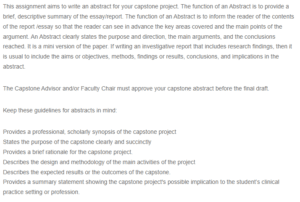
This assignment aims to write an abstract for your capstone project. The function of an Abstract is to provide a brief, descriptive summary of the essay/report. The function of an Abstract is to inform the reader of the contents of the report /essay so that the reader can see in advance the key areas covered and the main points of the argument. An Abstract clearly states the purpose and direction, the main arguments, and the conclusions reached. It is a mini version of the paper. If writing an investigative report that includes research findings, then it is usual to include the aims or objectives, methods, findings or results, conclusions, and implications in the abstract.
Writing an Abstract – Intensive Care Unit Associated Venous Thromboembolisms
The Capstone Advisor and/or Faculty Chair must approve your capstone abstract before the final draft.
Keep these guidelines for abstracts in mind:
Provides a professional, scholarly synopsis of the capstone project
States the purpose of the capstone clearly and succinctly
Provides a brief rationale for the capstone project.
Describes the design and methodology of the main activities of the project
Describes the expected results or the outcomes of the capstone.
Provides a summary statement showing the capstone project’s possible implication to the student’s clinical practice setting or profession.