
Women’s and Men’s Health-Infections
The factors that affect fertility (STDs).
Several factors in the case presented affect fertility. Sexually transmitted infections such as chlamydia and gonorrhea are causal factors for pelvic inflammatory disease. PID can lead to permanent damage to the reproductive organs and consequent infertility. Chlamydia and gonorrhea are STDs of bacterial origin caused by Chlamydia trachomatis and Neisseria gonorrhea. Women can develop PID if these bacteria move up the reproductive tract from the vagina or the cervix to the upper reproductive organs. This may be during sexual intercourse or a result of clonal expansion of the bacteria if left untreated. PID causes tubal damage through an inflammatory process, resulting in infertility (Anyalechi et al., 2019). PID has also been implicated in ectopic pregnancy.
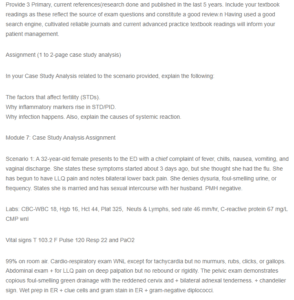
The case presented is of a 32-year-old female with complaints of fever, vaginal discharge, nausea, vomiting, and chills. Assessment findings on the patient reveal the presence of an infection and PID-like symptoms. Features indicative of infection in this patient include fever, elevated WBC, high pulse rate, presence of clue cells on wet prep, and presence of gram-negative diplococci on gram stain. These findings reveal that the patient has a bacterial infection. The gram stain findings highly suggest that the patient has a Neisseria gonorrhea infection. Assessment findings also reveal a high likelihood of PID. The chandelier sign on the patient, bilateral adnexal tenderness, nausea, vomiting, and vaginal drainage on the pelvic exam are highly suggestive of PID (Anyalechi et al., 2019). The patient in the case is at risk for infertility attributable to PID secondary to bacterial infections.
Why do inflammatory markers rise in STD/PID?
Elevated inflammatory markers are a common finding in STDs and PID. A rise in inflammatory markers in PID and STDs is often attributable to pathogen-induced inflammatory responses (Kargaltseva et al., 2019). These responses are part of the innate immunity targeted at fighting infections. STDs, like PID, are mostly of bacterial origin. Bacteremia seen upon contracting these infections elicits an inflammatory response with pro-inflammatory cytokines mediating the release of neutrophils, macrophages, and monocytes to fight the bacteria. This explains the CBC findings seen in bacterial infections causing STDs and PID.
In the patient case presented, WBC levels were found to be high. The C-reactive protein levels were also very high. This reveals the presence of acute inflammation. In the patient case presented, the C reactive protein value was 67mg/dL, up from the normal value of less than 10mg/dL. C-reactive proteins are also involved in activating the complement pathway that regulates various inflammatory responses.
Infections occur when pathogens enter the body. These pathogens may be from external sources or part of the normal flora—infection results when these pathogens get entry into a susceptible host. Entry of pathogens into the human body may occur through various portals, including the skin, mouth, urogenital openings, or wounds that compromise the skin barrier. Upon entering the body, these pathogens multiply. Diseases often result when these pathogens multiply and cause damage to the cells of the body.
Causes of a systemic reaction.
Multiplication and invasion of body cells by pathogens often elicit a systemic response. These systemic responses include immune reactions, inflammation, fever, and sepsis. The pulse rate is also elevated, and blood pressure is lowered. These responses eliminate invading pathogens while maintaining optimal physiologic activity (Gudisa et al., 2021). Microbial multiplications and tissue invasion often trigger systemic responses. The complex interplay of responses that characterizes infection responses is an attempt by the body to maintain homeostasis and eliminate the invading pathogen.
References
Anyalechi, G. E., Hong, J., Kreisel, K., Torrone, E., Boulet, S., Gorwitz, R., Kirkcaldy, R. D., & Bernstein, K. (2019). Self-reported infertility and associated pelvic inflammatory disease among women of reproductive age—National Health and Nutrition Examination Survey, United States, 2013–2016. Sexually Transmitted Diseases, 46(7), 446–451. https://doi.org/10.1097/olq.0000000000000996
Gudisa, R., Goyal, K., Gupta, P., & Singh, M. P. (2021). Localized and systemic immune response in the human reproductive tract. Frontiers in Cellular and Infection Microbiology, 11. https://doi.org/10.3389/fcimb.2021.649893
Kargaltseva, N. M., Kotcherovets, V. I., Mironov, A. Y., Borisova, O. Y., & Burbello, A. T. (2019). Inflammation markers and bloodstream infection (review of literature). Russian Clinical Laboratory Diagnostics, 64(7), 435–442. https://doi.org/10.18821/0869-2084-2019-64-7-435-442
ORDER A PLAGIARISM-FREE PAPER HERE
We’ll write everything from scratch
Question 
Provide 3 Primary, current references(research done and published in the last 5 years. Include your textbook readings as these reflect the source of exam questions and constitute a good review.n Having used a good search engine, cultivated reliable journals and current advanced practice textbook readings will inform your patient management.
Women’s and Men’s Health-Infections
Assignment (1 to 2-page case study analysis)
In your Case Study Analysis related to the scenario provided, explain the following:
The factors that affect fertility (STDs).
Why inflammatory markers rise in STD/PID.
Why infection happens. Also, explain the causes of systemic reaction.
Module 7: Case Study Analysis Assignment
Scenario 1: A 32-year-old female presents to the ED with a chief complaint of fever, chills, nausea, vomiting, and vaginal discharge. She states these symptoms started about 3 days ago, but she thought she had the flu. She has begun to have LLQ pain and notes bilateral lower back pain. She denies dysuria, foul-smelling urine, or frequency. States she is married and has sexual intercourse with her husband. PMH negative.
Labs: CBC-WBC 18, Hgb 16, Hct 44, Plat 325, Neuts & Lymphs, sed rate 46 mm/hr, C-reactive protein 67 mg/L CMP wnl
Vital signs T 103.2 F Pulse 120 Resp 22 and PaO2
99% on room air. Cardio-respiratory exam WNL except for tachycardia but no murmurs, rubs, clicks, or gallops. Abdominal exam + for LLQ pain on deep palpation but no rebound or rigidity. The pelvic exam demonstrates copious foul-smelling green drainage with the reddened cervix and + bilateral adnexal tenderness. + chandelier sign. Wet prep in ER + clue cells and gram stain in ER + gram-negative diplococci.