
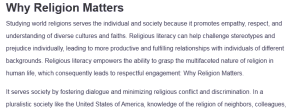
Why Religion Matters
Studying world religions serves the individual and society because it promotes empathy, respect, and understanding of diverse cultures and faiths. Religious literacy can help challenge stereotypes and prejudice individually, leading to more productive and fulfilling relationships with individuals of different backgrounds. Religious literacy empowers the ability to grasp the multifaceted nature of religion in human life, which consequently leads to respectful engagement: Why Religion Matters.
It serves society by fostering dialogue and minimizing religious conflict and discrimination. In a pluralistic society like the United States of America, knowledge of the religion of neighbors, colleagues, and classmates will make the country a stronger society and enable cooperation towards a common good.
Improving Americans’ understanding of the Sikh people, for instance, can greatly enhance the lives of Sikhs living in America. More knowledge about Sikhism, its teachings, its symbols such as the turban, and its values can decrease hate crimes, misidentification, and discrimination. Higher levels of education on minority religions like Sikhism are also associated with lower levels of prejudice and hostility.
Through education, ignorance can be replaced by understanding, and there will be more positive and respectful encounters and inclusive policies that secure the rights and dignity of Sikh Americans. Educational curricula and public information campaigns have the potential to facilitate this process.
Unless citizens are educated about world religions, society risks becoming more polarized and intolerant, perpetuating negative stereotypes that create more social tension and the marginalization of minorities along religious lines. Religious illiteracy may lead to policy that offends or even hostilely targets certain faith communities, undermines international understanding and cooperation, and feeds domestic intolerance (Tadros, 2022).
When individuals misunderstand both the motivations and the nature of religion, they are inclined to accept flawed stereotypes and support punitive legislation. In a global, pluralistic society that values religion, religious ignorance undermines the values of democracy, cultural unity, and peace. A religiously literate society is better equipped to live with differences and build inclusive communities.
References
Tadros, M. (2022). Religious equality and freedom of religion or belief: International development’s blindspot. The Review of Faith & International Affairs, 20(2), 96–108. https://doi.org/10.1080/15570274.2022.2065810
ORDER A PLAGIARISM-FREE PAPER HERE
We’ll write everything from scratch
Question 
NO AI USE AT ALL:
Now that you have reflected on the value of religious literacy, share why the study of the world religions might be beneficial or helpful to you personally and to society. Is there value to religious literacy on the personal and/or political level? For example, how might enhancing Americans’ knowledge of the Sikh people impact the lives of Sikh people in the U.S.? What is at stake in our society if citizens are illiterate when it comes to world religions?
Why Religion Matters