
Week 7 – Critiquing a Quantitative Study
Part 1: EDR-8500 Week 7 Alignment Worksheet
Two dissertations that were selected for analysis are “Hear Their Voices: Black Male Student Perceptions of Retention Initiatives at an HSI in the Midwest” by Watson (2024) and “The Undergraduate in the “New Urban University”: Recognizing the Role of Agency and Its Correlates in the Student’s Academic Life Story” by Galea (2017). Using Miles’ (2017) framework on alignment and the EDR-8500 Week 7 Alignment Worksheet, the core components of each study were charted as follows:
| Dissertation | Method | Design | Analysis |
| Hear Their Voices | Quantitative | Descriptive correlational | Descriptive statistics, t-tests |
| New Urban University | Quantitative | Comparative (causal-comparative) | ANOVA, frequency distributions |
Study 1: Hear Their Voices by Watson (2024)
| Item | Hear Their Voices: Black Male Student Perceptions of Retention Initiatives at an HSI in the Midwest |
| Problem? | There are two main problems that this research study addressed. First, the factors that affect the persistence and retention of Black male college students have not changed substantially over the past 17 years in response to social, political, and economic forces despite increasing Black male enrollment in college and substantial efforts by HEIs. |
| Purpose | The purpose of this study was to explore and understand coping strategies and support systems used by current Black male students who persisted at a Hispanic Serving Institution (HSI), which in this research study will be referred to by a pseudonym as Northsun University. |
| Research Question | What are some of the coping strategies and support systems used by current Black male students who have persisted at this HSI? |
| Design | Non-Experimental Descriptive Correlational |
| Independent Variable
Level of Measurement |
Coping strategies
Ordinal |
| Independent Variable
Level of Measurement |
Support systems
Ordinal |
| Independent Variable
Level of Measurement |
Leadership Style
Ordinal |
| Analysis: Descriptive Method(s) | Frequencies, Means, Percentages |
| Analysis: Inferential Method(s) | t-tests, Correlation |
Study 2: The New Urban University by Galea (2017)
| Item | The Undergraduate in the “New Urban University”: Recognizing the Role of Agency and Its Correlates in the Student’s Academic Life Story |
| Problem? | Modern urban students face unique challenges often neglected in current policies. |
| Purpose | The purpose of this study is to determine which combination of non-academic attributes, and the interplay between them, is most likely to generate and grow academic agency for undergraduate students within a specific environment, particularly the broad-access new urban university. |
| Research Question | These examined how demographic variables influence educational needs and perceptions. |
| Design | Causal-Comparative (non-randomized comparison between existing groups) |
| Independent Variable
Level of Measurement |
Institutional support
Ordinal |
| Independent Variable
Level of Measurement |
Mentorship
Ordinal |
| Analysis: Descriptive Method(s) | Frequencies, Central Tendency |
| Analysis: Inferential Method(s) | ANOVA |
In both cases, the alignment between the problem, purpose, and research questions was consistent, satisfying the criteria of methodological integrity. The choice of design and statistical techniques directly reflected the research aims and supported inferential conclusions appropriate for each context.
Part 2: The Alignment Matrix – for Research Alignment
Using the EDR-8500 Week 7 Alignment Worksheet and Miles (2017), I evaluated the alignment of my dissertation study on academic procrastination, stress, and academic performance among graduate students. The following matrix supports this evaluation:
| Problem Statement | Purpose Statement | Research Questions |
| Graduate student academic procrastination impairs well-being and achievement. | To examine predictive relationships between procrastination and both stress and GPA. | RQ1: To what extent does academic procrastination predict stress?
RQ2: To what extent does academic procrastination predict GPA? |
The three elements of the study (problem, purpose, and research questions) align to a great extent. The issue explicitly defines academic procrastination as a serious obstacle to the well-being and success of graduate students. This question is directly answered in the purpose, which suggests investigating the predictive relations between procrastination and two dependent variables, stress and academic performance. Such uniformity shows a high level of conceptual connection because everything leads to another in a logical manner. The predictive relationships are clearly measured through the research questions (RQs), which makes the study specific in terms of the outcomes that are intended. Alignment is further supported by the fact that the Academic Procrastination Scale (APS) and standardized stress inventories have been specifically designed to measure the constructs outlined. The problem statement establishes the frame of investigation, and the purpose and RQs convert the investigation into quantifiable, testable items that emulate the best practices in quantitative research design.
Statistical alignment is also present. It uses multiple regression analysis, which is suitable by the fact that the variables used are continuous in nature and the objective is not causal but rather predictive associations. According to the SPSS tutorial experience (Week 6), both the level of measurement and the research design are consistent with the choice of regression procedures, which supports the validity of the methodological decisions. Moreover, G*Power analysis done in Week 3 indicates that at least 55 participants are required to identify a medium effect size with sufficient power. This promotes the internal validity of the study since the sample size is adequate. The design is more robust with stratified sampling and repeated measures modeling, as it is possible to better control confounding variables. Finally, the coherence of the elements of the study, that is, problem, purpose, and RQs, follows the recommendations provided by Miles (2017) and Newman and Covrig (2013), which reinforces the overall consistency and methodological soundness of the study.
References
Galea, K. (2017). The undergraduate in the “new urban university”: Recognizing the role of agency and its correlates in the student’s academic life story (Publication No. 292) [Doctoral dissertation]. Digital Commons. https://digitalcommons.nl.edu/diss/292
Miles, D. A. (2017). Achieving alignment: How to achieve research alignment in a study. In Workshop: Confessions of a Dissertation Chair Part 1: The Six Mistakes Doctoral Students Make with the Dissertation.
Newman, I., & Covrig, D. M. (2013). Building consistency between title, problem statement, purpose, & research questions to improve the quality of research plans and reports. New Horizons in Adult Education and Human Resource Development, 25(1), 70–79. https://doi.org/10.1002/nha.20009
Watson, J. (2024). Hear their voices: Black male student perceptions of retention initiatives at an HSI in the Midwest (Publication No. 851) [Doctoral dissertation]. Digital Commons. https://digitalcommons.nl.edu/diss/851
ORDER A PLAGIARISM-FREE PAPER HERE
We’ll write everything from scratch
Question 
Week 7 – Critiquing a Quantitative Study
This assignment has two parts.
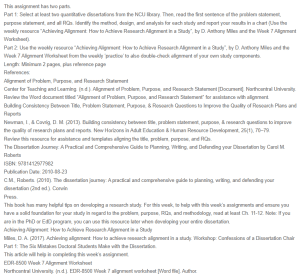
Part 1: Select at least two quantitative dissertations from the NCU library. Then, read the first sentence of the problem statement, purpose statement, and all RQs. Identify the method, design, and analysis for each study and report your results in a chart (Use the weekly resource “Achieving Alignment: How to Achieve Research Alignment in a Study”, by D. Anthony Miles and the Week 7 Alignment Worksheet).
Week 7 – Critiquing a Quantitative Study
Part 2: Use the weekly resource “Achieving Alignment: How to Achieve Research Alignment in a Study”, by D. Anthony Miles and the Week 7 Alignment Worksheet from the weekly ‘practice’ to also double-check alignment of your own study components.
Length: Minimum 2 pages, plus reference page
References:
Alignment of Problem, Purpose, and Research Statement
Center for Teaching and Learning. (n.d.). Alignment of Problem, Purpose, and Research Statement [Document]. Northcentral University.
Review the Word document titled “Alignment of Problem, Purpose, and Research Statement” for assistance with alignment.
Building Consistency Between Title, Problem Statement, Purpose, & Research Questions to Improve the Quality of Research Plans and Reports
Newman, I., & Covrig, D. M. (2013). Building consistency between title, problem statement, purpose, & research questions to improve the quality of research plans and reports. New Horizons in Adult Education & Human Resource Development, 25(1), 70–79.
Review this resource for assistance and templates aligning the title, problem, purpose, and RQs.
The Dissertation Journey: A Practical and Comprehensive Guide to Planning, Writing, and Defending your Dissertation by Carol M. Roberts
ISBN: 9781412977982
Publication Date: 2010-08-23
C.M., Roberts. (2010). The dissertation journey: A practical and comprehensive guide to planning, writing, and defending your dissertation (2nd ed.). Corwin
Press.
This book has many helpful tips on developing a research study. For this week, to help with this week’s assignments and ensure you have a solid foundation for your study in regard to the problem, purpose, RQs, and methodology, read at least Ch. 11-12. Note: If you are in the PhD or EdD program, you can use this resource later when developing your entire dissertation.
Achieving Alignment: How to Achieve Research Alignment in a Study
Miles, D. A. (2017). Achieving alignment: How to achieve research alignment in a study. Workshop: Confessions of a Dissertation Chair Part 1: The Six Mistakes Doctoral Students Make with the Dissertation.
This article will help in completing this week’s assignment.
EDR-8500 Week 7 Alignment Worksheet
Northcentral University. (n.d.). EDR-8500 Week 7 alignment worksheet [Word file]. Author.