
Visual Analysis Essay
The Harlequin Musician is an artwork painted by the Spanish artist Pablo Picasso, who lived from 1881 to 1973. The painting was created in 1924 and is exhibited in the National Gallery of Art. It is a creative work with ambiguity in comprehending its objective and creation, yet captivating through a combination of colors within a single piece: Visual Analysis Essay.
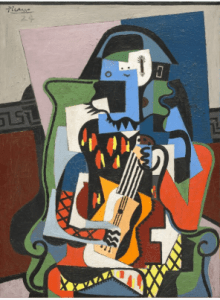
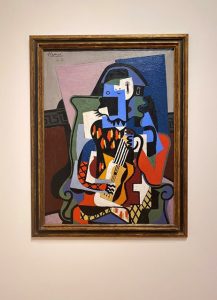
A vertical painting of a harlequin playing a guitar stands out in the artwork. The harlequin and the guitar are well visible due to the contrasting colors – yellow, blue, and red-incorporated in the painting. The piece contains geometric and wavy shapes, portraying a blurred and fragmented vision. The red hues depict the harlequin’s bare body with a diamond-patterned design on the right hand, resembling a harlequin costume.
The black paint used enhances the visual experience of the artwork’s nature. The combination of black grids with red and yellow clearly illustrates the costume. The guitar is prominent due to its large size, with its body marked by orange and black paint. The harlequin’s right hand holds the strings on the lower part of the guitar, while the left hand barely grips the upper strings.
The Harlequin Musician’s artistic style blends Cubism and Neoclassicism[1]. Picasso tends to shift his artistic work toward Neoclassicism as depicted by the forms and structures incorporated in the painting. The painting portrays an abstract presentation, which alters viewers’ realities to an imaginary and symbolic atmosphere.
The artist’s creativity has manipulated this artwork. The blending of colors and shapes makes the Harlequin Musician attractive, provoking critical thinking and keen attention to understanding how it was made. Picasso used oil paints on canvas to create the Harlequin Musician.
Picasso’s Harlequin Musician is a self-portrait of the artist that depicts the struggles and challenges expressed during the period when the artwork was created. Picasso used the Harlequin figure to illustrate his persona and alter ego. The painting was created when Picasso was experiencing marital struggles from his previous relationship with Olga Kokhlova and with his new fiancée, Marie-Thérèse Walter[2].
One can easily interpret the painting as a representation of emotional frustration in the artist’s life. Harlequin Musician also depicts the social role of the artist in society. Picasso played a significant role as a performer, who influenced the credibility of other artists[3]. His role can be illustrated through the guitar, a musical instrument often incorporated in performances.
The Harlequin Musician portrays a conspicuous and striking impression. The painting greatly captured my attention when I noticed the strings resembling my favorite musical instrument. Despite my inability to play the instruments, music carries me away, especially where string instruments are played. Picasso blended the colors of the guitar, making them highly visible.
The painting relaxed my mind, as it truly cultivated the atmosphere that music creates for me. However, the Harlequin Musician presents a contrasting vision through its color and shape combinations. His choice of color exemplifies an outstanding style of art. People are often attracted to art that is brilliant based on the colors incorporated.
Upon seeing the painting, one draws attention to the work, trying to figure out how it was crafted. Ultimately, the visual presentation of the painting prompts viewers to explore and investigate its objectives and significance in the public domain.
The size of the portrait is enormous, essential to the effectiveness of the structure utilized. Apart from the vibrant colors of the painting, the size makes it outstanding. Picasso gives his audience room for different interpretations.
The Harlequin character adds ambiguity to the painting. Viewers can interact with and extract varied perspectives from their understanding of what the artist wanted to convey. Picasso does not restrict his viewers to conform to a specific interpretation of the painting.
Artwork is a significant tool of self-expression and cultural preservation, aiming to impact its audience in a profound way. Picasso’s Harlequin Musician is not an exception. His style, including the figure, structure, and forms in the painting, hosts Cubism and Neoclassicism cultures. Moreover, Harlequin Musician is a personal reflection of the artist’s life.
Picasso depicts his social role and also the personal struggles he was facing, especially in his marriage. Additionally, the painting is a great motivation for the public. Understanding the context around when the painting was created encourages viewers to keep fighting regardless of the struggles and barriers encountered in life.
Picasso might have been at his lowest point in life, but he managed to craft outstanding art, which remains striking despite changes over time and is preserved in the National Gallery of Art.
 Artist: Pablo Picasso
Title: Harlequin Musician
Created Date: 1924
Medium: oil on canvas
Dimensions overall: 130 x 97.2 cm (51 3/16 x 38 1/4 in.)
Framed: 150.8 x 117.8 x 5.7 cm (59 3/8 x 46 3/8 x 2 1/4 in.)
Accession Number: 1989.31.2
Work Cited
Harlequin Musician. National Gallery of Art https://www.nga.gov/artworks/71072-harlequin-musician
[1]Harlequin Musician: National Gallery of Art. https://www.nga.gov/artworks/71072-harlequin-musician
[2]Harlequin Musician: National Gallery of Art. https://www.nga.gov/artworks/71072-harlequin-musician
[3]Harlequin Musician: National Gallery of Art. https://www.nga.gov/artworks/71072-harlequin-musician
ORDER A PLAGIARISM-FREE PAPER HERE
We’ll write everything from scratch
Question 
ART 100 Visual Analysis Essay Spring 2025
Students are required to write one Visual Analysis essay (65 points). This writing assignment focuses on how to describe and evaluate a work of art. A formal analysis is not a research paper; rather, it measures your ability to assess a work of art based on your knowledge of its history, technique, process, and information from the object. This requires close looking and spending time with an object.
Logistics:
- Begin by selecting one of the objects from the approved list below.
- These images are on view at the National Gallery of Art in Washington, DC
- Alternatively, students can also propose an object from the collection that is currently on view. This object must be approved by Dr. Hunt at least two weeks in advance of the assignment deadline.
What to do when viewing an object:
Bring a pencil (no pens allowed) and a piece of paper to the museum so that you can write down the information on the museum label for your object [if available: artist (if known), title, date, style, medium, size, and accession number].
- What does this information tell you about the object, i.e., for whom was it made?
- What kind of purpose did it serve? What subject does it depict?
- How was it made? What material did the artist use?
- Next, look carefully at your object. What do you notice about it? What kind of impression do you think the artist and patron wanted the viewer to get from the object?
Visual Analysis Essay
You may also want to bring the Context-Subject-Style sheet to help you start thinking of questions about the object. (ATTACHED)
You should also bring a camera or camera phone to snap a photo of your object so you can refer to it later and include it as a part of your final essay.
Mechanics for Writing the Visual Analysis
Your short essay will bring your notes and observations together. Begin with an introduction that identifies the work of art you have chosen, and a thesis statement that suggests the overall idea or impression you have developed about it. Then, in the body of your essay, describe the object in detail and discuss the aspects mentioned above: the context, the subject, the style, etc.
Finally, your essay should have a conclusion, in which you summarize your thoughts. For an example of a visual analysis, see the sample essay by Sylvan Barnet under the Writing Assignments tab on Canvas (ATTACHED).
You will not need any outside research sources for this assignment beyond the museum label and your own eyes. Wherever you use information from the museum label, include a footnote at the end of that sentence that gives the label information and the object’s accession number (see the example at the end of this sentence).
To insert a footnote, click on the “References” tab in Microsoft Word, and select “insert footnote.” Remember that all information you take from the museum label must be cited.
All papers must have a minimum 750 words, formatted to 8.5 x 11-inch paper with 1-inch margins written in Times New Roman font 12 point. All papers need to have an attached image of yourself at the museum in front of the object to receive full credit. All papers are due on June 28, 2025 at 11:59 PM EST submitted directly to the Canvas course page.
Client’s Notes:
- I love music, and the strings are my favorite instrument, but I can’t play any instrument. I write poetry, if any of that helps. Thank you
- Please check and follow the rubric (ATTACHED)