
Video Script – Reflection on the Theory of Planned Behavior(TPB)
Hello and welcome!
My name is Sherita Dobbins, and today, I’ll be discussing the Theory of Planned Behavior, one of the most widely used models in health education and health promotion. This theory enables one to explain why and how people make specific health-related decisions and how improvements can be made toward the achievement of these decisions.
What is the theory of planned behavior?
Let’s start with the big picture.
Icek Ajzen developed the Theory of Planned Behavior (TPB) in the late 1980s. It builds on the Theory of Reasoned Action by adding one important piece—perceived behavioral control. According to Ajzen, intention is the best predictor of whether a person will engage in a recommended behavior or not. In other words, intention presupposes a plan through which someone is more likely to act—provided that they think it feasible. According to TPB, intention is determined by three components, namely attitude toward the behavior, subjective norms, and perceived behavior control. These three elements constitute the fundamentals of the model.
Let’s break down each of the theory’s core constructs.
Attitude toward the behavior refers to whether someone thinks the behavior is a good idea. Do they see it as beneficial, enjoyable, or useful? If someone believes exercising regularly will make them healthier and feel better, they’ll likely have a more positive attitude and be more motivated to do it.
Subjective norms are about social influence. This means the person’s perception of whether the people around them—like friends, family, or even society—think they should engage in the behavior. If everyone in a person’s circle supports healthy eating, that person may feel encouraged to eat healthier, too.
Perceived behavioral control is about how easy or hard someone thinks it is to perform the behavior. It includes things like time, money, access to resources, and confidence. Even if someone wants to work out, if they don’t feel like they have enough time or don’t think they can stick to a routine, they may not do it. When all three of these elements are aligned positively, the person’s intention to perform the behavior is strengthened, making it more likely that they will actually take action.
Now let’s delve into the strengths and limitations of TPB.
Like any model, the Theory of Planned Behavior has its pros and cons.
On the positive side, TPB has huge generalizability and has been used to predict a diverse range of health behaviors, including smoking cessation, dietary behaviors, and physical activity. Educationists are able to find out where to target within this framework, be it changing the individual’s attitudes, their viewpoint of the society, or their self-beliefs and overcomes.
However, the theory does have limitations. It assumes that people always make rational decisions, which isn’t always true. Lack of willpower due to different emotions, past habits, or mental disorders may prevent a person from going through with what he or she intended (Sharma, 2022). Furthermore, TPB underemphasizes the component of intention, whereas individuals do not always follow through with their intentions due to barriers that are not always anticipated. Last, it seems that TPB fails to consider cultural or environmental factors and this can be extremely essential when targeting people from different cultures.
Applying TPB to Physical Activity
To further explain how TPB can be applied, let us discuss how it can be employed to increase physical activity among college students. A College student is at the crossroads of their information quest through their competent behaviors, thus making it essential to target such a group in efforts to boost their physical activity.
When adopting TPB, health educators would first address the attitudes by familiarizing them with the effects of exercise, such as increased energy productivity, improved mental health, and better grades. Such outcomes should be positively reinforced because they are likely to influence the student’s attitude towards exercise.
Secondly, through perceived behavioral control, health educators would facilitate the establishment of exercise buddies in the hope that, where the student ‘feel’ compelled to follow suit in performing the intended behavior with a peer in exercise routes, they will feel compelled to partake in other exercise routines as well. This is because when students notice their companions exercising, they may wish to imitate them due to the pressure that is exerted by their side.
Last of all, regarding perceived behavioral control, educators seek to provide chosen students with motivational exercise resources, including affordable campus gym membership, exercise classes, or exercise space that is easily available (Sharma, 2022). When the students realize that they have the required resources and the self-confidence to exercise, they will proceed to exercise as intended.
Attitudes, subjective norms, and perceived behavioral control are the three constructs that, when targeted by health educators, will ensure a high probability of behavioral change in this important population that is going to engage in normal physical activity.
In conclusion,
The Theory of Planned Behavior gives us a strong, research-backed way to understand and influence health behaviors. Although not entirely effective, its concentration on intention and the concepts that underlie it make this tool useful for health education. Therefore, to design effective interventions that can have an impact, it takes work on attitudes, norms, and perceived control.
Thank you for taking the time to explore TPB with me today!
References
Sharma, M. (2022). Theoretical foundations of health education and health promotion (4th ed.). Jones & Bartlett.
ORDER A PLAGIARISM-FREE PAPER HERE
We’ll write everything from scratch
Question 
Video Script – Reflection on the Theory of Planned Behavior(TPB)
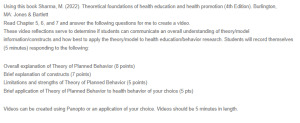
Using this book Sharma, M. (2022). Theoretical foundations of health education and health promotion (4th Edition). Burlington,
MA: Jones & Bartlett
Read Chapter 5, 6, and 7 and answer the following questions for me to create a video.
These video reflections serve to determine if students can communicate an overall understanding of theory/model information/constructs and how best to apply the theory/model to health education/behavior research. Students will record themselves (5 minutes) responding to the following:
Reflection on the Theory of Planned Behavior
Overall explanation of Theory of Planned Behavior (8 points)
Brief explanation of constructs (7 points)
Limitations and strengths of Theory of Planned Behavior (5 points)
Brief application of Theory of Planned Behavior to health behavior of your choice (5 pts)
Videos can be created using Panopto or an application of your choice. Videos should be 5 minutes in length.