
Usage, Mechanisms, Side Effects, and Interactions of Medications
Q1. Recommended Medications
The patient had a positive diagnosis of chlamydia, pneumonia, and seasonal allergies. Recommended medications to start on this patient include azithromycin, acetaminophen, and cetirizine. Azithromycin is the generic name for a macrolide antibiotic. Its trade name in the U.S. is Zithromax. Azithromycin is administered on a 3- or 5-day regimen, with both regimens maintaining similar efficacy against chlamydial pneumonia (Socan, 2016). The three-day regimen is given in single 24-hour doses of 500mg, while the 5-day regimen consists of a 500mg single dose on the first day followed by 250mg every 24 hours for four days. Do you need urgent assignment help ? Get in touch with us at eminencepapers.com. We endeavor to provide you with excellent service.
Cetirizine is an antihistamine with the trade name Zyrtec in the U.S. Zyrtec is started at 5mg once daily with a maximum daily dose of 10mg for allergic reactions. Acetaminophen is an antipyretic analgesic with the trade name Tylenol, Mapap, or Panadol in the U.S. The starting dose for Tylenol is 650mg every 4 to 6 hours in managing fever to a maximal amount of 3250mg per day in divided doses.
Q2. Mechanism of Action
Azithromycin is a macrolide antibiotic that is bacteriostatic against susceptible bacteria. It binds to the 50s ribosomal subunit of bacterial ribosome, thereby inhibiting bacterial protein synthesis. Azithromycin also interferes with bacterial quorum sensing and biofilm formation (Parnham et al., 2017). Azithromycin is effective against respiratory and urogenital bacterial infections, among others.
Zyrtec is an antihistamine that is selective to the peripheral H1 histaminic receptors. Cetirizine inhibits histaminic actions on all cells with a preferential blockade on the respiratory smooth muscle cells, immune cells, vascular smooth muscles, and the gastrointestinal tract (Corsico et al., 2019). It thus reduces fluid secretions and consequent congestion attributable to allergic reactions, such as reactions seen in allergic rhinitis.
Acetaminophen is a centrally-acting antipyretic analgesic. It works in the central nervous system to inhibit the cyclooxygenase pathway, thus resulting in its antipyretic and mild analgesic effects (Ayoub, 2021). Acetaminophen has been used in the management of mild pain and fever.
Q3. Side Effects
Azithromycin is a relatively safe drug that is pretty well tolerated by a majority of the population. It, however, produces side effects of QT prolongation, tachycardia, nausea, diarrhea, and hepatotoxicity. Hypersensitive reactions have also been recorded, with some cases being severe, as seen in Steven Johnson syndrome attributable to azithromycin use.
Zyrtec is somewhat tolerated, although the side effects of fatigue, pharyngitis, drowsiness, and dry mouth are often present. Other minor side effects after prolonged use include hepatitis, anemia, and hypersensitivity (Corsico et al., 2019). Acetaminophen is relatively safe, but at high doses, hepatotoxicity has been recorded. Other minor side effects include hypertension and hypersensitivity (Ayoub, 2021).
Q4. Drug-Drug Interactions
Both Azithromycin and Zyrtec produce mild QT prolongation as a side effect. Therapeutic regimens that include both drugs may lead to pronounced QT interval prolongation due to the additive effects of the two drugs.
Q5. Non-Pharmacological Interventions
Self-care to limit exposure to allergy triggers is necessary as an intervention to prevent allergic reactions. Subcutaneous allergen immunotherapy subcutaneous immunotherapy is also an intervention utilized in allergic rhinitis. This therapy involves gradually administering increasing amounts of an allergen to an individual (Kamlesh Kumar & Mila Nu Nu, 2020). This intervention is targeted at tempering the immune response and alleviating the symptoms of allergic rhinitis.
References
Ayoub, S. (2021). Paracetamol (acetaminophen): A familiar drug with an unexplained mechanism of action. Temperature, 8(4), 351-371. https://doi.org/10.1080/23328940.2021.1886392
Corsico, A., Leonardi, S., Licari, A., Marseglia, G., Miraglia del Giudice, M., & Peroni, D. et al. (2019). Focus on the cetirizine use in clinical practice: a reappraisal 30 years later. Multidisciplinary Respiratory Medicine, 14(1). https://doi.org/10.1186/s40248-019-0203-6
Kamlesh Kumar, D., & Mila Nu Nu, H. (2020). Pathophysiology and Non-Pharmacological Management of Allergic Rhinitis. International Archives Of Public Health And Community Medicine, 4(3). https://doi.org/10.23937/2643-4512/1710050
Parnham, M., Haber, V., Giamarellos-Bourboulis, E., Perletti, G., Verleden, G., & Vos, R. (2017). Azithromycin: Mechanisms of action and their relevance for clinical applications. Pharmacology & Therapeutics, 143(2), 225-245. https://doi.org/10.1016/j.pharmthera.2014.03.003
Socan, M. (2016). Treatment of Atypical Pneumonia with Azithromycin: Comparison of a 5-Day and a 3-Day Course. Journal Of Chemotherapy, 10(1), 64-68. https://doi.org/10.1179/joc.1998.10.1.64
ORDER A PLAGIARISM-FREE PAPER HERE
We’ll write everything from scratch
Question 
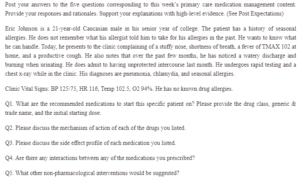
Post your answers to the five questions corresponding to this week’s primary care medication management content. Provide your responses and rationales. Support your explanations with high-level evidence. (See Post Expectations)
Usage, Mechanisms, Side Effects, and Interactions of Medications
Eric Johnson is a 21-year-old Caucasian male in his senior year of college. The patient has a history of seasonal allergies. He does not remember what his allergist told him to take for his allergies in the past. He wants to know what he can handle. Today, he presents to the clinic complaining of a stuffy nose, shortness of breath, a fever of TMAX 102 at home, and a productive cough. He also notes that over the past few months, he has noticed a watery discharge and burning when urinating. He does admit to having unprotected intercourse last month. He undergoes rapid testing and a chest x-ray while in the clinic. His diagnoses are pneumonia, chlamydia, and seasonal allergies.
Clinic Vital Signs: BP 125/75, HR 116, Temp 102.5, O2 94%. He has no known drug allergies.
Q1. What are the recommended medications to start this specific patient on? Please provide the drug class, generic & trade name, and the initial starting dose.
Q2. Please discuss the mechanism of action of each of the drugs you listed.
Q3. Please discuss the side effect profile of each medication you listed.
Q4. Are there any interactions between any of the medications you prescribed?
Q5. What other non-pharmacological interventions would be suggested?