
Unit 1 Individual Project: Performance Management
Performance management is a crucial aspect of managing organizations. It ensures that organizational processes and employee activities align well with the organizational strategy. When considering a start-up tech company, performance management is critical to ensuring operational execution and leadership vision. Essentially, this is because a start-up tech company will require speed, innovation, and collaboration (Giacomelli et al., 2024). The information in this paper defines performance management, discusses its importance to organizations, and outlines the significant components of an effective performance management system. Further, the paper identifies the necessary factors for managers and employees to successfully implement a performance management system effectively. The coverage of these aspects highlights how a successful start-up can foster sustained growth and long-term competitiveness.
What is performance management?
According to Bauwens et al. (2024), performance management is a continuous process that entails planning, monitoring, reviewing, and improving performance to achieve organizational objectives. The process emphasizes continuous communication between employers and employees by aligning individual objectives with the company’s strategic priorities. Ideally, it does not care much about evaluating past performance. Instead, it considers developing employee potential to overcome challenges in real time. In the contemporary world, performance management ensures clear expectations are set, regular feedback is provided, identification of training needs, and recognition of attained goals. Therefore, performance management forms a basis for measuring developmental processes and supports employees consistently to achieve overall business success.
Why is performance management important to organizations?
A direct association exists between performance management and organizational productivity, employee satisfaction, and strategic alignment. Accordingly, performance management is critical in numerous ways. First, it assists employees in working toward a common goal. Essentially, this is an important success aspect for start-ups, which are often characterized by limited resources. Second, an efficient performance management system creates a culture of accountability and transparency. When effectively implemented, it makes it easier to identify better-performing employees and performance gaps. Third, an effective performance management system assists in offering clear development pathways—this occurs through employee engagement. When a structured performance management system is not in place, there is a risk of misaligned organizational efforts, reduced morale, and decreased market competitiveness (Cosa & Torelli, 2024). This can prove costly for tech start-ups, which could mean missed opportunities.
What are the components of a performance management system?
An effective performance management system consists of several interconnected components. The first one is goal setting. Notably, defining organizational objectives ensures that all activities contribute to overarching business priorities. Second, regular constructive feedback is necessary to help employees understand their progress and areas for improvement. The third component is performance appraisal. A performance management system should offer periodic evaluations that are crucial in assessing the overall performance of employees against their set goals. Fourth, a good performance management system should embrace learning and development. Notably, this is so because opportunities for skill development will mean that employees will be empowered to adapt to evolving business needs and technological changes. Fifth, there needs to be recognition and rewards in an efficient performance management system. When this is done, desired behaviors are reinforced as employees get motivated to excel. Rewards and recognition can entail monetary incentives, promotions, and public acknowledgements. Lastly, an effective performance management system should be characterized by accurate record-keeping that enables organizations to track trends, measure the effectiveness of performance initiatives, and make informed HR decisions.
What factors do managers and employees need to succeed in an effective performance management system?
Managers and employees can engage in many activities to succeed in an effective performance management system. First, there is a need for clear communication. Regarding communication, managers should communicate performance expectations clearly, while employees need to feel comfortable discussing matters around their job. Second, there is a need for manager training. Notably, this will ensure managers have practical performance evaluation skills to avoid biased and unhelpful evaluations. Third, there should be employee buy-in to the performance management system. Essentially, this can assist in reducing resistance to change, and this can be attained through understanding the benefits of performance management. Fourth, there needs to be access to resources for both employees and managers. Resources such as finances and technology are crucial for success. Fifth, there needs to be a consistent follow-up whereby performance management should be undertaken as an ongoing process rather than a one-time event. Lastly, there should be organizational cultural support for the performance management system. A culture that values learning, accountability, and collaboration should be reinforced among managers and employees.
Conclusion
Overall, performance management is a process with no end. The process ensures employee activities are aligned with organizational objectives. Notably, this happens through monitoring, feedback, and development. Performance management is essential for organizations as it can be the primary driver for strategic alignment, employee engagement, and better productivity. Therefore, an effective performance management system should incorporate crucial aspects like goal setting, feedback, appraisals, recognition, and accurate documentation. In the case of a start-up tech company’s case, implementing a performance management system can be the driver behind sustained growth and innovation. Further, it can enhance the start-up’s competitiveness in the rapidly changing marketplace.
References
Cosa, M., & Torelli, R. (2024). Digital transformation and flexible performance management: A systematic literature review of the evolution of performance measurement systems. Global Journal of Flexible Systems Management, 25(3), 445–466. https://link.springer.com/article/10.1007/s40171-024-00409-9
Bauwens, R., Audenaert, M., & Decramer, A. (2024). Performance management systems, Innovative work behavior and the role of transformational leadership: An experimental approach. Journal of Organizational Effectiveness: People and Performance, 11(1), 178–195. https://doi.org/10.1108/JOEPP-03-2022-0066
Giacomelli, G., Micacchi, M., & Micacchi, L. (2024). Performance shall not live by results alone: Organizational subcultures and perceived performance in public administration. Public Money & Management, 44(6), 500–514. https://doi.org/10.1080/09540962.2023.2295366
ORDER A PLAGIARISM-FREE PAPER HERE
We’ll write everything from scratch
Question 
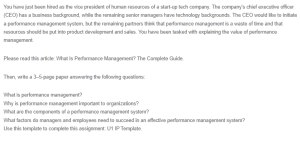
You have just been hired as the vice president of human resources of a start-up tech company. The company’s chief executive officer (CEO) has a business background, while the remaining senior managers have technology backgrounds. The CEO would like to initiate a performance management system, but the remaining partners think that performance management is a waste of time and that resources should be put into product development and sales. You have been tasked with explaining the value of performance management.
Unit 1 Individual Project – Performance Management
Please read this article: What Is Performance Management? The Complete Guide.
Then, write a 3–5-page paper answering the following questions:
What is performance management?
Why is performance management important to organizations?
What are the components of a performance management system?
What factors do managers and employees need to succeed in an effective performance management system?
Use this template to complete this assignment: U1 IP Template.