
Understanding Neurobiology – Neurons, Subcortical Structures, Glia Cells, Synapses, and Neuroplasticity
A neuron is a basic unit of the nervous system. The anatomy of a neuron is made up of a cell body that houses the nucleus, dendrites, axons, and synaptic terminals (Camprodon & Roffman, 2016). When a neuron is activated, electrical impulse conduction occurs, and the dendrites receive incoming signals, such as from a hot or cold surface. The electrical signal travels to the cell body, where the axon picks them up and moves them toward the synaptic terminals (Caire et al., 2022). Due to the signal, the synaptic terminals trigger neurotransmitters into the synaptic cleft, then bind to receptors on the postsynaptic neuron, which then propagates the electrical impulse (Chen & Lui, 2019).
The major subcortical structures include
- Diencephalon
- Pituitary gland
- Limbic structures
- Basal ganglia.
- Which component plays a role in learning, memory, and addiction?
The hippocampus, amygdala, and striatum play a role in the development of addiction and earning and memory (Klenowski et al., 2015).
- What are the two key neurotransmitters located in the nigra striatal region of the
brain that plays a major role in motor control?
The two key neurotransmitters contained in the nigra striatal region of the brain are dopamine and the striatum (Goodman & Packard, 2016).
The glia cells’ role is to support neural function in the nervous system providing required nutrition and maintaining optimal homeostasis (Camprodon & Roffman, 2016). The glia cells also support the development of the blood-brain barrier. The glia cells further repair and support the regeneration of neural tissue. Microglia, such as the astrocytes, play a role in synapse maintenance and myelinating axons (Camprodon & Roffman, 2016).
The presynaptic neuron and the postsynaptic neuron communicate at the synapse. The presynaptic neuron’s synaptic terminals trigger the release of neurotransmitters into the synaptic cleft (Caire et al., 2022). The neurotransmitters cross the chemical or electric synaptic cleft to bind to the receptors of the receiving postsynaptic neuron.
Neuroplasticity is the brain’s ability to change and adapt to changes in its chemical composition within its lifetime. It involves neurons reorganizing themselves and forming new connections as they adjust to a new context or environment. For instance, the neurons can form new connections as they adjust their activity due to stimulations from certain drugs over time, creating an addiction.
References
Caire, M. J., Reddy, V., & Varacallo, M. (2022). Physiology, Synapse. StatPearls. https://www.ncbi.nlm.nih.gov/books/NBK526047/
Camprodon, J. A., & Roffman, J. L. (2016). Psychiatric neuroscience: Incorporating pathophysiology into clinical case formulation. In Theodore. A. Stern, M. Fava, T. E. Wilens, & J. F. Rosenbaum (Eds.), Massachusetts General Hospital Psychopharmacology and Neurotherapeutics (1st ed., pp. 1–19). Elsevier.
Chen, I., & Lui, F. (2019). Neuroanatomy, Neuron Action Potential. StatPearls. http://europepmc.org/books/NBK546639
Goodman, J., & Packard, M. G. (2016). Memory systems and the addicted brain. Frontiers in Psychiatry, 7(FEB), 24. https://doi.org/10.3389/FPSYT.2016.00024/BIBTEX
Klenowski, P., Morgan, M., & Bartlett, S. E. (2015). The role of δ-opioid receptors in learning and memory underlying the development of addiction. British Journal of Pharmacology, 172(2), 297–310. https://doi.org/10.1111/BPH.12618
ORDER A PLAGIARISM-FREE PAPER HERE
We’ll write everything from scratch
Question 
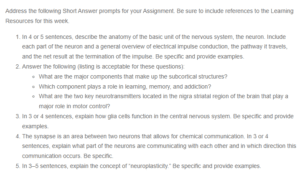
Understanding Neurobiology
Address the following Short Answer prompts for your Assignment. Be sure to include references to the Learning Resources for this week.
- In 4 or 5 sentences, describe the anatomy of the basic unit of the nervous system, the neuron. Include each part of the neuron and a general overview of electrical impulse conduction, the pathway it travels, and the net result at the termination of the impulse. Be specific and provide examples.
- Answer the following (listing is acceptable for these questions):
- What are the major components that make up the subcortical structures?
- Which component plays a role in learning, memory, and addiction?
- What are the two key neurotransmitters located in the nigra striatal region of the brain that play a major role in motor control?
- In 3 or 4 sentences, explain how glia cells function in the central nervous system. Be specific and provide examples.
- The synapse is an area between two neurons that allows for chemical communication. In 3 or 4 sentences, explain what part of the neurons are communicating with each other and in which direction this communication occurs. Be specific.
- In 3–5 sentences, explain the concept of “neuroplasticity.” Be specific and provide examples.