
Tobacco Use Disorders and Nicotine Replacement Gum
Tobacco use disorder refers to compulsive tobacco use and dependence on nicotine and the inability to quit the use despite bearing adverse health and social repercussions. This condition is still one of the leading causes of morbidity and mortality throughout the world that could be prevented (Leone & Evers-Casey, 2022). It is for this reason that knowledge of the effects of nicotine dependency, the medications, and therapies, including nicotine gum, would prove critical for psychiatric-mental health nurse practitioners (PMHNPs).
Diagnostic Criteria for Tobacco Use Disorder
The Diagnostic and Statistical Manual of Mental Disorders, Fifth Edition (DSM-5) has established specific diagnostic criteria for tobacco use disorder. It entails the inability to cut down the use of tobacco in the desired manner, using tobacco more often or in greater quantities than planned, repeated efforts to quit and failed attempts, and the experience of a strong desire to use tobacco along with continued tobacco use regardless of health issues (American Psychiatric Association, 2022). Other criteria include dependence and withdrawal, as well as giving up different activities to use tobacco. Diagnosis can be made if the afflicted patient meets at least two of these criteria for twelve months.
Street Names and Methods of Use
Tobacco is commonly referred to by the street names: “smokes,” “chew,” “dip,” and “cigs.” Tobacco is used in many forms and ways; the most common types are smoking, chewing, or snuffing (Cornelius et al., 2023). Nicotine, the addictive substance, is readily absorbed through the mucous membranes or the lungs, resulting in quick onset of effects.
Symptoms of Use and Withdrawal Symptoms
Some of the effects that go with the use of nicotine include increased alertness, elated mood, poor appetite, tachycardia, and hypertension. However, such effects are temporary and lead to ongoing use in order to sustain the high level of stimulation. Withdrawal symptoms usually commence within a few hours post-cessation of tobacco use and may include irritability, anxiety, trouble with concentration, agitation, insomnia, and an increase in appetite (Kaye et al., 2020). These symptoms can significantly complicate the attempt to quit.
Treatment Recommendations
Behavioral and pharmacological interventions are recommended for first-line treatment for tobacco use disorder. According to Theodoulou et al. (2023), Nicotine replacement therapy (NRT), like nicotine replacement gum, is approved by The United States Food and Drug Administration (FDA) and is a pharmacotherapy that is commonly utilized for the management of craving and withdrawal syndromes. It is acknowledged as safe and effective for those who want to quit and are willing to do so.
Mechanism of Action
The mechanism of action of nicotine gum is that it delivers nicotine in a controlled manner via the oral mucosa. The nicotine then gets access to the bloodstream to bind with the nicotinic receptors in the ventral tegmental area of the brain, and subsequently, the nucleus accumbens releases dopamine (Devi et al., 2020). This assists in reducing the extent of withdrawal signs and also minimizes the temptation to smoke due to the maintenance of steady and small concentrations of nicotine within the blood.
Common Side Effects
Some of the side effects of nicotine replacement gum are quite mild and include irritation of the throat, hiccups, discomfort in the jaw, and nausea (Devi et al., 2020). These are mostly short-term and could be reduced if good chewing habits are embraced.
Administration and Dosage
Nicotine gum is available in two forms, 2 mg and 4 mg pieces. The 2 mg dose should be taken in cases when the patient smokes fewer than 25 cigarettes per day, and the 4 mg per case is for those who smoke more (CDC, 2021). The gum should be chewed slowly until it produces a tingling sensation, and then it should be parked between the cheek and the gum. This should then be repeated for approximately 30 minutes. It is recommended that patients should use one piece every 1–2 hours in the first six weeks and reduce it gradually in the next 12 weeks.
Baseline and Ongoing Assessments
The baseline assessments should comprise assessing smoking history, a patient’s readiness for smoking cessation, and the presence of comorbidities such as cardiovascular diseases (Sandhu et al., 2023). Ongoing monitoring also involves evaluating adherence to the intervention, monitoring side effects, and tracking the patient’s progress in meeting the cessation goals.
Non-Pharmacologic Interventions
Several measures can be taken alongside nicotine gum. Some of them are cognitive behavioral therapy (CBT), motivational interviewing, and involvement in support groups (Vinci, 2020). Other strategies that can be implemented include modifying lifestyle through exercise and stress management to prevent relapse.
Conclusion
Tobacco use disorder is still a significant and complex issue in society. With pharmacologic and non-pharmacologic strategies such as nicotine replacement gum, PMHNPs play a crucial role in enhancing cessation outcomes while engaging a patient-centered approach. Educating and continuing to influence and follow up on patients can enable them to take control of their lives from nicotine dependence.
References
American Psychiatric Association. (2022). Diagnostic and statistical manual of mental disorders (DSM-5-TR). Psychiatry.org; American Psychiatric Association. https://www.psychiatry.org/psychiatrists/practice/dsm
CDC. (2021, July 9). How to use nicotine gum | quit smoking | tips from former smokers. Www.cdc.gov. https://www.cdc.gov/tobacco/campaign/tips/quit-smoking/quit-smoking-medications/how-to-use-quit-smoking-medicines/how-to-use-nicotine-gum.html
Cornelius, M. E., Loretan, C. G., Jamal, A., Lynn, B. C. D., Mayer, M., Alcantara, I. C., & Neff, L. (2023). Tobacco product use among adults – United States, 2021. MMWR Morbidity and Mortality Weekly Report, 72(18), 475–483. https://doi.org/10.15585/mmwr.mm7218a1
Devi, R. E., Barman, D., Sinha, S., Hazarika, S. J., & Das, S. (2020). Nicotine replacement therapy: A friend or foe. Journal of Family Medicine and Primary Care, 9(6), 2615–2620. https://doi.org/10.4103/jfmpc.jfmpc_313_20
Kaye, J. T., Baker, T. B., Beckham, J. C., & Cook, J. W. (2020). Tobacco withdrawal symptoms before and after nicotine deprivation in veteran smokers with posttraumatic stress disorder and with major depressive disorder. Nicotine & Tobacco Research, 23(7), 1239–1247. https://doi.org/10.1093/ntr/ntaa242
Leone, F. T., & Evers-Casey, S. (2022). Tobacco use disorder. Medical Clinics of North America, 106(1), 99–112. https://doi.org/10.1016/j.mcna.2021.08.011
Sandhu, A., Hosseini, S. A., & Saadabadi, A. (2023, November 12). Nicotine replacement therapy. StatPearls – NCBI Bookshelf. https://www.ncbi.nlm.nih.gov/books/NBK493148/
Theodoulou, A., Chepkin, S. C., Ye, W., Fanshawe, T. R., Bullen, C., Hartmann-Boyce, J., Livingstone-Banks, J., Hajizadeh, A., & Lindson, N. (2023). Different doses, durations and modes of delivery of nicotine replacement therapy for smoking cessation. Cochrane Library, 2023(6). https://doi.org/10.1002/14651858.cd013308.pub2
Vinci, C. (2020). Cognitive behavioral and mindfulness-based interventions for smoking cessation: A review of the recent literature. Current Oncology Reports, 22(6), 58. https://doi.org/10.1007/s11912-020-00915-w
ORDER A PLAGIARISM-FREE PAPER HERE
We’ll write everything from scratch
Question 
Tobacco Use Disorders and Nicotine Replacement Gum
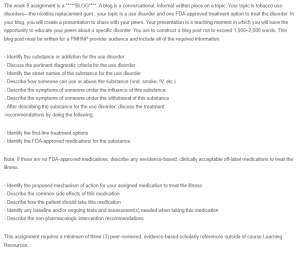
The week 9 assignment is a *****BLOG****. A blog is a conversational, informal written piece on a topic. Your topic is tobacco use disorders—the nicotine replacement gum ; your topic is a use disorder and one FDA-approved treatment option to treat the disorder. In your blog, you will create a presentation to share with your peers. Your presentation is a teaching moment in which you will have the opportunity to educate your peers about a specific disorder. You are to construct a blog post not to exceed 1,500–2,000 words. This blog post must be written for a PMHNP provider audience and include all of the required information:
Tobacco Use Disorders and Nicotine Replacement Gum
– Identify the substance or addiction for the use disorder
– Discuss the pertinent diagnostic criteria for the use disorder
– Identify the street names of the substance for the use disorder
– Describe how someone can use or abuse the substance (oral, smoke, IV, etc.)
– Describe the symptoms of someone under the influence of this substance
– Describe the symptoms of someone under the withdrawal of this substance
– After describing the substance for the use disorder, discuss the treatment.
-recommendations by doing the following:
– Identify the first-line treatment options
– Identify the FDA-approved medications for the substance.
Note: If there are no FDA-approved medications, describe any eevidence-based, clinically acceptable off-label medications to treat the illness.
– Identify the proposed mechanism of action for your assigned medication to treat the illness
– Describe the common side effects of this medication
– Describe how the patient should take this medication
– Identify any baseline and/or ongoing tests and assessment(s) needed when taking this medication
– Describe the non-pharmacologic intervention recommendations
This assignment requires a minimum of three (3) peer-reviewed, evidence-based scholarly references outside of course Learning Resources.
Note: You will need to include the APA formatting citation of all references used with a Reference list.
My topic is Tobacco Use Disorders – Nicotine replacement gum
AGAIN THIS IS A BLOG NO MORE THEN 2000 words