
Theorist Research Project: Jean Piaget and Lev Vygotsky
Jean Piaget
Piaget was born on 9th August 1896, in Neuchâtel, Switzerland, and passed on in 1980 in Geneva. He was the firstborn child of Arthur Piaget and Rebecca Jackson. Piaget was the most influential psychologist of the 20th century, known for his theory of intellectual development in children. Piaget’s father was a literature professor with an interest in local history and education. The character of his mother, intelligent yet neurotic, influenced Piaget’s love for psychology. At the age of ten, Piaget published his first article, and by 15, he had published numerous articles that earned him great recognition. However, during his later teenage years, the contradictory aspects of religion and science motivated him to research the nature of knowledge, which became the foundation of his life’s work (Kurt).
Piaget’s passion for biology drew his curiosity to understand the development of the mind in knowledge acquisition. He observed how infants interact, associate, and accommodate objects, marking the foundation of his approach to child psychology. Jean developed four stages of cognitive development to explain his observations. The first stage, sensorimotor, lasts from a child’s birth to two years, where a child familiarizes themselves with their surroundings. The child uses their senses and movements to experience the environment. The second stage, preoperational reasoning, lasts from two to seven years. Language development accelerates as the child begins to mimic the people around them. The child uses their memory and imagination to reconnect past, present, and future aspects, often using symbols as representations of things. The third stage, from seven to eleven years, is called concrete operational. In this stage, the child uses logical reasoning skills to assimilate what they see and hear. The child acknowledges the influence of external aspects while making personal decisions and judgments. Finally, the formal operational stage occurs from eleven years and older, where the child applies systematic reasoning to abstract concepts, enhancing problem-solving skills (Kurt). Key terms in the theory include assimilation, accommodation, adaptation, and equilibrium.
According to Piaget’s cognitive development theory, parents and caregivers have a vital role in the development of a child. Caregivers should provide a supportive environment for children in all their developmental stages to foster effective cognitive growth. The environment should stimulate growth by promoting exploration and providing play tools, such as toys, to enhance their senses, movements, critical thinking, and logical reasoning through active experiences and exposure.
Lev Vygotsky
Vygotsky was born on 17th November 1896, in Orsha, and passed on in 1934 in Moscow. He was born into a middle-class Jewish family. Vygotsky initially received education through home schooling and later enrolled in a private Jewish school, where he earned a formal degree. He eventually attended Moscow University, but his studies were interrupted due to crises in the country. Finally, he was awarded a degree in Psychology and Art from the Institute of Psychology in Moscow (McLeod).
Vygotsky researched the significance of social interactions and cultural influence on children’s development, prompting him to develop the sociocultural theory. He developed the theory during the period when Piaget developed the cognitive development theory. He believed that social interactions play a fundamental role in a child’s growth, which differs from Piaget’s theory. Vygotsky believed that a child’s cognitive development varies across cultures due to differences in cultural and social settings. He stated that interacting with a “knowledgeable other” propels children’s values, beliefs, and ability to solve problems (The Early Years & Childcare Service). Key terms in Vygotsky’s sociocultural theory are social interaction, cultural influence, and knowledgeable other.
Moreover, Vygotsky emphasized the importance of parents and caregivers in teaching and supporting a child’s development. When a more knowledgeable person interacts with a child-even a fellow peer, the child learns from that interaction, enhancing their cognitive growth and development.
Works Cited
Kurt, Serhat. “Jean Piaget: Biography, Theory and Cognitive Development.” Education Library, 17 Nov. 2022, educationlibrary.org/jean-piaget-biography-theory-and-cognitive-development/#the-life-of-jean-piaget-.
McLeod, Saul. “Vygotsky’s Sociocultural Theory of Cognitive Development.” Simply Psychology, 18 Mar. 2025, www.simplypsychology.org/vygotsky.html.
The Early Years & Childcare Service. “Exploring Pedagogy – Introducing Lev Vygotsky.” The Education People, 19 Oct. 2021, www.theeducationpeople.org/blog/exploring-pedagogy-introducing-lev-vygotsky/.
ORDER A PLAGIARISM-FREE PAPER HERE
We’ll write everything from scratch
Question 
Directions:
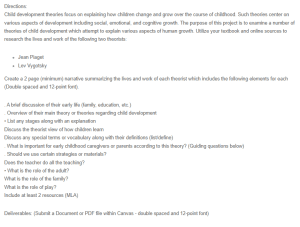
Child development theories focus on explaining how children change and grow over the course of childhood. Such theories center on various aspects of development including social, emotional, and cognitive growth. The purpose of this project is to examine a number of theories of child development which attempt to explain various aspects of human growth. Utilize your textbook and online sources to research the lives and work of the following two theorists:
Theorist Research Project – Jean Piaget and Lev Vygotsky
- Jean Piaget
- Lev Vygotsky
Create a 2 page (minimum) narrative summarizing the lives and work of each theorist which includes the following elements for each (Double spaced and 12-point font).
. A brief discussion of their early life (family, education, etc.)
. Overview of their main theory or theories regarding child development
• List any stages along with an explanation
Discuss the theorist view of how children learn
Discuss any special terms or vocabulary along with their definitions (list/define)
. What is important for early childhood caregivers or parents according to this theory? (Guiding questions below)
. Should we use certain strategies or materials?
Does the teacher do all the teaching?
• What is the role of the adult?
What is the role of the family?
What is the role of play?
Include at least 2 resources (MLA)
Deliverables: (Submit a Document or PDF file within Canvas – double spaced and 12-point font)