
The Use of Clinical Systems to Improve Outcomes and Efficiencies
Clinical systems help in the delivery of healthcare worldwide. The use of health information technology and evidence-based practices helps to improve outcomes in patients. Clinical systems can improve efficiency, identify at-risk patients, integrate patient medical history in one place, and are used for research. One such clinical system is the Clinical Decision Support System (CDSS). CDSS are programs that analyze information in electronic health records (EHRs) to assist healthcare providers in making clinical decisions. This paper will examine four research articles on the application of CDSS to improve patient outcomes and efficiency.
Annotated Bibliography
Taheri Moghadam, S., Sadoughi, F., Velayati, F., Ehsanzadeh, S. J., & Poursharif, S. (2021). The effects of clinical decision support system for prescribing medication on patient outcomes and physician practice performance: A systematic review and meta-analysis. BMC Medical Informatics and Decision Making, 21(1). https://doi.org/10.1186/s12911-020-01376-8
According to Taheri Moghadam et al. (2021), using CDSS for prescribing aims to improve patient outcomes and the practice performance of physicians. This study is a systematic review to evaluate the effects of using various CDSSs on patient outcomes and physician performance. The study was done by searching multiple databases, including Cochrane Library and PubMed. A meta-analysis was done based on the medication subgroups, the type of CDSS used, and the various categories of outcomes. Essentially, 45 previous studies were qualified for analysis based on the inclusion criteria. The study results revealed that CDSS was effective in prescribing various diseases and efficient for patients taking multiple medications. These diseases include diabetes, cardiovascular, respiratory, and mental diseases.
In diabetes, for instance, CDSS was effective as it reminded patients to comply with their medication by sending short message reminders. It was also helpful in ensuring missed doses were taken. The use of CDSS for managing patients with diabetes revealed an improvement in HBA1C levels.
In managing patients with cardiovascular disease, the prescription of prophylaxis for venous thromboembolism increased. Another study revealed that the incidence of discrepancy among physicians when prescribing thromboprophylaxis was reduced. This reduction resulted from the treatment recommendations offered by the use of CDSS. Other reviewed studies revealed that CDSS positively affected physicians’ performance when giving anti-inflammatory and lipid-lowering drugs for treatment. In another survey reviewed by Taheri Moghadam et al. (2021), CDSS positively affected patient adherence to medication.
Taheri Moghadam et al. (2021) found that, in some trials, the integration of CDSS and Electronic health records (EHR) led to a decrease in the prescription of antibiotics and macrolides. Subsequently, this minimized the misuse of antibiotics and reduced antibiotic resistance.
One study revealed that four patients needing urgent treatment had their treatment delayed in patients taking multiple medications. This showed that CDSS should be monitored and evaluated as the adverse effects can be fatal. Another study, however, showed that using CDSS in patients with multiple prescriptions can be beneficial. Better intervals for drug use and improved primary doses of medication evidenced this. For mental health patients, CDSS alerts reduce the risk of injury.
CDSS improved medication prescription by improving physician compliance with available medication recommendations. Accordingly, this resulted in a reduction in the side effects experienced by the patients.
Sutton, R. T., Pincock, D., Baumgart, D. C., Sadowski, D. C., Fedorak, R. N., & Kroeker, K. I. (2020). An overview of clinical decision support systems: benefits, risks, and strategies for success. NPJ digital medicine, 3, 17. https://doi.org/10.1038/s41746-020-0221-y
According to Sutton et al. (2020), one of the advantages of using CDSS is improved patient safety. One way this is achieved is by reducing medication errors. Drug-drug interactions are preventable and can often be fatal. Sutton et al. (2020) cite that up to 65% of inpatients are exposed to potentially harmful drug combinations. CDSS is usually integrated into computerized provider order entry (CPOE) systems and electronic health records (EHR). CPOEs have drug safety software that performs drug-drug interaction checks and helps prevent therapy duplication. Electronic drug dispensing systems (EDDS) help with prescribing, transcribing, dispensing, and administering medication to contain medication administration errors. Studies have shown that these systems are efficient in reducing errors.
Sutton et al. (2020) further indicate that CDSS can also monitor blood glucose. This is achieved using reminder systems that automatically prompt nurses to measure glucose levels. Accordingly, this lowers the number of hypoglycemic events. Overall, using CDSS in patient safety targets drug errors by highlighting contraindications for certain drugs and drug interactions and minimizing prescribing errors. However, Sutton et al. (2020) suggest that patient safety is usually a secondary objective for most CDSS.
Another benefit of CDSS is that it increases the likelihood of adhering to the available clinical guidelines (Sutton et al., 2020). Most clinicians do not internalize and implement new policies. The new guidelines can be encoded into CDSS. Patients also benefit from CDSS as clinicians can be alerted to contact patients who need follow-up. Patients can also benefit from CDSS as these systems can suggest more cost-effective medications and clinical interventions without affecting hospital mortality or length of stay.
This study by Sutton et al. (2020) generally concluded that CDSS could improve patient outcomes by improving patient safety. It can also benefit the patient by helping them to adhere to their medication and monitoring, such as in diabetic patients who need to monitor their blood glucose regularly. It also allows clinicians to adhere to medication guidelines.
Moja, L., Polo Friz, H., Capobussi, M., Kwag, K., Banzi, R., Ruggiero, F., González-Lorenzo, M., Liberati, E. G., Mangia, M., Nyberg, P., Kunnamo, I., Cimminiello, C., Vighi, G., Grimshaw, J. M., Delgrossi, G., & Bonovas, S. (2019). Effectiveness of a hospital-based Computerized Decision Support System on clinician recommendations and patient outcomes. JAMA Network Open, 2(12). https://doi.org/10.1001/jamanetworkopen.2019.17094
According to Moja et al. (2019), CDSS is designed to link patient information in EHRs to evidence-based knowledge. This information then guides the patient’s case through algorithms or rules programmed into software.
This study by Moja et al. (2019) is a randomized clinical trial to investigate the effectiveness of CDSS on the recommendations made by clinicians and patient outcomes. The study involved 6480 patients admitted to the internal medicine ward in a general hospital. CDSS was integrated into the patient’s health records to generate patient-specific recommendations. Moja et al. (2019) found that CDSS led to faster identification and resolution of medical problems. These problems were mainly addressed via a change in practice. Approximately 4 out of 100 patients were affected by this change in course.
This means that using CDSS effectively reduced the incidence of inappropriate medication prescriptions compared to using guidelines alone. In this study, Moja et al. (2019) concluded that the use of CDSS was marginally effective in modifying routine practice at the hospital. The change was, however, not statistically significant to affect patient outcomes.
Jeffries, M., Salema, N.-E., Laing, L., Shamsuddin, A., Sheikh, A., Avery, A., Chuter, A., Waring, J., & Keers, R. N. (2021). The implementation, use, and sustainability of a clinical decision support system for medication optimization in primary care: A qualitative evaluation. PLOS ONE, 16(5). https://doi.org/10.1371/journal.pone.0250946
In this qualitative study, Jeffries et al. (2021) tried to understand the implementation, use, and sustainability of CDSS to optimize medication in primary care. The study design was semi-structured interviews of stakeholders involved in implementing CDSS in primary care settings.
Jeffries et al. (2021) explain that stakeholder engagement is essential to sustain CDSS use by prescribers. The sustained implementation of CDSS must balance the patient’s holistic needs, the prescriber’s judgment, and the prescribing alerts. This highlights the need to consider patients’ and prescribers’ needs. The participants’ view was that CDSS has a role in enhancing medication safety and improving the quality of care. Participants observed that using CDSS positively affected medication safety. Prescribers also had access to relevant patient information on time.
Conclusion
In conclusion, the various articles reviewed propose that CDSSs can improve healthcare care efficiency and quality of life. The studies showed that using CDSS can improve patient outcomes in multiple ways. This included enhanced patient safety by correctly identifying drug-drug interactions, improving the compliance of physicians and healthcare providers to available clinical guidelines, and reducing medication errors. The use of CDSS can also enhance drug compliance in patients by sending reminders. One study, however, found that the use of CDSS can have serious adverse events if not carefully monitored.
ORDER A PLAGIARISM-FREE PAPER HERE
We’ll write everything from scratch
Question 
In this Assignment, you will review existing research on applying clinical systems. After scanning, you will summarize your findings.
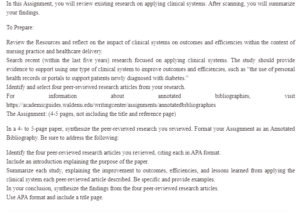
The Use of Clinical Systems to Improve Outcomes and Efficiencies
To Prepare:
Review the Resources and reflect on the impact of clinical systems on outcomes and efficiencies within the context of nursing practice and healthcare delivery.
Search recent (within the last five years) research focused on applying clinical systems. The study should provide evidence to support using one type of clinical system to improve outcomes and efficiencies, such as “the use of personal health records or portals to support patients newly diagnosed with diabetes.”
Identify and select four peer-reviewed research articles from your research.
For information about annotated bibliographies, visit https://academicguides.waldenu.edu/writingcenter/assignments/annotatedbibliographies
The Assignment: (4-5 pages, not including the title and reference page)
In a 4- to 5-page paper, synthesize the peer-reviewed research you reviewed. Format your Assignment as an Annotated Bibliography. Be sure to address the following:
Identify the four peer-reviewed research articles you reviewed, citing each in APA format.
Include an introduction explaining the purpose of the paper.
Summarize each study, explaining the improvement to outcomes, efficiencies, and lessons learned from applying the clinical system each peer-reviewed article described. Be specific and provide examples.
In your conclusion, synthesize the findings from the four peer-reviewed research articles.
Use APA format and include a title page.