
The Psychiatric Interview
Chief Complaint (CC): Patient 1 stated, “I have been feeling irritable and having trouble sleeping for months.”
History of Present Illness (HPI)
Patient 1 reported that symptoms began eight months ago with a gradual onset of persistent irritability, reduced sleep quality, and decreased concentration. The irritability manifests daily and is often aggravated by workplace stress, disagreements with coworkers, and high caffeine consumption. He finds temporary relief by engaging in solitary activities and relaxation techniques. Sleep onset is delayed by more than one hour, and he awakens several times nightly, sleeping three to four hours on average. Severity is rated 6/10, and over-the-counter melatonin has offered minimal benefit.
Psychiatric Review of Symptoms
The patient endorses chronic irritability, occasional excessive worry, and mild distractibility. He denies panic attacks, euphoria, risky behaviors, or hallucinations. He has noticed a gradual withdrawal from social activities but reports no changes in appetite or hygiene. He denies paranoia, obsessive thoughts, or suicidal/homicidal ideation.
Psychiatric History
There is no prior psychiatric diagnosis, hospitalization, or outpatient mental health treatment. The patient denies previous suicidal or homicidal thoughts, suicide attempts, or deliberate self-harm. He has never taken psychiatric medication and reports a short-lived attempt at meditation several years ago, which was discontinued after two weeks due to perceived ineffectiveness.
Past Medical/Surgical History
Patient 1 was diagnosed with hypertension at age 50 and is currently controlled with lisinopril. He underwent an appendectomy at age 22. He denies neurological disorders, traumatic brain injuries, or chronic infectious diseases. Immunizations are current, and he maintains regular follow-ups with his primary care provider.
Family History
His mother had major depressive disorder in her 60s, and his father had hypertension and died from a myocardial infarction at age 72. There is no known family history of suicide or substance use disorders.
Substance Use History
He smokes one to two cigars weekly and drinks two to three beers on weekends. He denies binge drinking, illicit drug use, or misuse of prescription or over-the-counter medications.
Personal and Social History
The patient completed high school and has worked as a warehouse supervisor for 25 years. He is married, has two adult children, and lives with his spouse in a suburban home. He reports a supportive marriage, denies current financial or legal problems, and notes a safe living environment. He disclosed a history of verbal abuse in childhood but denies physical or sexual abuse (Lyon et al., 2020)
Medications
Lisinopril 10 mg PO daily; melatonin 5 mg PO nightly as needed.
Medication Allergies: Has no known drug allergies.
Medical Review of Systems
- General: Denies recent weight change, chills, fever, or night sweats; he reports occasional mild fatigue but no significant energy level changes.
- Skin: No changes in lesions or moles, rashes, bruises, bleeding, discolorations, or delayed healing.
- Eyes: Wears corrective lenses; reports no blurred vision or other visual changes.
- Ears: Denies ringing, discharge, hearing loss, or ear pain.
- Nose/Mouth/Throat: He denies nosebleeds, nasal discharge, or sinus issues. Denies any dental disease, dysphagia, hoarseness, or throat pain.
- Breast: No self-breast exam changes, bumps, lumps, or other abnormalities.
- Heme/Lymph/Endo: HIV negative; denies any blood transfusion history, bruises, night sweats, swollen glands, increased thirst/hunger, or heat/cold intolerance.
- Cardiovascular: Denies edema, orthopnea, or chest discomfort; occasional palpitations during stress.
- Respiratory: Denies wheezing, cough, hemoptysis, or dyspnea. No history of pneumonia or tuberculosis.
- Gastrointestinal: Denies experiencing any of the following symptoms: hepatitis, hemorrhoids, ulcers, eating disorders, constipation, diarrhea, vomiting, or black, tarry stools.
- Genitourinary/Gynecological: Denies having a history of sexually transmitted diseases; no complaints about the prostate or urine; sexual activity without problems; and no frequency, urgency, burning, or color changes in the urine.
- Musculoskeletal: Reports mild knee stiffness; denies osteoporosis, back pain, fractures, or joint swelling.
- Neurological: Denies experiencing syncope, seizures, paresthesia, weakness, or blackout episodes (Nichol et al., 2024).
Mental Status Exam
- Appearance: Neatly groomed, casually dressed.
- Behavior: Cooperative, mild psychomotor agitation (foot tapping).
- Speech: Normal rate, rhythm, and tone.
- Mood: “Frustrated.”
- Affect: Constricted but mood-congruent.
- Thought Process: Logical and goal-directed.
- Thought Content: No delusions, hallucinations, or suicidal/homicidal ideation.
- Cognition: Memory is unharmed, alert, and oriented to time, place, and people (Voss & Das, 2024).
- Insight/Judgment: Fair.
- Impulse Control: Adequate
Safety Assessment
Patient 1 denies suicidal or homicidal ideation, has no access to firearms, and reports no history of violence, indicating no immediate safety concerns at this time.
Assessment
Adjustment Disorder with Mixed Disturbance of Emotions and Conduct (F43.25), evidenced by prolonged irritability, situational stress, and functional impairment without criteria for a major mood disorder (Van Wijk, 2024).
Plan
Initiate cognitive behavioral therapy for stress management and sleep hygiene. Continue melatonin at the lowest effective dose and reassess efficacy. Educate on consistent sleep schedules, reduced caffeine, and relaxation strategies (Hittle et al., 2023). Follow up in four weeks to monitor symptom changes and treatment adherence.
References
Hittle, B. M., Hils, J., Fendinger, S. L., & Wong, I. S. (2023). A scoping review of sleep education and training for nurses. International Journal of Nursing Studies, 142, 104468. https://doi.org/10.1016/j.ijnurstu.2023.104468
Lyon, T. D., Williams, S., & Stolzenberg, S. N. (2020). Understanding expert testimony on child sexual abuse denial after New Jersey v. J.L.G.: Ground truth, disclosure suspicion bias, and disclosure substantiation bias. Behavioral Sciences & the Law, 38(6), 630–647. https://doi.org/10.1002/bsl.2490
Nichol, J. R., Sundjaja, J. H., & Nelson, G. (2024, April 30). Medical history. StatPearls – NCBI Bookshelf. https://www.ncbi.nlm.nih.gov/books/NBK534249/
Van Wijk, C. H. (2024). Prevalence estimate for adjustment disorders in the South African Navy. Clinical Practice and Epidemiology in Mental Health, 20(1). https://doi.org/10.2174/0117450179301661240528064329
Voss, R. M., & Das, J. M. (2024, April 30). Mental status examination. PubMed. https://pubmed.ncbi.nlm.nih.gov/31536288/
ORDER A PLAGIARISM-FREE PAPER HERE
We’ll write everything from scratch
Question 
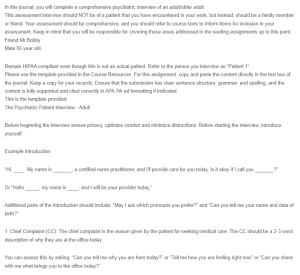
In this journal, you will complete a comprehensive psychiatric interview of an adult/older adult.
This assessment interview should NOT be of a patient that you have encountered in your work, but instead, should be a family member or friend. Your assessment should be comprehensive, and you should refer to course texts to inform items for inclusion in your assessment. Keep in mind that you will be responsible for covering those areas addressed in the reading assignments up to this point.
Friend Mr Bobby
The Psychiatric Interview
Male 55 year old,
Remain HIPAA compliant even though this is not an actual patient. Refer to the person you interview as “Patient 1”.
Please use the template provided in the Course Resources. For this assignment, copy and paste the content directly in the text box of the journal. Keep a copy for your records. Ensure that the submission has clear sentence structure, grammar, and spelling, and the content is fully-supported and cited correctly in APA 7th ed formatting if indicated.
This is the template provided
The Psychiatric Patient Interview – Adult
Before beginning the interview ensure privacy, optimize comfort and minimize distractions. Before starting the interview, introduce yourself:
Example Introduction:
“Hi, ____. My name is _______, a certified nurse practitioner, and I’ll provide care for you today. Is it okay if I call you _______?”
Or “Hello _____, my name is ____, and I will be your provider today.”
Additional parts of the introduction should include: “May I ask which pronouns you prefer?” and “Can you tell me your name and date of birth?”
1. Chief Complaint (CC): The chief complaint is the reason given by the patient for seeking medical care. The CC should be a 2-3 word description of why they are at the office today.
You can assess this by asking: “Can you tell me why you are here today?” or “Tell me how you are feeling right now” or “Can you share with me what brings you to the office today?”
2. History of Present Illness (HPI): Describes the course of the patient’s illness, including when it began, the character of symptoms, the location where the symptoms began, aggravating or alleviating factors, pertinent positives and negatives, other related diseases, past illnesses, and surgeries or past diagnostic testing related to the present illness. While obtaining the HPI, it is important to incorporate “OLD CARTS”.
O = Onset (Was it an acute or gradual onset? When did your symptoms begin? Did they develop suddenly or over a period of time? Does anyone you know or have been in contact with have similar symptoms? Are you experiencing symptoms now?)
L = location (Where is the pain or symptom located? Is it in a specific area? Does the symptom radiate to another location?)
D = Duration (When you experience this, how long does it last? Since the symptoms began, have they become worse? Are they intermittent?)
C = Characteristics (Describe the symptoms? Dull, sharp, intermittent? Describe how the symptoms feel or look? Describe the sensation: stabbing, dull, aching, throbbing?)
A = Aggravating factors ( What makes it worse? What are the symptoms aggravated by? Walking, eating, position? )
R = Relieving factors (What makes it better? What relieves the symptoms?)
T = Treatments (What have you tried to resolve the problem? What was the response to that treatment? Have you continued with that treatment, or if you have not, why? If you have tried anything to manage your symptoms, what medication and dose have you taken?)
S = Severity (How severe is this? On a scale of 1-10, with ten being the most severe, can you rate your pain?)
3. Psychiatric Review of Symptoms: This should include current symptoms typically presenting within the past two weeks.
You can assess this by asking about:
Current anxiety symptoms (easily startled, jittery, hypervigilance, excessive worry), racing thoughts, ruminations, panic attacks
Depression symptoms (down, depressed, hopeless), thoughts/intent/plan to harm self or others.
Changes in sleep and appetite
Changes in mood, grandiosity or impulsivity
Changes in concentration and memory
Aggressiveness, irritability, aloofness or withdrawal.
Auditory/visual/tactile/olfactory hallucinations, fears, phobias, paranoia, or fixations
Changes in the ability to follow through with tasks, or attend to work, home, and school obligations
Changes in self-care routines, hygiene
4. Psychiatric History: This should include past data and any current data not addressed previously.
You can assess this by asking about
Past and current psychiatric diagnoses.
Prior psychotic or aggressive ideas, including thoughts of physical or sexual aggression or homicide.
Prior aggressive behaviors (e.g., homicide, domestic or workplace violence, other physically or sexually aggressive threats or acts).
Prior suicidal ideas, suicide plans, and suicide attempts, including aborted or interrupted ones, as well as details of each attempt (e.g., context, method, damage, potential lethality, intent).
Prior intentional self-injury in which there was no suicide intent.
History of psychiatric hospitalization and/or emergency department visits for psychiatric issues.
Past psychiatric treatments (type, duration, and, where applicable, doses).
Response to past psychiatric treatments.
Adherence to past and current pharmacological and nonpharmacological psychiatric treatments.
5. Past Medical/Surgical History: Ask the patient to share their past medical history. If the patient is not forthcoming with information, you may need to ask specifically about health conditions.
You can assess this by asking: “Can you please tell me about your medical history?” or “What medical problems have you had?”
Additional questions may be: “Have you ever been pregnant?” or “How many children do you have?”
Additionally, ask about:
Environmental and food allergies (Medication allergies are addressed later)
Whether or not the patient has an ongoing relationship with a primary healthcare professional.
Past or current medical illnesses and related hospitalizations.
Relevant past or current treatments, including surgeries, other procedures, or complementary and alternative medical treatments.
Immunization status.
Past or current neurological or neurocognitive disorders or symptoms.
Physical trauma, including head injuries.
Sexual and reproductive history.
Cardiopulmonary status.
Past or current endocrinological disease.
Past or current infectious diseases, including sexually transmitted diseases, HIV, tuberculosis, hepatitis C, and locally endemic infectious diseases, such as Lyme disease.
Past or current symptoms or conditions associated with significant pain and discomfort.
6. Family History You can assess this by asking: “Can you tell me about your family history?” or “Does your mother, father, or siblings have any medical or psychiatric history?” or ”Are your parents alive and well?”
Specifically ask about:
History of suicidal behaviors
History of violent behaviors
Psychiatric illness
Substance use disorders
7. Substance Use History
You can assess this by asking about:
Use of tobacco, alcohol, and other substances (e.g., marijuana, cocaine, heroin, hallucinogens) and any misuse of prescribed or over-the-counter medications or supplements.
Current or recent substance use disorders or change in use of alcohol or other substances.
Any current or prior treatment for substance use disorders
8. Personal and Social History Ask the patient about education level, occupational history, current living situation/partner/marital status, and substance use/abuse, ETOH, tobacco, and marijuana (if not done so already), safety status, and support status.
You can assess this by asking, “How many years of education do you have?” or “ What do you do for a living?”, or “How do you spend your time?” or “Do you currently live alone or with someone else?” and “In an apartment, house or somewhere else?” adding, “Do you feel safe where you live?” and “Who in your life can you count on for support?”
Specifically, you can assess this through inquiry of:
Presence of psychosocial stressors (e.g., financial, housing, legal, school/occupational, or interpersonal/relationship problems; lack of social support; painful, disfiguring, or terminal medical illness).
Review of the patient’s trauma history.
Exposure to violence or aggressive behavior, including combat exposure or childhood abuse.
Legal or disciplinary consequences of past aggressive behaviors.
Literacy or learning difficulties
Cultural factors related to the patient’s social environment.
Personal/cultural beliefs and cultural explanations of psychiatric illness.
Patient’s need for an interpreter.
9. Medications: Ask the patient about the medications, frequency, and dosages of current medications.
You can assess this by asking: “What prescribed and over-the-counter medications do you take?”
10. Medication allergies: Ask the patient if they have any medication allergies and have them describe their allergic response to the medications. You could also request for the patient to share any additional allergies that they may have.
You can assess this by asking: “Are you allergic to any medications?” or “Do you have any allergies?” or “Are you allergic to anything?”
11. Medical Review of Systems You can assess this through a brief inquiry of systems at the first visit, and an updated inquiry at subsequent visits e.g., Have there been any changes to your general health or medical conditions?
● General: Weight change, fatigue, fever, chills, night sweats, and change energy level
● Skin: Delayed healing, rashes, bruising, bleeding or skin discolorations, and any changes in lesions or moles
● Eyes: Corrective lenses, blurring, and visual changes of any kind
● Ears: Ear pain, hearing loss, ringing in ears, and discharge
● Nose/Mouth/Throat: Sinus problems, dysphagia, nose bleeds or discharge, dental disease, hoarseness, and throat pain
● Breast: SBE, lumps, bumps, or changes
● Heme/Lymph/Endo: HIV status, bruising, blood transfusion hx, night sweats, swollen glands, increase thirst, increase hunger, and cold or heat intolerance
● Cardiovascular: Chest pain, palpitations, PND, orthopnea, and edema
● Respiratory: Cough, wheezing, hemoptysis, dyspnea, pneumonia hx, and TB
● Gastrointestinal: Abdominal pain, N/V/D, constipation, hepatitis, hemorrhoids, eating disorders, ulcers, and black, tarry stools
● Genitourinary/Gynecological:Urgency, frequency burning, change in color of urine. Contraception, sexual activity, STDs. Female: last pap, breast, mammo, menstrual complaints, vaginal discharge, pregnancy hx. Male: prostate, PSA, urinary complaints
● Musculoskeletal: Back pain, joint swelling, stiffness or pain, fracture hx, and osteoporosis
● Neurological: Syncope, seizures, transient paralysis, weakness, paresthesias, and black-out spells
After you have completed all components above, you will then let the patient know that you would like to proceed to ask a few more questions and/or obtain more data through standardized tests in order to help inform the plan of care. You would then proceed to obtain the patient’s assent to gather any additional information needed to complete a full Mental Status Exam. If necessary, you would tell the patient, “I’d like to gather a little more information to help get a better picture of how to help you best, would that be okay?” At that point, you would administer any standardized tests or proceed with additional questioning, safety assessment, etc.