
The Occupational Safety and Health Administration
Introduction
Many industries across the United States rely on the Occupational Safety and Health Administration (OSHA) to achieve workplace safety. The information in this paper evaluates the history and purpose of this regulatory agency. Further, it explores OSHA’s necessary standards and provides real-life examples to illustrate the consequences of OSHA violations. The paper’s primary objective is to highlight the importance of OSHA in promoting a safe working environment. Both employees and employers require an understanding as a measure to remain compliant.
History of OSHA
OSHA dates back to 1970 when the Occupational Safety and Health Act was signed into law by President Nixon. Before it was signed into law, there were many cases of workplace injuries and fatalities. Therefore, the Act was a legal response to the growing number of workers getting killed or injured in their workplace, especially in high-risk industries (Occupational Safety and Health Administration, n.d.). Since 1970, the body has played a significant role in formulating standards and training employees and employers on reducing workplace hazards.
Purpose of OSHA
The primary purpose of OSHA is to ensure a safe and healthy workplace environment. It assists in setting standards, offers training, outreach, and education, and provides assistance associated with preventing work-related injuries and deaths. OSHA implements proactive safety measures such as regular workplace inspections and holding companies/employers accountable for a hazard-free workplace environment. Also, OSHA empowers employees as it gives them the right to report unsafe conditions with no fear of repercussions.
OSHA Standards
Several OSHA standards are often applied in the workplace. First, OSHA requires employers to provide employees with personal protective equipment where necessary. Notably, this standard ensures that workers are adequately equipped to perform their jobs safely (Felsen, 2024). Second, through the Hazard Communication Standard, OSHA mandates that employers inform workers about hazards associated with their work. The standard is observed by informing workers about chemicals they may be exposed to, including proper training and labeling. Lastly, through the Fall Protection Standard that applies to construction environments, OSHA requires employers to implement safety measures against falling objects. The standard is observed by incorporating safety nets in the construction to reduce fall risks at heights of more than six feet. Overall, the three standards are important in reducing injuries and maintaining a safe workplace.
Real-World Example
The West Fertilizer Company example can be used to illustrate an OSHA violation. The violation occurred in 2013, when a massive explosion in the company resulted from improper storage of ammonium nitrate in West, Texas, resulting in 15 people losing their lives. Further, more than 160 injuries were reported, including those of firefighters and emergency responders. An investigation by OSHA into the issue revealed that the facility had not been inspected since 1985 (Zimmer et al., 2024). Further, it was established that proper storage requirements regarding hazardous chemicals were not followed. The massive property damage is a testament to pertinent safety oversight gaps. Therefore, OSHA and other government agencies were pressured to enhance regulatory enforcement on chemical storage.
Conclusion
OSHA has had a significant role in enhancing safety at the workplace since its establishment in 1970. Its purpose is centered on protecting the welfare of workers using enforceable standards. Major regulations enforced by the body, such as those concerning personal protective equipment, hazard communication, and fall protection, are crucial to maintaining safe work environments. The case described of West Fertilizer Company serves as a reminder of why OSHA compliance is needed to prevent future workplace tragedies.
References
Felsen, M. (2024). Addressing worker safety and health through the lens of strategic enforcement—Part One. NEW SOLUTIONS: A Journal of Environmental and Occupational Health Policy, 34(2), 133–146. https://doi.org/10.1177/10482911241259874
Occupational Safety and Health Administration. (n.d.). OSHA at a glance. https://www.osha.gov/Publications/3439at-a-glance.pdf
Zimmer, R., Strahley, A., Aguilar, A., Montez, K., Palakshappa, D., Hanchate, A., Pulgar, C. A., Yang, M., Moore, J. B., Kirby-Straker, R., Dixon, C., & Brown, C. L. (2024). Using the Environmental Health Disparities Framework to understand Black and Latino perspectives of a local fertilizer plant fire. BMC Public Health, 24(1). https://doi.org/10.1186/s12889-024-20235-z
ORDER A PLAGIARISM-FREE PAPER HERE
We’ll write everything from scratch
Question 
The Occupational Safety and Health Administration
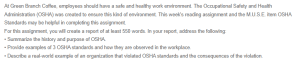
At Green Branch Coffee, employees should have a safe and healthy work environment. The Occupational Safety and Health Administration (OSHA) was created to ensure this kind of environment. This week’s reading assignment and the M.U.S.E. item OSHA Standards may be helpful in completing this assignment.
The Occupational Safety and Health Administration
For this assignment, you will create a report of at least 550 words. In your report, address the following:
• Summarize the history and purpose of OSHA.
• Provide examples of 3 OSHA standards and how they are observed in the workplace.
• Describe a real-world example of an organization that violated OSHA standards and the consequences of the violation.