
The National Health and Nutrition Examination Survey (NHANES)
The National Health and Nutrition Examination Survey (NHANES) provides information on the health and nutritional status of non-institutionalized Americans. The initiative was designed to monitor the health of Americans. It collects and analyzes data on diverse health and nutritional topics, informing aspects of wellness, such as disease risk and the prevalence of chronic illnesses. The components of NHANES include physical examinations by physicians, dietary and medical history, household questionnaires, and clinical tests and procedures. Data from the NHANES dataset can be broadly categorized into demographic, clinical measurements, laboratory, questionnaire, anthropometric, and specific health conditions.
Lessons Learned
The NHANES data set, along with publications reviewing the data, provides insight into the determinants of health in the US. Foremost, the information obtained informs the county’s current position in addressing health equity. Lau et al. (2023) note that NHANES continues to shed light on the existing health disparities within the country and their impact on individual wellness. Factors such as genetics, medical care, and environmental influences on American health can be obtained from the dataset. Likewise, the dataset details the position of the nation in attaining its health goals. The Healthy People initiative identifies key areas for improvement required to achieve a healthy community. The progress in achieving these goals can be monitored by using findings from NHANES. Another area in which the NHANES dataset becomes crucial is in informing the vulnerability of Americans to common illnesses (Ansah & Chiu, 2023). Information on the number of obese or overweight Americans can help show the expected trajectory of common chronic illnesses. Obesity and overweight are known modifiable risk factors for many chronic diseases. Also, data on the number of people with chronic diseases, such as diabetes and hypertension, can help show the likely spending on healthcare across the country. It is, therefore, important that healthcare agencies review the data frequently.
Population of Interest
The population of interest that will form the basis for the analysis is older adults. Old adults are one of the most vulnerable populations in the US. These populations are disproportionately affected by various health shocks, such as chronic illnesses. Guo et al. (2022) note that a combination of factors, such as frailty and comorbidity, influences the health and wellness of older Americans. The level of consumption of health products and resources remains high within this group. Likewise, other health concerns like falls continue to affect community-dwelling older Americans. The NHANES defines older adults as those aged 65 and above.
Data from the NHANES demonstrates the vulnerability index of older adults to disease and suffering. The increasing rates of elderly populations with multi-morbidity, obesity, reduced muscle strength, and low bone mass, among others, compound health concerns in this group. As a point of health promotion for these populations, it is necessary to educate them on these factors. Creating awareness of the health risks may help improve the overall health and wellness of the elderly. Community outreach programs and education at the point of care can be leveraged to facilitate such educational programs.
Research Questions Answered in the Project
The project will focus on improving the health and wellness of older Americans. The key focus areas will be obesity, overweight, and diabetes.
- What is the impact of the increasing prevalence of obesity and overweight on the health and wellness of older adults?
- What dietary factors predispose older Americans to obesity and diabetes?
References
Ansah, J. P., & Chiu, C.-T. (2023). Projecting the chronic disease burden among the adult population in the United States using a multi-state population model. Frontiers in Public Health, 10. https://doi.org/10.3389/fpubh.2022.1082183
Guo, J., Huang, X., Dou, L., Yan, M., Shen, T., Tang, W., & Li, J. (2022). Aging and aging-related diseases: From molecular mechanisms to interventions and treatments. Signal Transduction and Targeted Therapy, 7(1). https://doi.org/10.1038/s41392-022-01251-0
Lau, D. T., Ahluwalia, N., Fryar, C. D., Kaufman, M., Arispe, I. E., & Paulose-Ram, R. (2023). Data related to social determinants of health captured in the National Health and Nutrition Examination Survey. American Journal of Public Health, 113(12), 1290–1295. https://doi.org/10.2105/ajph.2023.307490
ORDER A PLAGIARISM-FREE PAPER HERE
We’ll write everything from scratch
Question 
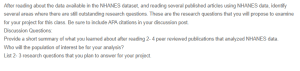
After reading about the data available in the NHANES dataset, and reading several published articles using NHANES data, identify several areas where there are still outstanding research questions. These are the research questions that you will propose to examine for your project for this class. Be sure to include APA citations in your discussion post.
NHANES
Discussion Questions:
Provide a short summary of what you learned about after reading 2- 4 peer reviewed publications that analyzed NHANES data.
Who will the population of interest be for your analysis?
List 2- 3 research questions that you plan to answer for your project.