
The Lives We Imagine
Stratification in Everyday Life
The character’s place in the stratification system, as a low-income, first-generation Somali American teenage girl, has a profound effect on her life chances. Growing up in a disadvantaged area of St. Paul, she has been attending underfunded public schools with no advanced classes or college counseling, thereby robbing her of any legitimate academic progress or opportunities in the future. Her single mother works two jobs, so she is often thrust into caregiving roles at home, taking time away from schoolwork. Systemic barriers such as lack of affordable healthcare, language differences, and cultural ignorance in healthcare settings prevent her from getting the care she needs.
Her race and gender also limit what she can envision for her future. As a Black Muslim girl, she faces stereotypes about her intellectual capacity and place in the classroom, which lower teacher expectations for her and minimize the likelihood that she is encouraged to attend college. In her Somali culture, cultural norms encouraging people to put family before themselves discourage ambitions that seem overly individualistic. Those overlapping disadvantages reduce her imagined and real-life chances and diminish her scope of success to what seems possible against the odds rather than what she might want. Her dreams are present but are shaped by survival more than aspiration.
Intersectionality as a Lived Experience
Intersectionality reveals that this Somali American teen’s intersecting identities, race, gender, class, religion, and newcomer status do not operate independently of one another but rather conflate to produce her unique experiences of disadvantage. As a low-income Black Muslim girl, she faces racialization, putting her down as someone less able to succeed at school, even as gender norms frame her as a free source of unpaid caregiving labor in her home. She might not have the same domestic duties if she was a male. Her educational and healthcare prospects might be brighter if she were white or middle class. However, for a marginalized immigrant, such identities compound, limiting her life chances and colors how institutions address her needs. Intersectionality draws attention to how identities do not simply add on but amplify structural burdens in distinctive, interlocking ways (Conerly et al., 2021).
Institutional and Structural Forces
The two primary institutions that form the trajectory of the character’s life are the public education system and the healthcare industry, both of which engage in institutional discrimination. She goes to an under-resourced school in a low-income area of St. Paul, Minnesota, and there, she has few opportunities for advanced coursework and college prep programs that are already severely limiting the scope of her academic and professional future. Teachers may have their own unconscious biases against her. Due to her race and immigrant background, they may be undervaluing her and dismissing her ambitions. In caring for her health, she encounters language barriers and a lack of culturally aware providers, which can lead to miscommunication, a lack of preventive care, and inadequate mental health support. These barriers are not strictly physical; they are a matter of uneven resource distribution and long-term neglect, not random misfortune. Institutional discrimination shows how structural injustices are nested in everyday institutions and constrain life prospects (Conerly et al., 2021).
Pathways to Change and Empowerment
If Minnesota increased funding for all the public schools in her low-income neighborhood, she would have better access to high-quality education and college prep programs. Culturally responsive school counselors and community health workers could help her maintain her mental health and address identity-specific struggles. If Minnesota had extended Medicaid to cover more people and provided mobile health clinics staffed with Somali-speaking professionals, she would have had access to preventative care and mental health services. Additionally, state investment in after-school tutoring and youth empowerment programs affirming her identity would ensure academic and emotional resilience. Institutional reform and life chances, grounded in a framework of institutional reform and life chances, would allow her to envision and strive for a future not shaped by caregiving and financial hardship.
References
Conerly, T. R., Holmes, K., & Tamang, A. L. (2021). Introduction to sociology (3rd ed.). OpenStax, Rice University.
ORDER A PLAGIARISM-FREE PAPER HERE
We’ll write everything from scratch
Question 
The Lives We Imagine
Objective:
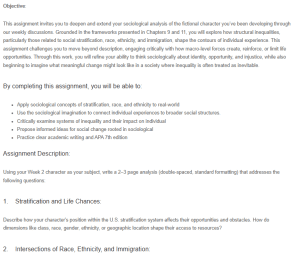
This assignment invites you to deepen and extend your sociological analysis of the fictional character you’ve been developing through our weekly discussions. Grounded in the frameworks presented in Chapters 9 and 11, you will explore how structural inequalities, particularly those related to social stratification, race, ethnicity, and immigration, shape the contours of individual experience. This assignment challenges you to move beyond description, engaging critically with how macro-level forces create, reinforce, or limit life opportunities. Through this work, you will refine your ability to think sociologically about identity, opportunity, and injustice, while also beginning to imagine what meaningful change might look like in a society where inequality is often treated as inevitable.
The Lives We Imagine
By completing this assignment, you will be able to:
- Apply sociological concepts of stratification, race, and ethnicity to real-world
- Use the sociological imagination to connect individual experiences to broader social structures.
- Critically examine systems of inequality and their impact on individual
- Propose informed ideas for social change rooted in sociological
- Practice clear academic writing and APA 7th edition
Assignment Description:
Using your Week 2 character as your subject, write a 2–3 page analysis (double-spaced, standard formatting) that addresses the following questions:
1. Stratification and Life Chances:
Describe how your character’s position within the U.S. stratification system affects their opportunities and obstacles. How do dimensions like class, race, gender, ethnicity, or geographic location shape their access to resources?
2. Intersections of Race, Ethnicity, and Immigration:
If relevant to your character, discuss how their racial or ethnic identity and/or immigrant background shapes their social experience. You may reflect on either historical or contemporary dynamics.
3. Social Forces and Systems:
Identify two structural or institutional forces (e.g., education, housing, law enforcement, health care) that significantly impact your character’s life. Analyze how these forces contribute to their current situation.
4. Change and Possibility:
Propose at least one meaningful change, at the policy, institutional, or cultural level, that could improve your character’s life circumstances. Be specific, and connect your proposal to course content. How could such change shift the structures that shape your character’s world?
Deliverable:
Submit a 2–3 page paper (double-spaced, 12-pt Times New Roman, APA 7th Edition formatting) organized into the following clearly labeled sections:
- Stratification and Life Chances
- Race, Ethnicity, and Immigration
- Structural Forces
- Change and Possibility
You should draw explicitly from course concepts introduced in Chapters 9 and 11. No outside sources are required, but you are welcome to incorporate them if you find it helpful.
Assessment Criteria:
Your submission will be evaluated on:
- Stratification Analysis: Clear, detailed connection between the character’s social location and life
- Intersectional Insight: Sophisticated integration of race, ethnicity, and immigration where
- Structural Analysis: Effective identification and critique of institutional or systemic forces.
- Identifying Change: Thoughtful and well-supported ideas for social change grounded in course
- Sociological Application: Integration of relevant theories and terms from the textbook and course
- Clarity and Organization: Strong academic writing, logical structure, and correct APA 7th edition