
The Impact of Social Media on Adolescent Mental Health
This paper investigates the effects of excessive social media usage among adolescents aged 13 to 17, especially on anxiety, depression, and self-esteem. Based on the literature and through a qualitative interview, it analyzes how social comparison, exposure to negative content, and decreased face-to-face communication are sources of distress. Consistent relationships are found in the reviewed literature between excessive use of social media and negative mental health, especially among female adolescents. Positive factors such as peer support and self-expression are noted but are overwhelmingly overshadowed. The study identifies areas of under-research, especially the absence of qualitative work speaking to adolescents’ voices. A semi-structured interview with an older adolescent echoes these findings and offers greater insights into everyday experience with social media. These findings highlight the need for adolescent-centered mental health interventions and media literacy education. This paper suggests further qualitative research to ensure the amplification of youths’ voices in creating healthier online environments.
Keywords: adolescent mental health, social media, depression, anxiety, body image, qualitative research, youth well-being, digital behavior
THE IMPACT OF SOCIAL MEDIA ON ADOLESCENT MENTAL HEALTH
Teenagers’ lives revolve around social media, which has a significant impact on their communication, comparison, and identity development. Concerns over the effects of mental health conditions like anxiety, depression, and low self-esteem are intensifying as usage rises. According to recent studies, teenagers who are emotionally and socially devoted to these websites suffer from poor mental health. This paper examines the impact of frequent use of social media on adolescents aged 13 to 17, focusing especially on emotional well-being and self-esteem. This draws upon contemporary scholarship and a semi-structured interview to analyze online behavior and mental health correlations. This study aims to increase knowledge about these relationships and raise awareness of the need for further qualitative, youth-focused work in this field.
Research Question
The guiding research question for this study is: How does frequent use of social media affect the mental health of adolescents aged 13–17, particularly in terms of anxiety, depression, and self-image? Drawing from existing literature and the interview data, the postulation is that greater use of social media is positively correlated with negative mental health outcomes for adolescents, with increased impacts found among females.
Hypothesis
These impacts are hypothesized to occur through social comparison processes, exposure to toxic content, and a decrease in in-person interactions. In addition, adolescents are expected to be cognizant of these impacts, yet are stymied in their efforts to alter their behavior due to the social and affective dependency on these sites.
Significance
This study is important for various reasons. On an academic note, it joins an expanding body of sociological and psychological literature examining digital behavior and adolescent growth. In practice, clinicians, teachers, and parents can use the findings to gain insights into the psychosocial processes adolescents are exposed to online and tailor interventions to address these. Socially, the study emphasizes the imperative of creating healthier virtual spaces and arming young users with media literacy. The mental health epidemic among young people continues to accelerate, and examining the contribution of social media is critical to guiding public health interventions and crafting responsible digital policy.
LITERATURE REVIEW
Abi-Jaoude, Elia, Karline Treurnicht Naylor, and Antonio Pignatiello. 2020. “Smartphones, Social Media Use and Youth Mental Health.” Canadian Medical Association Journal 192(6):E136–41. https://doi.org/10.1503/cmaj.190434.
In this study, growing rates of adolescent mental distress are attributed to increased use of smartphones and social media. Hospital admissions due to self-harm among adolescent girls rose by 110% in Canada over the period from 2009 to 2014. The authors of this study highlighted the dangers of online self-harm and decreased direct communication. The authors also acknowledged the requirement for balanced advising instead of prohibiting digital media.
Beyari, Hasan. 2023. “The Relationship between Social Media and the Increase in Mental Health Problems.” International Journal of Environmental Research and Public Health 20(3):2383. https://doi.org/10.3390/ijerph20032383.
The study explores how certain social media features affect Saudi youth’s mental health through the Analytical Hierarchy Process AHP. Conducted among 385 individuals aged 18 to 35, the study ranks features such as likes/commenters/followers, media browsing and posting, and so forth, in order of contribution to mental health problems. Results indicate that features dependent upon validation, such as lights and comments, have the greatest negative contribution, whereas games have the least. Entertainment emerges here as the leading factor influencing feature importance. This article helps delineate which features of social media are worse for mental health; it presents an AHP model with quantified measures that presents an organized methodology for analyzing user activity on sites.
Coyne, Sarah M., Emily Weinstein, J. Andan Sheppard, Spencer James, Megan Gale, Megan Van Alfen, Nora Ririe, Cameron Monson, Sarah Ashby, Allison Weston, and Kennedy Banks. 2023. “Analysis of Social Media Use, Mental Health, and Gender Identity among US Youths.” JAMA Network Open 6(7):e2324389. https://doi.org/10.1001/jamanetworkopen.2023.24389.
This cross-sectional study investigates the extent to which gender identity influences the relationship between mental health and social media use among adolescents aged 10 to 17. The study finds that transgender and nonbinary adolescents experience unique mental health issues related to social media compared to their cisgender peers, highlighting the need for gender-responsive practice in mental health care.
Keles, Betul, Niall McCrae, and Annmarie Grealish. 2019. “A Systematic Review: The Influence of Social Media on Depression, Anxiety and Psychological Distress in Adolescents.” International Journal of Adolescence and Youth 25(1):79–93. https://doi.org/10.1080/02673843.2019.1590851.
Adolescent mental health problems and social media use are consistently linked, according to recent empirical research. The study categorized social media use into time, activity, emotional investment, and addiction after methodically reviewing 13 studies. These were all found to be associated with distress, anxiety, and depression. The majority of the analyzed studies were cross-sectional, hence the authors caution that they were unable to determine causality.
Khalaf, Abderrahman M, Abdullah A. Alubied, Ahmed M Khalaf, and Abdallah A. Rifaey. 2023. “The Impact of Social Media on the Mental Health of Adolescents and Young Adults: A Systematic Review.” Cureus 15(8). https://doi.org/10.7759/cureus.42990.
The study validated correlations among media use and adolescent mental distress, self-harm, and suicidality. The authors observed chronic sleep loss due to media use impeded school performance and emotional control. Although the evidence is startling, the authors documented an insufficient study of teens’ personal and cultural interpretations of their experiences with media. Additional research is necessary to examine these personal and cultural views.
Popat, Anjali, and Carolyn Tarrant. 2022. “Exploring Adolescents’ Perspectives on Social Media and Mental Health and Well-Being – A Qualitative Literature Review.” Clinical Child Psychology and Psychiatry 28(1):323–37. https://doi.org/10.1177/13591045221092884.
The study looked at the qualitative research on teenagers’ individual social media usage. Five themes emerged: exposure to cyber hazards, peer support, pressure to keep in touch, attractiveness comparison, and self-expression and validation. Despite describing good benefits like connection and support, adolescents most frequently mentioned negative effects including addiction, anxiety, and problems with self-esteem. This demonstrates the complex impact of social media on the mental health of teenagers.
Sala, Arianna, Lorenzo Porcaro, and Emilia Gómez. 2024. “Social Media Use and Adolescents’ Mental Health and Well-Being: An Umbrella Review.” Computers in Human Behavior Reports 14:100404. https://doi.org/10.1016/j.chbr.2024.100404.
This review integrates evidence from 24 systematic, scoping, and narrative reviews. Meta-analysis published from January 2015 to April 2023 explored the association between adolescents’ use of social media and their mental health and well-being. The authors conclude that social media presents both risks and opportunities for adolescent mental health and that their outcomes depend upon characteristics of the individuals, patterns of use, and platform design. The authors emphasize the need for responsible platform design and enhanced data availability for researchers to improve comprehension of, and to moderate, possible harms. An overview of recent research on the impact of social media use on teenage mental health is provided in this paper. It is therefore a useful tool for comprehending the intricate nature of this relationship.
All these investigations affirm an association between mental health issues among adolescents and the use of social media. Notwithstanding these findings, there are still significant gaps—including insufficient longitudinal and qualitative research, underrepresentation of adolescents’ voices, and little understanding of cultural and personal interpretations of online experience. This research seeks to address these gaps by interviewing an adolescent participant with a semi-structured interview, which can provide more in-depth insights into how social media impacts mental health from the perspectives of the young people themselves.
EXPECTED FINDINGS
According to the literature and the insights gained from the interviews, it is hypothesized that adolescents who spend more time on social media sites would have higher anxiety, depression, and distress, especially those who have high emotional investment and spend more time online. I would predict that adolescent girls, in addition, would have more extreme negative effects because of comparison with others and the pressure of body image. Although positive factors like support from peers and personal expression are likely to surface, the trend would mostly show high correlations of excessive use of social media with mental issues. These would complement earlier research while underpinning calls for further research on adolescents’ perspectives and experiences to explore how they build their reality and navigate these virtual realms.
INTERVIEW GUIDE
Research Question
How does frequent use of social media affect the mental health of adolescents aged 13–17, particularly in terms of anxiety, depression, and self-image?
Semi-Structured Interview Questions
- What is your typical daily routine, and how frequently do you use social media?
- What are the emotions you normally feel after engaging with social media?
- Have you ever become anxious, depressed, or isolated due to anything you have viewed online? Can you tell me why?
- How, and to what extent, does social media influence how you view yourself and compare yourself to others?
- Are you influenced in your self-esteem or body image by social media? If so, how?
- How do your experiences with social media influence your relationships with your family or friends?
- Are adults or healthcare practitioners likely to appreciate the extent to which social media influences young people’s mental health?
- Are you comfortable speaking with your doctor or therapist about your mental health and your habits with social media? Why or why not?
SURVEY INSTRUMENT
Research Focus
Investigating the frequency and type of use of social media and their effects on adolescent mental health indicators (anxiety, depression, self-esteem).
Survey Questions
- Approximately how many hours each day do you spend on social media?
☐ Less than 1 hour
☐ 1–2 hours
☐ 3–4 hours
☐ No fewer than 5 hours
- How frequently do you feel nervous after being active on social media?
☐ Never
☐ Rarely
☐ Sometimes
☐ Often
☐ Always
- Social media worsens my self-esteem about my looks.
☐ I strongly disagree.
☐ Disagree
☐ Neutral
☐ I concur
☐ Strongly concur
- How frequently do you compare yourself with others on social media?
☐ Never
☐ Rarely
☐ Occasionally
☐ Too frequently
☐ Always
- Have you ever felt excluded or left out due to anything you have seen online?
☐ Yes
☐ No
- Social media makes me feel supported by my peers.
☐ I strongly disagree.
☐ Disagree
☐ Neutral
☐ I agree
☐ I strongly agree
- I have slept poorly because of late-night use of social media.
☐ Yes
☐ No
- I would be open to discussing with a healthcare provider how social media influences my mental health, if offered the option.
☐ Yes
☐ No
CONCLUSION
Social media permeates adolescent mental health, frequently amplifying issues such as anxiety, depression, and comparison. Platforms afford opportunities for self-expression and affiliation, yet they also present adolescents with damaging content and validation-seeking patterns. Empirical investigations have documented systematic correlations between high use of social media and mental health issues, particularly among girls. This investigation builds upon that body of knowledge by triangulating academic research with personal experiential information. Focusing on adolescents’ voices unmasks the emotional nuances of online experiences and highlights the need for media literacy and mental health interventions. Combating these issues is essential to creating a safer, healthier online space for adolescents.
REFERENCES
Abi-Jaoude, Elia, Karline Treurnicht Naylor, and Antonio Pignatiello. 2020. “Smartphones, Social Media Use and Youth Mental Health.” Canadian Medical Association Journal 192(6):E136–41. https://doi.org/10.1503/cmaj.190434.
Beyari, Hasan. 2023. “The Relationship between Social Media and the Increase in Mental Health Problems.” International Journal of Environmental Research and Public Health 20(3):2383. https://doi.org/10.3390/ijerph20032383.
Coyne, Sarah M., Emily Weinstein, J. Andan Sheppard, Spencer James, Megan Gale, Megan Van Alfen, Nora Ririe, Cameron Monson, Sarah Ashby, Allison Weston, and Kennedy Banks. 2023. “Analysis of Social Media Use, Mental Health, and Gender Identity among US Youths.” JAMA Network Open 6(7):e2324389. https://doi.org/10.1001/jamanetworkopen.2023.24389.
Keles, Betul, Niall McCrae, and Annmarie Grealish. 2019. “A Systematic Review: The Influence of Social Media on Depression, Anxiety and Psychological Distress in Adolescents.” International Journal of Adolescence and Youth 25(1):79–93. https://doi.org/10.1080/02673843.2019.1590851.
Khalaf, Abderrahman M, Abdullah A. Alubied, Ahmed M Khalaf, and Abdallah A. Rifaey. 2023. “The Impact of Social Media on the Mental Health of Adolescents and Young Adults: A Systematic Review.” Cureus 15(8). https://doi.org/10.7759/cureus.42990.
Popat, Anjali, and Carolyn Tarrant. 2022. “Exploring Adolescents’ Perspectives on Social Media and Mental Health and Well-Being – A Qualitative Literature Review.” Clinical Child Psychology and Psychiatry 28(1):323–37. https://doi.org/10.1177/13591045221092884.
Sala, Arianna, Lorenzo Porcaro, and Emilia Gómez. 2024. “Social Media Use and Adolescents’ Mental Health and Well-Being: An Umbrella Review.” Computers in Human Behavior Reports 14:100404. https://doi.org/10.1016/j.chbr.2024.100404.
ORDER A PLAGIARISM-FREE PAPER HERE
We’ll write everything from scratch
Question 
The Impact of Social Media on Adolescent Mental Health
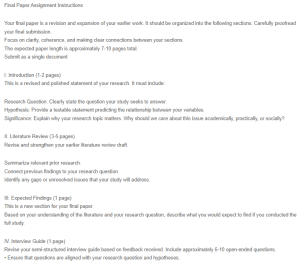
Final Paper Assignment Instructions
Your final paper is a revision and expansion of your earlier work. It should be organized into the following sections: Carefully proofread your final submission.
Focus on clarity, coherence, and making clear connections between your sections.
The expected paper length is approximately 7-10 pages total.
Submit as a single document
The Impact of Social Media on Adolescent Mental Health
I. Introduction (1-2 pages)
This is a revised and polished statement of your research. It must include:
Research Question: Clearly state the question your study seeks to answer.
Hypothesis: Provide a testable statement predicting the relationship between your variables.
Significance: Explain why your research topic matters. Why should we care about this issue academically, practically, or socially?
II. Literature Review (3-5 pages)
Revise and strengthen your earlier literature review draft.
Summarize relevant prior research.
Connect previous findings to your research question.
Identify any gaps or unresolved issues that your study will address.
III. Expected Findings (1 page)
This is a new section for your final paper.
Based on your understanding of the literature and your research question, describe what you would expect to find if you conducted the full study.
IV. Interview Guide (1 page)
Revise your semi-structured interview guide based on feedback received. Include approximately 6-10 open-ended questions.
• Ensure that questions are aligned with your research question and hypotheses.
V. Survey Instrument (1 page)
Revise your survey instrument based on feedback received. Include 8-15 close-ended survey questions.
• Make sure your questions clearly connect to your key variables.
Formatting Requirements
Typed, double-spaced 12-point Times New Roman font .1-inch margins
• Use ASA citation style consistently