
The Impact of Remote Work on Employee Job Satisfaction
Project topic
The Impact of Remote Work on Employee Job Satisfaction: A Study of Contributing Factors and Organizational Outcomes.
Alignment to the Program of Study
The topic of the proposed study is the impact of remote work on employee job satisfaction, specifically exploring the contributing factors and organizational outcomes associated with remote work arrangements. The nature of work in many industries has changed dramatically with the rapid increase in remote work due to the COVID-19 pandemic. This change has sparked an exploration of how remote working affects job satisfaction, work-related wellness, and productivity within organizations. While remote work is associated with enhanced work-life balance, it impacts job satisfaction both positively and negatively depending on the level of organizational autonomy, support, and the type of work being performed. The study will aim to capture remote workers from many different organizational contexts to better understand the effects of remote work. This study focuses on job satisfaction since it demonstrates an employee’s satisfaction with their job and is affected by many elements, like their work-life rhythm, autonomy at work, and the general workplace setting (Ali et al., 2023; Yadav & Madhukar, 2024). Remote work is thought to enhance job satisfaction since it comes with flexibility and more control over one’s schedule (Makridis & Schloetzer, 2022), but other studies argue that it can increase work-related stress as a result of disrupted boundaries between work and personal life (Rizwan & Sivasubramanian, 2022). Other organizational outcomes like voluntary turnover, employee productivity, and well-being also form the core elements of this research (Pabilonia & Redmond, 2024; García-Salirrosas et al., 2023). Understanding how remote work impacts these outcomes is essential for determining the primary factors that foster job satisfaction and organizational productivity during remote work. This is important because it connects with recent developments in the office environment. In knowledge-intensive sectors, remote work is a fundamental feature of modern organizational practices (Atti et al., 2022). Achieving organizational goals in today’s highly networked world requires understanding the remote work context and the factors that affect job satisfaction in remote work environments to enhance employee productivity, well-being, and retention (Anakpo et al., 2023). This analysis will add to the literature on remote work and help inform organizational frameworks about remote work, employee involvement policies, and work organization in remote and hybrid systems.
Project Problem
The problem this study addresses is the limited understanding of the nuanced relationship between remote work and employee job satisfaction, particularly in terms of the factors that contribute to satisfaction and the organizational outcomes of such arrangements. Remote work has grown in popularity, but there is still a lack of understanding regarding its overall impact on employees’ job satisfaction as well as organizational productivity, retention, and employee wellness (Mohite & Kulkarni, 2019). Some research suggests remote work fosters increased satisfaction due to greater autonomy and flexibility, while other research argues strong perceptions of social isolation and blurred work-life boundaries detrimentally impact well-being and job performance (Yadav & Madhukar, 2024; Ferrara et al., 2022).
Problem to be Addressed
The scholarly literature on remote work suggests that it improves job satisfaction due to flexible hours and autonomy afforded to employees. It also brings challenges such as isolation and problematic work-life boundaries. However, how these factors collectively influence overall employee satisfaction, productivity, and retention in an organization, as well as its outcome, differs from industry to industry, and the type of job is poorly understood. Some theoretical models, like the Ability, Motivation, Opportunity (AMO) framework, claim remote work affects employee satisfaction through intrinsic as well as extrinsic factors. However, remote work employee satisfaction and organizational outcome integration have received little attention (Yadav & Madhukar, 2024; Rizwan & Sivasubramanian, 2022).
From previously published work, it appears that factors such as autonomy, organizational support, work-life balance, and the nature of tasks performed shape remote work satisfaction (Ali et al., 2023; Drayton, 2024). For instance, autonomous positions, especially in IT and Software Development, tend to report higher satisfaction compared to more supervised roles (Russo et al., 2023). Fewer social contact opportunities can also contribute to lower job satisfaction and an even greater decline in organizational culture (García-Salirrosas et al., 2023; Atti et al., 2022). Even with the insights these findings highlight, the body of research available is still sparsely scattered. Most studies do not integrate the multifaceted interdependence of individual, organizational, and task factors toward satisfaction within remote working setups.
The lack of integrated detailed models relating to each multifaceted job satisfaction and organizational outcome in remote work settings is a critical gap in the literature. Some research examines autonomy and work-life balance (Kurdy et al., 2023; Flores, 2019); however, there is little understanding of how these factors interact to influence employee satisfaction as well as organizational outcomes like retention and productivity. Additionally, while software development and academia are studied extensively, other sectors are lacking research attention (Capone et al., 2024). This gap in understanding is important because remote work presents different challenges and opportunities for various organizational industries.
Additionally, the surge in remote work, particularly during and after the COVID-19 pandemic, necessitates a review of the existing models of job satisfaction and productivity (Elisabetta et al., 2025). Initially, remote work was perceived as a stopgap measure; however, organizations must now embrace the persistent growth of hybrid and fully remote work models. So, it is crucial to analyze the trajectory of remote work, its evolution over time, and its effects on employee job satisfaction and organizational outcomes (Pabilonia & Redmond, 2024).
Gap
This study will assess the impact of job autonomy and organizational support alongside work-life balance and other relevant tasks for achieving satisfaction for remote workers. The investigation will further determine the relevance of these concepts for organizational outcomes like employee productivity, retention, and general employee wellness. The theoretical contribution aims to fill the gap in the body of knowledge of remote work by developing an integrated framework that considers individual and organizational factors simultaneously. These gaps can be filled by focusing on understanding the drivers of organizational outcomes in remote workplaces, alongside remote work job satisfaction, as in the situation being studied. The phenomenon of remote work is particularly important at this time due to the widespread adoption of remote work across different sectors. This research seeks to bridge the identified gaps by synthesizing findings from several studies and offering strategic recommendations to enhance employee satisfaction and productivity through effective remote work management. The findings are intended to expand the discourse on post-pandemic work realities and serve as a basis for subsequent investigations into remote work and organizational outcomes.
. Supporting Evidence
Literature review addresses previous relevant projects and articulates theoretical (practice) orientation.
Primary Orientation
Provide an introduction to the review of scholarly literature, an argument for conducting the review, and a primary theoretical (and practice) orientation. Suggested length 1-2 paragraphs.
Efforts to Address the Problem
Provide a synthesized review of the scholarly literature to expose, explain, and analyze previous scholarly efforts to address the problem. Suggested length 1-2 paragraphs.
Synthesis of the Evidence
Provide a logically organized and synthesized review and analysis of the literature in close alignment with the topic, problem, and gap. Suggested length 1-2 paragraphs.
Purpose of the Project and Project Questions
Purpose and questions align with topic, problem, and supporting evidence, including definition of terms.
Purpose of the Project
Provide one-to-two sentences aligned with the topic, problem, gap in practice, and project question to state the purpose of the project.
Statement of Primary Question(s)
Provide 1-3 project questions that align with the topic, problem, and supporting evidence within the program. Suggested length 1 paragraph.
Definition of Terms
Present a list of terms and definitions that relate to the program, topic, problem, gap, program, and project framework. This is a working section which you will continue to update in future courses. Suggested length 1 paragraph.
If you are seeking Topic Endorsement in XX-V8926 – Doctoral Project Development – Topic Approval, you only need to complete the sections above for the approval.
Proposed Project Framework
Methodological approach is clearly defined and includes constructs, phenomena, variables, and population.
Methodological Approach
Provide a description and explanation of the methodological approach. The methodological approach must align to the topic, problem, supporting evidence, and data sources. Suggested length 2-3 paragraphs.
Population and Sample (including site if necessary)
Describe the general target population (e.g., size, characteristics). Suggested length 1-2 paragraphs.
Constructs, Phenomena, Variables
Present evidence and explanation for the final choice of framework. Constructs, phenomena, and/or variables must align to the topic, problem, gap, and project questions. Suggested length 2-3 paragraphs.
Proposed Data Sources
Instrumentation and data collection tools address project concepts; ethical threats and their mitigation are detailed.
Measures or Artifacts to be Reviewed
Present a description of instrumentation or data collection tools. Measures or artifacts must closely align with the methodological approach. Suggested length 3-4 paragraphs.
Detailed Procedures
Present a description of the processes needed to complete the instruments by the participants or observers. Suggested length 3-4 paragraphs.
Validity/Reliability/Credibility/Dependability
Identify and present the potential threats to reliability and validity (quantitative techniques) or trustworthiness (qualitative techniques). Include a proposed plan to mitigate the noted threats. Suggested length 1-2 paragraphs.
Proposed Data Collection
Describe sampling, recruitment, data collection procedures, and potential ethical considerations.
Sampling Strategy, Number participants
Describe, explain, and justify the sampling strategy to be used. Suggested length 2-3 paragraphs.
Recruitment Procedures
Provide a recruitment process to identify, screen, and recruit participants as it aligns with the methodological approach. Present the inclusion and exclusion criteria for participating in the project. Suggested length 2-3 paragraphs.
Data Collection Process
Provide a logical step-by-step data collection process as it aligns with the methodological approach. Suggested length 3-4 paragraphs.
Ethical Considerations
Identify potential ethical issues and provide a proposed plan to adhere to strict ethical standards. Include details regarding privacy, confidentiality, and data security procedures and concerns. Suggested length 1-2 paragraphs.
Proposed Data Analysis Plan
Articulate data analysis techniques appropriate to project framework.
Present a plan to analyze and present data with techniques that are appropriate to the project, framework, data sources, and sample size. Suggested length 3-4 paragraphs.
References
Ali, A. D., Narine, L. K., Hill, P. A., & Bria, D. C. (2023). Factors affecting remote workers’ job satisfaction in Utah: An exploratory study. International Journal of Environmental Research and Public Health, 20(9), 5736. https://doi.org/10.3390/ijerph20095736
Anakpo, G., Nqwayibana, Z., & Mishi, S. (2023). The impact of work-from-home on employee performance and productivity: A systematic review. Sustainability, 15(5), 4529. https://doi.org/10.3390/su15054529
Atti, C., Cross, C., Dogan, A. B., Hubbard, C., Page, C., Montague, S., & Rabieinejad, E. (2022). Impacts and integration of Remote-First working environments. arXiv (Cornell University). https://doi.org/10.48550/arxiv.2209.04383
Capone, V., Schettino, G., Marino, L., Camerlingo, C., Smith, A., & Depolo, M. (2024). The new normal of remote work: exploring individual and organizational factors affecting work-related outcomes and well-being in academia. Frontiers in Psychology, 15. https://doi.org/10.3389/fpsyg.2024.1340094
Drayton, E. (2024, December 17). Assessing the influence of remote work on corporate culture and productivity. Journal of the American Institute, 1(1), 6–10. https://americanjournal.us/index.php/american/article/view/4
Elisabetta, C., Paola, R., Maran, D. A., Filippetti, S., Marco, P., Pellegrino, E., Ferrante, M., Giuseppe, L. T., & Fiore, M. (2025). Remote workers’ life quality and stress during COVID-19: A systematic review. European Journal of Public Health, 35(1), 141–146https://doi.org/10.1093/eurpub/ckae167
Ferrara, B., Pansini, M., De Vincenzi, C., Buonomo, I., & Benevene, P. (2022). Investigating the role of remote working on employees’ performance and well-being: an evidence-based systematic review. International Journal of Environmental Research and Public Health, 19(19), 12373. https://doi.org/10.3390/ijerph191912373
Flores, M. F. (2019). Understanding the challenges of remote working and its impact on workers. International Journal of Business Marketing and Management (IJBMM), 4(11), 40-44. http://ijbmm.com/paper/Nov2019/824043604.pdf
García-Salirrosas, E. E., Rondon-Eusebio, R. F., Geraldo-Campos, L. A., & Acevedo-Duque, Á. (2023). Job satisfaction in remote work: The role of positive spillover from work to family and work-life balance. Behavioral Sciences, 13(11), 916. https://doi.org/10.3390/bs13110916
Kurdy, D. M., Al-Malkawi, H. N., & Rizwan, S. (2023). The impact of remote working on employee productivity during COVID-19 in the UAE: the moderating role of job level. Journal of Business and Socio-economic Development, 3(4), 339–352. https://doi.org/10.1108/jbsed-09-2022-0104
Makridis, C., & Schloetzer, J. D. (2022). Does working from home increase job satisfaction and retention? Evidence from the COVID-19 pandemic. Georgetown McDonough School of Business Research Paper, 4016657. https://dx.doi.org/10.2139/ssrn.4016657
Mohite, M. D., & Kulkarni, R. V. (2019). Job satisfaction factors of employee in virtual workplace: Review. International Journal of Trend in Scientific Research and Development, e-ISSN: 2456 – 6470. https://www.ijtsrd.com/papers/ijtsrd23059.pdf
Pabilonia, S. W., & Redmond, J. J. (2024). The rise in remote work since the pandemic and its impact on productivity. Beyond the Numbers: Productivity, 13(8). https://www.bls.gov/opub/btn/volume-13/remote-work-productivity.htm
Rizwan, M., & Sivasubramanian, C. (2022). Remote work and employee well-being: The blurred work-life boundaries. Asian Journal of Management and Commerce, 3(1), 137–146. https://www.allcommercejournal.com/archives/2022.v3.i1.C.122
Russo, D., Hanel, P. H., Altnickel, S., & van Berkel, N. (2023). Satisfaction and performance of software developers during enforced work from home in the COVID-19 pandemic. Empirical Software Engineering, 28(2), 53. https://doi.org/10.1007/s10664-023-10293-z
Yadav, P., & Madhukar, D. V. (2024). Impact of remote work on employee well-being conceptual perspective. International Journal of Management (IJM), 15(2), 96-107. https://papers.ssrn.com/sol3/Delivery.cfm/SSRN_ID4808518_code6685932.pdf?abstractid=4808518&mirid=1&type=2
ORDER A PLAGIARISM-FREE PAPER HERE
We’ll write everything from scratch
Question 
The Impact of Remote Work on Employee Job Satisfaction
Overview
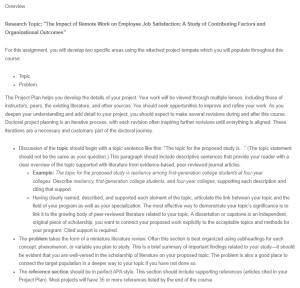
Research Topic: “The Impact of Remote Work on Employee Job Satisfaction: A Study of Contributing Factors and Organizational Outcomes”
For this assignment, you will develop two specific areas using the attached project tempate which you will populate throughout this course:
- Topic.
- Problem.
The Impact of Remote Work on Employee Job Satisfaction
The Project Plan helps you develop the details of your project. Your work will be viewed through multiple lenses, including those of instructors, peers, the existing literature, and other sources. You should seek opportunities to improve and refine your work. As you deepen your understanding and add detail to your project, you should expect to make several revisions during and after this course. Doctoral project planning is an iterative process, with each revision often inspiring further revisions until everything is aligned. These iterations are a necessary and customary part of the doctoral journey.
- Discussion of the topic should begin with a topic sentence like this: “The topic for the proposed study is…” (The topic statement should not be the same as your question.) This paragraph should include descriptive sentences that provide your reader with a clear overview of the topic supported with literature from evidence-based, peer-reviewed journal articles.
- Example: The topic for the proposed study is resiliency among first-generation college students at four-year colleges. Describe resiliency, first-generation college students, and four-year colleges, supporting each description and citing that support.
- Having clearly named, described, and supported each element of the topic, articulate the link between your topic and the field of your program as well as your specialization. The most effective way to demonstrate your topic’s significance is to link it to the growing body of peer-reviewed literature related to your topic. A dissertation or capstone is an independent, original piece of scholarship; you want to connect your proposed work explicitly to the acceptable topics and methods for your program. Cited support is required.
- The problem takes the form of a miniature literature review. Often this section is best organized using subheadings for each concept, phenomenon, or variable you plan to study. This is a brief summary of important findings related to your study—it should be evident that you are well-versed in the scholarship of literature on your proposed topic. The problem is also a good place to connect the target population in a deeper way to your topic if you have not done so.
- The reference section should be in perfect APA style. This section should include supporting references (articles cited in your Project Plan). Most projects will have 35 or more references listed by the end of the course.
Instructions
Consult the Acceptable Topics and Methods and Project Plan Guide provided by your program for specific expectations for the following sections. Be sure to update the reference list as you add resources to support your project development. Use the Project Plan Template to structure your assignment as follows:
Topic
- Describe the specific topic to be studied. Provide a brief synthesis of recent literature on the topic and clearly identify the target population, variables, and/or concepts under study. Ensure that the topic is grounded in a problem and aligned with your program of study.
- Example: The topic for the proposed study is the effect of transformational leadership on organizational citizenship behavior among employees in health care organizations. Describe transformational leadership, organizational citizenship behavior, and employees in health care organizations. Support and cite the support for each of these descriptions.
- Describe the significance of this topic to your program or field (business, counseling, education, technology, public service leadership, psychology, social work, and so on) and your specialization within your program if applicable.
- Correctly form the topic.
- Use appropriate language for key concepts/phenomena addressed by the topic.
- Clearly specify relationships among the foundations (quantitative method).
- Identify and define the specific concepts or foundations to be explored (qualitative method).
- Name the target population.
- Focus the concepts appropriately.
- Use scholarly literature to explain what is known and unknown about this topic. Report the actual study findings (not implications or recommendations) from recent (5–7 years from expected date of graduation), peer-reviewed articles, and seminal works to explain the current status of the topic and to show the gap in understanding that you propose to fill.
Problem
- Write a brief statement regarding the need for the study that fully describes the problem or need being addressed. The need for the study is often referred to as the project or research problem. Correctly state the problem:
- Summarize existing literature and key findings.
- Clearly formulate gaps in the existing literature or problems in practice.
- Explicitly state, rather than imply, the project or research problem.
- State the theoretical or conceptual framework with source.
- In simplified terms, the project or research problem might take this form: “The scholarly literature on _________ indicates that ________ is known and __________ is known, but what is not known is ______________.” Write out the problem statement and theoretical foundation.
- Quantitative problem statement example: “The proposed study will examine the extent to which (independent variable) influences (dependent variable) among (population) (moderated/mediated by [variable]). X Theory (citation) will serve as the theoretical framework of the proposed study.”
- Qualitative problem statement example: “The proposed study will seek to ________ (understand, describe, develop, discover) how [concepts/theory foundations] have addressed the ________ (central phenomenon, experience/event, process) for _______ (the target population). The tenets of Y theory (citation) will serve as the conceptual framework of the proposed study.”
- Example: “This qualitative generic inquiry study will explore how Maslow’s hierarchy of needs’ foundations of physiological and safety needs are associated with the perceptions of post-Covid 19 unemployed job seekers toward job hunting.”