
Suicide Policy Brief
This discussion focuses on the suicide policy brief. The policy brief used data on the rate of suicide in different locations, genders, races, and age groups, focusing on risk factors such as sociocultural and socioeconomic factors. Suicide is a global problem and one of the top ten causes of death in the United States. Different data on suicide were used in the evidence to inform the suicide policy brief. Studies show that about 45,000 deaths in 2016 occurred through suicide. There is a high number of suicide attempts where, for every suicide in individuals above 18 years, there are 30 reports of attempted suicide. Hospitalization cases concerning suicide are non-fatal suicide behavior such as suicide attempts, suicidal ideation, and fatally injured suicide behavior. There are several suicide cases and attempts that do not get reported treated hospitalized. Further, the cost of suicide includes societal impacts such as the impact on families, which is difficult to estimate, work loss costs, and medical costs. The estimated cost of suicide is about 69 billion dollars (Centers for Disease Control and Prevention, 2018). In addition, the rate of suicide is different between regions, gender, age groups, and ethnic groups. Also, studies show that the rate of suicide is higher in rural areas than in metropolitan areas (Salt et al., 2022).
The data on suicide was used to come up with policy and strategy options that target and benefit specific groups. The data that showed higher rates of suicide in rural areas was used to improve access to behavioral and mental health services in rural areas. Notably, information technology will be used to increase access to telehealth mental services. The availability of mental health services through the telephone is timely, easily accessible, and beneficial to emergency cases such as suicide attempts (Pruitt et al., 2022). Besides, telehealth services benefit individuals who face stigma and do not want to visit healthcare facilities physically.
References
Centers for Disease Control and Prevention. (2018). Suicide Policy Brief. Centers for Disease Control and Prevention. Retrieved November 11, 2022, from https://www.cdc.gov/ruralhealth/suicide/policybrief.html.
Pruitt, Z., Chapin, K. P., Eakin, H., & Glover, A. L. (2022). Telehealth during COVID-19: Suicide Prevention and American Indian Communities in Montana. Telemedicine Journal and E-Health: The Official Journal of the American Telemedicine Association, 28(3), 325–333.
Salt, E., Wiggins, A. T., Cerel, J., Hall, C. M., Ellis, M., Cooper, G. L., Adkins, B. W., & Rayens, M. K. (2022). Increased rates of suicide ideation and attempts in rural dwellers following the SARS-CoV-2 pandemic. The Journal of Rural Health: Official Journal of the American Rural Health Association and the National Rural Health Care Association, 10.1111/jrh.12686. Advanced online publication. https://doi.org/10.1111/jrh.12686.
ORDER A PLAGIARISM-FREE PAPER HERE
We’ll write everything from scratch
Question 
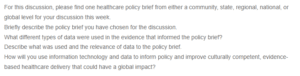
Suicide Policy Brief
For this discussion, please find one healthcare policy brief from either a community, state, regional, national, or global level for your discussion this week.
Briefly describe the policy brief you have chosen for the discussion.
What different types of data were used in the evidence that informed the policy brief?
Describe what was used and the relevance of data to the policy brief.
How will you use information technology and data to inform policy and improve culturally competent, evidence-based healthcare delivery that could have a global impact?