
Strategies to Promote Academic Integrity and Professional Ethics
The Connection Between Academic and Professional Integrity
Academic integrity is an important aspect of academic writing. By academic integrity, I refer to the maintenance of the highest levels of honesty possible when writing all work related to your learning and practice, including your academic assignments, during research, and when publishing your research findings. The relationship between academic integrity and writing can be clearly identified and defined during the development of a student’s academic work or research. It is through writing that students can communicate their ideas with others. It shows how well they have understood the topic they are writing about and how well they can arrange their ideas to be understood by their readers. In this case, they must ensure that they observe the set principles of academic integrity during their writing, including keeping plagiarism at a minimum and avoiding cases of cheating in their academic work. Plagiarism in writing remains to be an academic issue of concern in modern educational settings. Plagiarism occurs when a writer or student cannot paraphrase another person’s ideas or content and cannot define a boundary for using writing materials and content from other sources (Perkins et al., 2020). Plagiarism in academic writing may be unintentional or intentional; regardless of whether intentional or unintentional, plagiarism in academic writing has a negative impact on academic integrity and overall professionalism (Eaton, 2021).
Professional practices and scholarly ethics are related basic elements of academic integrity. Professional practices define the behaviors and codes of conduct that are expected of an individual in their professional capacity and settings. On the other hand, scholarly ethics refers to the set ethical principles and standards that students and professionals must adhere to in practice, research, and in academics. Professional and scholarly practices are related in that they both guide how individuals in professional and academic settings are expected to do their work within their field. For instance, nurses are expected to observe the set Nursing Ethics Code in nursing care. The nursing ethics codes provide guidelines for nurses to carry out their responsibilities to a level of standard that remains consistent with the set standards of quality nursing care as well as the ethics of the nursing profession (American Nurses Association (ANA), n.d.). This means that, as per the nursing professional practices, nurses are expected to observe the ethical standards established in the nursing profession and be honest in the delivery of nursing services. These qualities and the ability to adhere to professional practices are ingrained through a process of learning. Throughout their learning, nurses must adhere to the principles of scholarly ethics, including avoiding plagiarism by ensuring they reference the source materials they utilize in developing their academic work or in developing evidence to support their practice. Glasper (2016) argues that cheating has a long-term negative impact on the integrity of the nursing profession. Additionally, evidence shows that dishonest clinical students within the learning context are more likely to be dishonest within their clinical and practice contexts as professionals (Pittman & Barker, 2020). Therefore, scholarly ethics define the ability to understand and adhere to the expected professional practices.
Do you need urgent assignment help ? Reach out to us. We endeavor to assist you the best way possible.
Tools that improve grammar and detect plagiarism, such as Grammarly, Turnitin, and paraphrasing, contribute immensely to academic integrity (Perkins et al., 2020). Grammarly provides online grammar, punctuation, and sentence structuring tools that can improve the accuracy and readability of a student’s work. Turnitin is a large database of a wide variety of academic resources that helps compare written academic work to detect similarities within the work and other content available across the internet. Additionally, paraphrasing is a skill that enables students to borrow and use ideas of other people and sources in their own words without distorting the meaning of the ideas (Perkins et al., 2020). Therefore, these tools and skills can help a student not only avoid plagiarism and improve the quality of their work but also help them to coherently express their understanding of course content and topic as well as remain original in their writing. Hence, the tools improve the student’s level of academic integrity.
PART 2: Strategies for Maintaining Integrity of Work
As earlier noted, plagiarism can occur intentionally or unintentionally. As an MSN program student at Walden University, I understand that academic integrity is a critical requirement of my learning process as in my practice settings. I have identified various strategies I intend to pursue to maintain integrity and ethics in my academic work as an MSN student and in my professional work as a nurse. As a Walden University student in the MSN program, my first priority is to get more familiar with Walden’s policies related to academic integrity and other guidelines that the university provides to students to improve their academic writing. Secondly, I will explore the resources provided by the Academic Guides at Walden University, especially those that provide guidelines on plagiarism and improving academic writing (Walden University Academic Skills Center, n.d.). Such resources will help me understand how to check for plagiarism, prevent plagiarism, and cite and reference my sources correctly.
Additionally, I will continuously train myself in academic writing to improve my skills on the same. On the other hand, as a nurse in my career settings, I will maintain integrity and ethics in my professional work by first familiarizing myself with the nursing ethics code and other practice guidelines provided by related nursing organizations such as the (American Nurses Association (ANA), n.d.). I will also observe scholarly ethics throughout my learning period to create a good foundation for my future professional practice. Most importantly, I will also adopt a reflective approach to nursing care to ensure that I critically assess all decisions and actions I take against the standards and principles of ethics within my practice settings.
References
American Nurses Association (ANA). (n.d.). The Code of Ethics for Nurses. ANA. Retrieved June 2, 2023, from https://www.nursingworld.org/practice-policy/nursing-excellence/ethics/code-of-ethics-for-nurses/
Eaton, S. E. (2021). Plagiarism in Higher Education: Tackling Tough Topics in Academic Integrity (1st ed.). Libraries Unlimited.
Glasper, A. (2016). Does cheating by students undermine the integrity of the nursing profession? British Journal of Nursing (Mark Allen Publishing), 25(16), 932–933. https://doi.org/10.12968/BJON.2016.25.16.932
Perkins, M., Gezgin, U. B., & Roe, J. (2020). Reducing plagiarism through academic misconduct education. International Journal for Educational Integrity 2020 16:1, 16(1), 1–15. https://doi.org/10.1007/S40979-020-00052-8
Pittman, O. A., & Barker, E. (2020). Academic dishonesty: What impact does it have and what can faculty do? Journal of the American Association of Nurse Practitioners, 32(9), 598–601. https://doi.org/10.1097/JXX.0000000000000477
Walden University Academic Skills Center. (n.d.). Home – Plagiarism Prevention Resource Kit. Retrieved June 2, 2023, from https://academicguides.waldenu.edu/writingcenter/plagiarism
ORDER A PLAGIARISM-FREE PAPER HERE
We’ll write everything from scratch
Question 
Strategies to Promote Academic Integrity and Professional Ethics
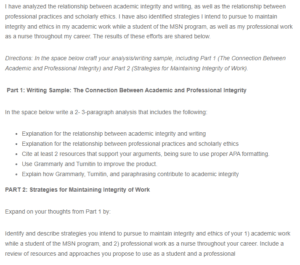
I have analyzed the relationship between academic integrity and writing, as well as the relationship between professional practices and scholarly ethics. I have also identified strategies I intend to pursue to maintain integrity and ethics in my academic work while a student of the MSN program, as well as my professional work as a nurse throughout my career. The results of these efforts are shared below.
Directions: In the space below craft your analysis/writing sample, including Part 1 (The Connection Between Academic and Professional Integrity) and Part 2 (Strategies for Maintaining Integrity of Work).
Part 1: Writing Sample: The Connection Between Academic and Professional Integrity
In the space below write a 2- 3-paragraph analysis that includes the following:
- Explanation for the relationship between academic integrity and writing
- Explanation for the relationship between professional practices and scholarly ethics
- Cite at least 2 resources that support your arguments, being sure to use proper APA formatting.
- Use Grammarly and Turnitin to improve the product.
- Explain how Grammarly, Turnitin, and paraphrasing contribute to academic integrity
PART 2: Strategies for Maintaining Integrity of Work
Expand on your thoughts from Part 1 by:
Identify and describe strategies you intend to pursue to maintain integrity and ethics of your 1) academic work while a student of the MSN program, and 2) professional work as a nurse throughout your career. Include a review of resources and approaches you propose to use as a student and a professional