
Social Determinants of Health
Social determinants of health are factors other than primary healthcare that can be influenced by social policies and contribute to individuals’ thriving in their communities. Social determinants of health shape individuals’ lives in powerful ways and have been a target for modification by governments and other groups seeking to improve the health of individuals in their communities. This paper details an action plan incorporating health promotional strategies for Mr. Kagawa’s family case study. Do you need help with your assignment ? Contact us at eminencepapers.com.
Social Determinants of Health
Healthy People 2030 outlines factors impacting individuals’ quality of life in their communities and groups them into five domains. These are economic stability, access to quality education, neighborhoods, social and community context, and quality healthcare (“Social Determinants of Health – Healthy People 2030 | health.gov”, 2022). Mr. Kagawa’s case is a replica of how social determinants of health (SDOH) affect wellness and well-being.
This family case represents an economically stable, well-off family with access to primary healthcare, clean water, and healthy food. The family members also have access to quality education and enjoy a sound social support system from within the family and the larger neighborhood. The larger neighborhood where Mr. Kagawa lives is generally tranquil, with little evidence of violence, pollution, and other safety risks. Such highlights the affluence of their living conditions and corresponds to their socioeconomic status. All of these contribute to their health and wellness. The family is healthy and knowledgeable in various aspects of health and wellness. A faction of the family, however, lags. The younger family members struggle with unhealthy foods and do not indulge in healthy behaviors such as exercising. The older family members, on the other hand, are skeptical about the healthcare system in the country and do not indulge in health promotional activities targeting them. This is because of their individual beliefs and cultural affiliations. Culture, beliefs, and family shape individuals’ attitudes and health-seeking behaviors (Randolph et al., 2020). All these vices may erode, to some extent, the gains in health and wellness that the family has enjoyed.
Age Appropriate Screenings
The case presented is a multi-generational Asian family coexisting as a single-family unit. All family members are eligible for screening for blood pressure and lipids. Screening for blood pressure and lipids may help early detect hypertension and other cardiovascular disorders. Mr. Kagawa’s mother, his two aunts, and two uncles are all eligible for screening, eye examination, screening for various types of cancer, hearing test, and periodontal examination. This is because, in the elderly, functional losses due to senility and chronic disorders become apparent. Detecting these functional declines may contribute to preserving their lives. Mr. Kagawa’s mother and his two aunts are eligible for bone density examination and ovarian cancer screening. This is because osteoporotic lesions are higher in females aged 65 and above. The CDC also recommends ovarian cancer screening for all women aged 35 and above. Mr. Kagawa and his other uncles are eligible for prostate examination. A prostate exam is recommended for all males aged 40 and above.
Health Model
The social cognitive model is one of the health models that can assist in creating an action plan for Mr. Kagawa’s family. This model describes how environmental factors, the actions of others, or individual experiences influence an individual’s health-seeking behavior. This model emphasizes the significance of the external environment in shaping an individual’s health behavior (Smith et al., 2020). The social cognitive model is the best choice for Mr. Kagawa’s family. This is because most family members have basic knowledge of various aspects of their health and receive constant advice on aspects of their health that may be concerning them. They are also well-educated and can perceive most aspects of their health concerns. This model gives them authority to discern their health concerns and act on them. It also allows them to have control over their health behavior and make an informed decision on their health behavior based on what they see, learn, and experience.
Steps for Health Promotion Plan.
Family-centered health promotion using the social cognitive theoretical provision requires an initial understanding of the family and its constituents. This entails knowing the family’s ability to nurture, teach, and influence their members as well as the psychosocial support system of the family. The second step will be to identify care areas that require health promotion. This will be followed by framing the importance of addressing these family health concerns and identifying specific strategies. Partnering with the family to achieve the required goal is the next step. This is an elaborate step that involves communication with the family members.
Several communication strategies can be utilized while partnering with the family. These include being genuine, paying attention to them, using simple language, empathy, and respecting their beliefs and values (Hyland-Wood et al., 2021). During the communication process, it is essential to emphasize the family’s capacity to effect positive health changes and to empower them to assess and design an effective solution to their health threats (Barnes et al., 2020). All these may influence the family’s health behavior and are pivotal in family-centered health promotion.
Social determinants of health remain essential factors when designing an action plan for health promotional activities within the community. Preserving the health of communities requires addressing areas where communities lag as far as SDOH is concerned. Health promotion models such as the social cognitive model provide a framework for addressing such health concerns. This model also provides a framework for outlining a family-centered health promotion action plan.
References
Barnes, M., Hanson, C., Novilla, L., Magnusson, B., Crandall, A., & Bradford, G. (2020). Family-Centered Health Promotion: Perspectives for Engaging Families and Achieving Better Health Outcomes. INQUIRY: The Journal Of Health Care Organization, Provision, And Financing, 57, 004695802092353. https://doi.org/10.1177/0046958020923537
Hyland-Wood, B., Gardner, J., Leask, J., & Ecker, U. (2021). Toward effective government communication strategies in the era of COVID-19. Humanities And Social Sciences Communications, 8(1). https://doi.org/10.1057/s41599-020-00701-w
Randolph, S., Golin, C., Welgus, H., Lightfoot, A., Harding, C., & Riggins, L. (2020). How Perceived Structural Racism and Discrimination and Medical Mistrust in the Health System Influences Participation in HIV Health Services for Black Women Living in the United States South: A Qualitative, Descriptive Study. Journal Of The Association Of Nurses In AIDS Care, 31(5), 598-605. https://doi.org/10.1097/jnc.0000000000000189
Social Determinants of Health – Healthy People 2030 | health.gov. Health.gov. (2022). Retrieved 1 September 2022, from https://health.gov/healthypeople/priority-areas/social-determinants-health.
ORDER A PLAGIARISM-FREE PAPER HERE
We’ll write everything from scratch
Question 
Assessment Description
Refer to the interview and evaluation you conducted in the Topic 2 Family Health Assessment assignment. Identify the social determinants of health (SDOH) contributing to the family’s health status. In a 750-1,000 word paper, create a plan of action to incorporate health promotion strategies for this family. Include the following:
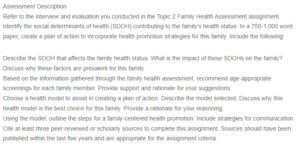
Social Determinants of Health
Describe the SDOH that affects the family health status. What is the impact of these SDOHs on the family? Discuss why these factors are prevalent for this family.
Based on the information gathered through the family health assessment, recommend age-appropriate screenings for each family member. Provide support and rationale for your suggestions.
Choose a health model to assist in creating a plan of action. Describe the model selected. Discuss why this health model is the best choice for this family. Provide a rationale for your reasoning.
Using the model, outline the steps for a family-centered health promotion. Include strategies for communication.
Cite at least three peer-reviewed or scholarly sources to complete this assignment. Sources should have been published within the last five years and are appropriate for the assignment criteria.