
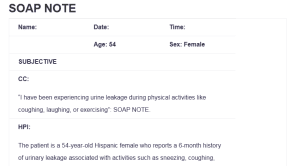
SOAP NOTE
| Name: | Date: | Time: |
| Age: 54 | Sex: Female | |
| SUBJECTIVE | ||
| CC:
“I have been experiencing urine leakage during physical activities like coughing, laughing, or exercising”: SOAP NOTE. |
||
| HPI:
The patient is a 54-year-old Hispanic female who reports a 6-month history of urinary leakage associated with activities such as sneezing, coughing, laughing, or exercising. She states the incontinence has progressively worsened, and she now wears liners daily. Denies urgency, dysuria, nocturia, or hematuria. No fever, chills, or weight loss. She denies any recent UTI but notes that the leakage has affected her quality of life and social engagement. She has not tried any treatments yet. |
||
| Medications:
Lisinopril 10 mg daily – for hypertension Multivitamin – general health |
||
| PMH
Allergies: NKDA Medication Intolerances: None reported Chronic Illnesses/Major traumas; Hypertension Hospitalizations/Surgeries Has never been diagnosed with diabetes, peptic ulcer disease, asthma, lung disease, heart disease, cancer, TB, thyroid issues, kidney disease, or psychiatric conditions. |
||
| Family History
Mother: HTN, DM |
||
| Social History
High school graduate. Works part-time as a receptionist. Married, lives with husband. No tobacco, alcohol, or drug use. Feels safe at home and work.
|
||
| ROS | |
| General
No weight change, no fatigue, no fever or chills |
Cardiovascular
No chest pain or palpitations |
| Skin
No rashes or lesions |
Respiratory
No dyspnea or cough |
| Eyes
No vision changes |
Gastrointestinal
No N/V/D, no abdominal pain |
| Ears
No hearing loss or tinnitus |
Genitourinary/Gynecological
Reports urinary leakage with physical exertion; denies dysuria or urgency
Menopausal x3 years. Last Pap smear 2 years ago—normal. No vaginal discharge |
| Nose/Mouth/Throat
No sore throat or nasal discharge |
Musculoskeletal
No joint pain |
| Breast
No lumps or nipple discharge |
Neurological
Syncope, seizures, transient paralysis, weakness, paresthesias, blackout spells |
| Heme/Lymph/Endo
No bruising, no heat/cold intolerance |
Psychiatric
No depression or anxiety |
| OBJECTIVE | |
| Weight 168 lbs BMI 28.7 | Temp 98.4°F | BP 132/84 |
| Height 5’4” | Pulse 74 | Resp 16 |
| General Appearance
Healthy-appearing adult in no acute distress. |
||
| Skin
Intact, no rashes |
||
| HEENT
Normal findings |
||
| Cardiovascular
RRR, no murmurs |
||
| Respiratory
Clear on auscultation |
||
| Gastrointestinal
Soft, non-tender, no masses |
||
| Breast
Breast is free from masses or tenderness, no discharge, no dimpling, wrinkling, or discoloration of the skin. |
||
| Genitourinary
Bladder non-distended. No CVA tenderness. Normal external genitalia. No lesions. Vaginal walls well rugated. No masses or prolapse noted on bimanual exam. Uterus non-tender. No adnexal masses. |
||
| Musculoskeletal
Normal ROM in extremities |
||
| Neurological
Alert, oriented x3, normal gait and coordination |
||
| Psychiatric
Appropriate mood and affect, cooperative |
||
| Lab Tests
None ordered at this visit
|
| Special Tests
§ Fluorescein Stain Test: Not performed. No signs of corneal abrasion or ulcer based on clinical evaluation. § Visual Acuity Test: Normal in both eyes (20/20), no reported vision changes. § Eversion of Eyelid: Not performed due to absence of foreign body sensation or trauma. § Photophobia Test: Negative. No discomfort upon light exposure. § Lymph Node Palpation: No preauricular or cervical lymphadenopathy palpated.
|
| Diagnosis |
| Differential Diagnoses
o 1- Stress urinary incontinence (ICD-10 Code: N39.3) The patient states that she does not experience urinary urgency or nocturia but only loses urine when the abdominal pressure increases, which confirms the classical manifestation. This is the main diagnosis due to the lack of irritability of the bladder or a lack of infection. o 2- Urge urinary incontinence (ICD-10 Code: N39.41) o 3- Mixed urinary incontinence (ICD-10 Code: N39.46) Although this is still in the differential since it is the result of changes to the bladder associated with aging, the fact that the patient does not experience urgency, frequency, or a nocturic pattern makes this diagnosis less likely in this situation. Diagnosis o Stress urinary incontinence (ICD-10 Code: N39.3) |
| Plan/Therapeutics |
| o Plan:
§ Further Testing: § Urinalysis and urine culture to rule out infection as a contributing factor § Bladder diary for three consecutive days to assess voiding patterns and incontinence episodes § Optional: Referral for urodynamic testing if symptoms persist or fail to improve with conservative management § Medication: § No pharmacologic treatment initiated at this time, as first-line management for stress incontinence is non-pharmacological § Consider vaginal estrogen therapy if vaginal atrophy becomes apparent during follow-up, especially if postmenopausal § Education: § Educate the patient about stress urinary incontinence, risk factors, and prognosis § Review the importance of weight management and avoiding bladder irritants (such as caffeine, alcohol, and carbonated drinks) § Instruct on performing pelvic floor muscle exercises (Kegel exercises) regularly—recommended 3 sets of 10 repetitions daily § Encourage lifestyle modifications, including regular physical activity and avoiding heavy lifting § Non-Medication Treatments: § Referred to pelvic floor physical therapy for guided pelvic strengthening and biofeedback § Advised trial of bladder training techniques (timed voiding) § Discussed potential future options such as pessary use or surgical referral if conservative therapy fails |
| Evaluation of patient encounter
The patient was not only active on the visit but also responsive and attentive. She had some worries about the effect of the urinary leakage on her quality of life, and she was fairly well informed of the diagnosis and prescribed treatment course. The patient asked appropriate questions and did not hesitate to read educational materials and change her lifestyle. She expressed the desire to take up pelvic floor exercises and start keeping a bladder diary. Follow-up would follow to measure the success of conservative management and seek other further interventions in case necessary. |
References
Harris, S., & Riggs, J. (2020). Mixed urinary incontinence. PubMed; StatPearls Publishing. https://www.ncbi.nlm.nih.gov/books/NBK534234/
Lugo, T., & Riggs, J. (2020). Stress incontinence. PubMed; StatPearls Publishing. https://www.ncbi.nlm.nih.gov/books/NBK539769/
Nandy, S., & Ranganathan, S. (2022, September 19). Urge incontinence. PubMed; StatPearls Publishing. https://www.ncbi.nlm.nih.gov/books/NBK563172/
ORDER A PLAGIARISM-FREE PAPER HERE
We’ll write everything from scratch
Question 
Client’s Notes:
- Topic for soap note, 54 yr old woman Hispanic, presents to primary care office to see FNP for “urinary incontinence” or stress incontinence.
- Please use the same format from previous soap note assignments
| Name: | Date: | Time: |
| Age: | Sex: | |
| SUBJECTIVE | ||
| CC:
Reason given by the patient for seeking medical care “in quotes” |
||
| HPI:
Describe the course of the patient’s illness, including when it began, character of symptoms, location where the symptoms began, aggravating or alleviating factors; pertinent positives and negatives, other related diseases, past illnesses, surgeries or past diagnostic testing related to present illness. |
||
| Medications: (list with reason for med ) | ||
| PMH
Allergies:
Medication Intolerances:
Chronic Illnesses/Major traumas
Hospitalizations/Surgeries
“Have you every been told that you have: Diabetes, HTN, peptic ulcer disease, asthma, lung disease, heart disease, cancer, TB, thyroid problems or kidney disease or psychiatric diagnosis.” |
||
| Family History
Does your mother, father or siblings have any medical or psychiatric illnesses? Anyone diagnosed with: lung disease, heart disease, htn, cancer, TB, DM, or kidney disease. |
||
| Social History
Education level, occupational history, current living situation/partner/marital status, substance use/abuse, |
||
SOAP NOTE
| ETOH, tobacco, marijuana. Safety status | |
| ROS | |
| General
Weight change, fatigue, fever, chills, night sweats, energy level |
Cardiovascular
Chest pain, palpitations, PND, orthopnea, edema |
| Skin
Delayed healing, rashes, bruising, bleeding or skin discolorations, any changes in lesions or moles |
Respiratory
Cough, wheezing, hemoptysis, dyspnea, pneumonia hx, TB |
| Eyes
Corrective lenses, blurring, visual changes of any kind |
Gastrointestinal
Abdominal pain, N/V/D, constipation, hepatitis, hemorrhoids, eating disorders, ulcers, black tarry stools |
| Ears
Ear pain, hearing loss, ringing in ears, discharge |
Genitourinary/Gynecological
Urgency, frequency burning, change in color of urine.
Contraception, sexual activity, STDS
Fe: last pap, breast, mammo, menstrual complaints, vaginal discharge, pregnancy hx
Male: prostate, PSA, urinary complaints |
| Nose/Mouth/Throat
Sinus problems, dysphagia, nose bleeds or discharge, dental disease, hoarseness, throat pain |
Musculoskeletal
Back pain, joint swelling, stiffness or pain, fracture hx, osteoporosis |
| Breast
SBE, lumps, bumps or changes |
Neurological
Syncope, seizures, transient paralysis, weakness, paresthesias, black out spells |
| Heme/Lymph/Endo
HIV status, bruising, blood transfusion hx, night sweats, swollen glands, increase thirst, increase hunger, cold or heat intolerance |
Psychiatric
Depression, anxiety, sleeping difficulties, suicidal ideation/attempts, previous dx |
| OBJECTIVE | |
| Weight BMI | Temp | BP |
| Height | Pulse | Resp |
| General Appearance
Healthy appearing adult female in no acute distress. Alert and oriented; answers questions appropriately. Slightly somber affect at first, then brighter later. |
||
| Skin
Skin is brown, warm, dry, clean and intact. No rashes or lesions noted. |
||
| HEENT
Head is normocephalic, atraumatic and without lesions; hair evenly distributed. Eyes: PERRLA. EOMs intact. No conjunctival or scleral injection. Ears: Canals patent. Bilateral TMs pearly grey with positive light reflex; landmarks easily visualized. Nose: Nasal mucosa pink; normal turbinates. No septal deviation. Neck: Supple. Full ROM; no cervical lymphadenopathy; no occipital nodes. No thyromegaly or nodules. Oral mucosa pink and moist. Pharynx is nonerythematous and without exudate. Teeth are in good repair. |
||
| Cardiovascular
S1, S2 with regular rate and rhythm. No extra sounds, clicks, rubs or murmurs. Capillary refill 2 seconds. Pulses 3+ throughout. No edema. |
||
| Respiratory
Symmetric chest wall. Respirations regular and easy; lungs clear to auscultation bilaterally. |
||
| Gastrointestinal
Abdomen obese; BS active in all 4 quadrants. Abdomen soft, non-tender. No hepatosplenomegaly. |
||
| Breast
Breast is free from masses or tenderness, no discharge, no dimpling, wrinkling or discoloration of the skin. |
||
| Genitourinary
Bladder is non-distended; no CVA tenderness. External genitalia reveals coarse pubic hair in normal distribution; skin color is consistent with general pigmentation. No vulvar lesions noted. Well estrogenized. A small speculum was inserted; vaginal walls are pink and well rugated; no lesions noted. Cervix is pink and nulliparous. Scant clear to cloudy drainage present. On bimanual exam, cervix is firm. No CMT. Uterus is antevert and positioned behind a slightly distended bladder; no fullness, masses, or tenderness. No adnexal masses or tenderness. Ovaries are non-palpable.
(Male: both testes palpable, no masses or lesions, no hernia, no uretheral discharge. )
(Rectal as appropriate: no evidence of hemorrhoids, fissures, bleeding or masses—Males: prostrate is smooth, non-tender and free from nodules, is of normal size, sphincter tone is firm). |
||
| Musculoskeletal
Full ROM seen in all 4 extremities as patient moved about the exam room. |
||
| Neurological
Speech clear. Good tone. Posture erect. Balance stable; gait normal. |
||
| Psychiatric
Alert and oriented. Dressed in clean slacks, shirt and coat. Maintains eye contact. Speech is soft, though clear and of normal rate and cadence; answers questions appropriately. |
||
| Lab Tests
Urinalysis – pending Urine culture – pending Wet prep – pending |
| Special Tests |
| Diagnosis |
| Differential Diagnoses
o 1- o 2- o 3- Diagnosis o |
| Plan/Therapeutics |
| o Plan:
§ Further testing § Medication § Education § Non-medication treatments |
| Evaluation of patient encounter |