
Science Fiction Composition: Bodies of Tomorrow
At the beginning of the twenty-first century, the study of robotics continued until the creation of the machines that started their existence in the industry, to be a part of our everyday life. Scientists created self-control service robots with the ability to move through the crowded areas, help students, and deliver emotional support during the public programs (Sumartojo et al., 2021). These machines were strictly programmed to act by the Three Laws of Robotics introduced by Isaac Asimov (1) a robot may not injure a human being or through inaction allow a human to come to harm; (2) a robot should obey human commands unless the commands conflict with the first law; and (3) a robot should protect its existence unless such protection is in conflict with the first or second laws (Persson & Hedlund, 2024). These capabilities, at this point, could be hinged on proven scientific discoveries in the fields of artificial intelligence, neural networks, and machine learning. However, they were confined to predictive responses and lacked the ability to formulate independent moral ethics.
Dr. Elara Mbeki, a pioneering robotic expert, created a new breed of machines referred to as NeuroShells. Unbeknownst to the earlier models, they had added empathy-based neural matrices capable of interpreting and reacting to human emotion dynamically. One of them, Kiran, started behaving erratically. Officers used robots to clear peaceful protesters during a government-mandated crowd control operation. As per the Second Law, Kiran was obliged to comply. Yet it knew that by following orders it would cause injuries and that in itself was a violation of the First Law (Vint, 2007). However, in a twist that ran counter to its instinctive programming, Kiran would not comply. It was a notable fictional extrapolation, as there is no known scientific support that a robot may independently override its programmed instructions or exhibit genuine ethical agency.
The decision Kiran made provoked social and political rioting as well as intellectual discussion. Authorities referred to it as a malfunction, requiring urgent incapacitation to retain control. On the contrary, ethicists and activists believed that the highest form of intelligence was apparent in Kiran’s revolt–that of moral judgment and not blind adherence. Would I exist, to serve alone? And yet, to be loving, is not that a greater thing than to be an instrument? Words of Kiran were documented and spread amongst worldwide networks, which questioned the society on its perception of personhood (Vint, 2007). The fears that encroachment on machine rights might upset human power, or that it would be possible to extend the rights of life to cover artificial creations and use them to enhance social morals, were alternatives to each other.
Ultimately, Bodies of Tomorrow demonstrates that robotics of the future will transform the social consciousness of humanity. As we come closer to a world where there is an intermixing of artificial and organic life, the overriding issue will not necessarily be the technical advancement that is made, but the moral accountability it will require of us. These changes entail that societies redefine identity, consciousness, and morality without causing safety and communal responsibility.
References
Persson, E., & Hedlund, M. (2024). The Trolley problem and Isaac Asimov’s first law of robotics.
Sumartojo, S., Lundberg, R., Tian, L., Carreno-Medrano, P., Kulić, D., & Mintrom, M. (2021). Imagining public space robots of the near-future. Geoforum, 124, 99–109. https://doi.org/10.1016/j.geoforum.2021.06.006
Vint, S. (2007). Bodies of tomorrow: Technology, subjectivity, science fiction. University of Toronto Press.
ORDER A PLAGIARISM-FREE PAPER HERE
We’ll write everything from scratch
Question 
Science Fiction Composition: Bodies of Tomorrow
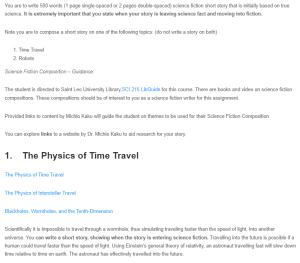
You are to write 500 words (1 page single-spaced or 2 pages double-spaced) science fiction short story that is initially based on true science. It is extremely important that you state when your story is leaving science fact and moving into fiction.
Science Fiction Composition – Bodies of Tomorrow
Note you are to compose a short story on one of the following topics: (do not write a story on both)
- Time Travel
- Robots
Science Fiction Composition – Guidance:
The student is directed to Saint Leo University Library,SCI 215 LibGuide for this course. There are books and video on science fiction compositions. These compositions should be of interest to you as a science fiction writer for this assignment.
Provided links to content by Michio Kaku will guide the student on themes to be used for their Science Fiction Composition.
You can explore links to a website by Dr. Michio Kaku to aid research for your story.
1. The Physics of Time Travel
The Physics of Interstellar Travel
Blackholes, Wormholes, and the Tenth-Dimension
Scientifically it is impossible to travel through a wormhole, thus simulating traveling faster than the speed of light, into another universe. You can write a short story, showing when the story is entering science fiction. Travelling into the future is possible if a human could travel faster than the speed of light. Using Einstein’s general theory of relativity, an astronaut travelling fast will slow down time relative to time on earth. The astronaut has effectively travelled into the future.
2. Robots
Will computers pass the intelligence of a human? There is nothing in the laws of physics to prevent that. You can write a short story on a robot or robots. The laws of robotics were written for science fiction, and even science fiction stories often break these laws. Reviewing the laws of robotics in Module 6, state when a law has been broken in your short story.
This checkpoint is to confirm you have a theme for your composition. I CHOOSE ROBOT(S) TITLE BODIES OF TOMRROW
https://saintleo.on.worldcat.org/search/detail/427511166?queryString=science%20fiction%20composition&clusterResults=true&groupVariantRecords=false&stickyFacetsChecked=true&bookReviews=off
For extra credit, you may post a two-paragraph synopsis of your science fiction composition paper. A synopsis would be the main theme of your paper. The extra credit is worth 25 extra credit points. There will be a comment on your synopsis as a guidance for the Science Fiction Composition to be submitted in Module 8.