
School Social Work Intervention Plan: Bullying in School
Introduction
This intervention plan aims to provide a response strategy for addressing a common issue in the school setting: bullying. As a school social worker, I will develop a detailed intervention plan that incorporates micro, meso, and macro-level intervention strategies. The intervention plan will draw upon an anti-racist, anti-oppressive model, which adheres to Bettina Love’s (2019) abolitionist approach, advancing educational justice, healing, and fighting against an oppressive system (Love, 2019). Bullying, particularly school bullying, is a breach of students’ rights to mental well-being, school performance, and overall health. It is vital to address this menace not only for the immediate protection of students but to challenge ingrained problems such as racism, ableism, homophobia, and classism that underpin the menace.
School bullying is a common phenomenon that has a massive influence on students’ social, emotional, and academic lives. At the national level, nearly one in five American students report being bullied, and these students are more likely to suffer from depression, anxiety, and academic underachievement (CDC, 2024). Social inequality further complicates the issue because it disproportionately targets already marginalized groups of students such as Black, Indigenous, and LGBTQ+ students. This intervention plan aims not only to reduce bullying but also to foster a culture where every student feels secure, respected, and nurtured. Through the inclusion of Love’s abolitionist strategy, I aim to reinforce students’ wellness and prepare them for a justice-centered future focused on healing and happiness.
Assessment Plan
The initial implementation strategy of the intervention plan is to determine the level and magnitude of bullying at the school setting. My role as a school social worker would entail starting by a collection of quantitative and qualitative data as regards to bullying. This will involve the examination of school reports to determine the trends in bullying, like their occurrence, place and the perpetrators. Moreover, I would use such tools as surveys, focus groups, and separate interviews with the students, teachers, and employees to learn more about the culture of bullying at the school. Such approaches would assist in accumulating the knowledge on the forms of bullying, such as physical, verbal, and cyberbullying, as well as on the student groups that are impacted the most often by the bullying phenomenon, and on the causal factors of the occurrence of these behaviors (Namey et al., 2021). As an example, a survey may demonstrate that bullying could be more likely in certain places around the school, such as cafeteria or playground, or that LGBTQ + students are especially susceptible.
In the assessment, it will be about acquiring different stakeholders which will include the teachers, counselors, administrators, and parents where they will make their own executions. Teachers will provide parent with insights that refer to the behavior of students in classes and parents are able to share what their child experienced. Also, students who are the major victims of bullying will need to be included in the assessment. They will give meaningful contribution either by conducting interviews or focus groups by giving them their personal exposures and proposed solutions. The assessment will be comprised of all who are involved in the situation and thereby we will have full picture of what is going on and make the intervention plan informed and accepted. Such teamwork will raise awareness of collective responsibility in solving the problem of bullying and building the culture of inclusion and respect.
Besides surveys and interviews, the observation will be conducted to track the bullying behaviors in real-time. Social workers and staff can identify places where bullying has the highest likelihood of taking place by monitoring students at strategic time of the day, including recess, lunch, or transition time. Such observances will note certain environmental observations such as a congested hallway or unmonitored areas that will product possibly be a source of bullying. Monitoring of these trends will mean more pertinent information of where and when bullying occurs so that more focused remedial measures can be taken.
To further enhance the assessment process, school social workers will coordinate with external facilities, such as local community organizations and mental health providers. Such outside collaborators may have more information concerning the underlying factors of bullying, such as socioeconomic stresses, family issues as well as community factors. This is because by using outside-school perspectives, we can identify factors that may influence students’ behavior in ways that are not easily observable in the school environment.
Development of the Intervention Plan
After the assessment has been made, an elaborate intervention plan will be formulated to address bullying through three levels, individual, group, and school-wide. The multi-tier intervention will be used which means that along with prevention strategies; it will include specific measures used to intervene at the early level and also provide more intensive work with those students requiring additional assistance. To ensure this, all the stakeholders such as the teachers, the administrators, the parents, as well as the community organizations will be involved in the plan development. The involvement of these stakeholders would make the intervention practical and relevant to the school environment and culturally adapted. This will also make the plan to be appropriate to the needs of the school and the students.
The intervention plan will be organized in accordance to the various levels of support commencing with the universal strategies and taking to more specific and personalized interventions. At Tier I, everyone will be invited and encouraged to embrace a positive school climate by promoting school wide programs. These will comprise the use of anti-bullying programs, empathy and respect in every classroom, and the use of social-emotional learning (SEL) curriculum. The aim of the SEL programs is to help students to learn how to understand and control their emotions, have a healthy relationship, and solve conflicts in a non-violent form (Bailey et al., 2021). The main objective of Tier I is to create a culture in which students are respected and valued as an individual so that the occurrence of bullying behaviors does not take place in the first place.
Tier II will involve an intervention of the students either at-risk of being bullies, or those who have already been labeled as bullies. Such students will be offered more specific and targeted support in order to fix their behavior. The interventions will be the implementation of small-group counseling sessions, behavior modification strategies, and peer mediation programs that will enable the students to acquire better social-emotional skills and strategies on how they can differently communicate with other people. As an example, those students who have perpetrated bullying will be referred into a restorative justice program through which they will get a chance to interact with the victim, presumably give an apology and collectively find a way to fix the damage done. These Tier II interventions are aimed at offering additional support to students and making them aware of the consequences of their behavior and facilitating their progress to healthier and more respectful behaviors.
The intervention, at the Tier III level, will focus on students who require more intensive, individualized help. These pupils maybe those who have been the subjects of severe bullying or those whose bullying is more ongoing and harmful. Tier III intervention may include one-to-one counseling, trauma-informed treatment, and coordination with community-based interventions for dealing with the issues behind the bullying behavior. In some cases, pupils may require additional support in areas such as mental health, family functioning, or academics. Through being individualized, the intervention can address the personal needs of every learner and facilitate long-term positive outcomes (Ali et al., 2024). Throughout the intervention process, regular progress monitoring shall be conducted, and adjustments shall be made as necessary to ensure that the strategies are proven effective in reducing bullying and enhancing student well-being.
Intervention Plan
Micro-Level Interventions
A micro-level intervention strategy will be aimed at providing individual and small group assistance to students directly involved in bullying, whether as the bullied or the bullies. Tier I will focus on developing a positive and affirming school climate where every student can feel safe, valued, and respected. This can be achieved through initiatives such as anti-bullying programs across schools, guidance class lessons on empathy and respect, and the integration of social-emotional learning (SEL) into the curriculum. SEL curricula, such as the Second Step program, function to teach students about recognizing and managing their emotions, problem-solving, and establishing healthy interpersonal relationships (Hosokawa et al., 2025). Such programs can deter bullying by promoting a culture of respect and mutual understanding among individuals.
At the Tier II level, intervention will incorporate assistance to students found to be engaged in bullying activities or suspected to have been treated as bullies. Where students are identified as perpetrators of bullying, the remedies will strive to make them aware of the implications of their actions and help them learn to relate to others differently. These may include items such as Check-In Check-Out (CICO), where students check in with a trusted adult at the beginning and end of each day to discuss goals and progress (Sottilare & Blair, 2023). In the case of the bullied students, Tier II interventions will focus on having them provided with emotional support and offered a safe environment in which they will be able to vent their frustrations and be counseled. This could be achieved through group counseling sessions, where students can open up to one another and gain insight into how they can cope with it.
Tier III will be more intensive and provide one-to-one support to students who require it. It is possible that they have a long history of being bullied or that they have extreme social-emotional issues that lead to bullying. The Tier III interventions will offer the most intensive programs to the students who experience great challenges pertaining to bullying either as victims or the bullies. The school social worker or the school psychologist will counsel these students one on one and in a manner that conforms to their needs. There can also be a referral of community-based mental health services so that they get proper external support. On the one hand, trauma-informed care will be included in the interventions of some students due to the fact that any traumatic experience can affect their behavior. Trauma-informed approaches will be associated with healing and individual development, as well as enabling students to process their experiences and learn more positive coping strategies (Waseem & Nickerson, 2023). Tier III interventions are aimed to treat the roots of bullying often characterized by unresolved issues on the emotional level and lead to long-term emotional and behavioral change and help students overcome their difficulties.
Meso-Level Interventions
Tier I interventions are based on prevention of bullying through a positive school environment. The introduction of social-emotional learning (SEL) curriculums, such as the “Second Step” curriculum, will assist students in regulating their emotions, empathy and making responsible choices. The skills will make students handle conflicts positively and deal with each other in a respectful manner. Additional awareness about the harmful effects of bullying and the importance of inclusivity will be brought to the schoolwide with the help of anti-bullying assembly and Unity Days (Gaffney et al., 2021). With this, every student will feel appreciated and valued.
Tier II interventions target students that have the risk factors of being bullied or bullies. Such students will be given special attention with peer mentoring schemes to establish healthy relationships and conflict-resolving measures. Educators and school employees will be guided with the recognition of the earliest signs of bullying and how to deal with it (Gaffney et al., 2021). In the case of the participants of the bullying, the small-group counseling will involve the treatment of the underlying reasons of the behavior and the skill of managing their emotions and interacting with others more effectively.
Tier III interventions involve highly supportive measures to students whose bullying is persistent or have experienced severe effects of bullying. Such students will be counseled individually in order to deal with some underlying problems such as either trauma or emotional distress. One of these components will involve trauma-informed care and in particular to the victims of bullying. Furthermore, students can be directed to the community-based mental health where they can get additional assistance, so they will have an opportunity to obtain the care they require to facilitate the healing process and long-term behavioral change.
Macro-Level Interventions
At the macrosystem level, the intervention strategy will address bullying by targeting district-wide policies, state legislation, and nationwide initiatives aimed at establishing a safer and more welcoming school environment for all students. The priority is to ensure that anti-bullying policies are well-defined and consistently applied throughout the district. This includes creating or revising district-level policies to indicate that bullying is defined comprehensively, including all forms of bullying, such as physical, verbal, and cyberbullying, and marginalized groups, such as LGBTQ+ students and students with disabilities. The policies must be followed by clear procedures for reporting bullying, investigating bullying incidents, and providing assistance to victims. It is imperative that such policies comply with state law and that school districts collaborate to share best practices and resources for successfully implementing anti-bullying strategies.
The provision of continuous professional development training on the topic of bullying to educators, administrators, and school personnel, focusing on recognizing behavior, responding to incidents of bullying, and creating a positive school climate, is another fundamental constituent at the macro level (Burger et al., 2022). This can also include master’s and doctoral degree programs in teaching the use of restorative justice methods that have been found to deter bullying and provide individuals with a sense of responsibility, without resorting to fines. In addition to professional training, schools should also allow parents and the community to become actively involved in the process of preventing bullying. The latter can be achieved through parent-teacher conferences, community programs, and partnerships with local agencies that operate in the fields of mental health, youth development, and social justice. The creation of a network of families and community groups beyond the school implies that the intervention plan will address the issue of bullying on multiple levels and will be useful in helping students obtain the necessary services to achieve succeed.
The adoption of curricula that promote diversity, equity and respect is one key measure that school districts should take. This may encompass, among others, the introduction of anti-racism and anti-oppression education into an already existing school curriculum and the support of the performance of previously marginalized groups (Banerjee et al., 2023). These education programs will be useful in establishing a culture of inclusiveness in schools where students will learn about the appreciation of differences and diversity. Moreover, school systems will have to promote the policies able to correct systemic disparities in education, including unequitable access to resources, which may lead to the occurrence of negative behaviors, including bullying. A thorough intervention plan must be implemented to create a healthy and supportive atmosphere so that long-term changes across the system can be achieved to empower all learners to succeed and feel appreciated.
Connecting Plan to Love’s (2019) Abolitionist Approach
The above-proposed tiered intervention plan is closely interconnected with the abolitionist approach to ending bullying in schools developed by Bettina Love (2019), who promotes the abandonment of the historically punitive approach to healing, justice, and the freedom of marginalized students. One of the greatest concepts of the abolitionist approach by Love (2019) is the theory of mattering; that is, all students, especially those who are oppressed, should feel they matter in order to continue living (Love, 2019). This intervention plan emphasizes the importance of ensuring that every student feels respected, appreciated, and valued, regardless of their background or identity. The plan will help create a sense of belonging and importance for all students within their school community by promoting restorative approaches to discipline rather than punitive measures.
The concept of a spirit murder, as introduced by Love (2019), which implies the emotional and psychological damage committed to students by the mechanism of oppression, is mentioned in the suggested interventional plan as well. Racial, gender-based, or sexual forms of bullying can cause significant emotional harm and break down the self-esteem of a student (Ibrahim et al., 2024). Minimizing such harm and helping students with the recovery process are the reasons the intervention plan focuses on trauma-informed care and restorative justice. Specifically, restorative practices provide learners with an opportunity to repair, understand the lessons of their wrongdoing, and collaborate on a pathway to healing, which negates the state of spirit murder.
The second component of the Love abolitionist strategy that is critical to the work is what I describe as freedom dreaming, that is, dreaming of a future where the central aspects of human life are justice, healing, and joy, without being weighed down by the oppressive systems that generate them. This plan shares this vision, and one way the plan achieves this vision is by providing provisions that not only foster the intellectual development of students but also their emotional, social, and psychological well-being. By establishing empathy, respect, and inclusivity as the foundation of personal development, the plan aims to dismantle the systemic obstacles that generally contribute to bullying, ensuring that none of the students are undermined about their identity and enthusiasm. In addition, the strategy tackles the underlying causes of bullying, including poverty, trauma, and societal inequality, by putting in place measures to facilitate healing and resilience.
Lastly, the emphasis on critical race theory and decolonization by Love (2019) aligns with the perspective of the intervention plan that considers the situation of bullying as a manifestation of the bigger injustice in the society (Love, 2019). The plan also considers that bullying is frequently rooted in more fundamental systems of racism, classism, ableism, and different types of oppression. The plan entails education, policy change, and community involvement in the remedy of these established causes. Focusing on the experience of marginalized students and pushing to transform the education system as a whole, the strategy is aligned with the idea expressed by Love (2019), who called on the notion of abolitionist approach to schooling to help dismantle the negative patterns and construct a new learning system that is not only more equitable but also holds justice to all students.
Accountability and Evaluation
Accountability in this intervention plan should be based on justice, love, healing, and reconstruction of humanity, as stressed by Love (2019). It implies that all stakeholders of the plan implementation, including parents, school social workers, teachers, administrators, and residents of the community, should actively work on its success and equity (Salmivalli et al., 2021). As part of establishing a notion of shared responsibility, there will be continuous monitoring to monitor the effectiveness of intervention and how effective it is in the reduction of bullying and implementation of a more inclusive environment. Student, staff, and family feedback will be continuously taken to assess the effectiveness of the strategies, and establish the areas that need new measures. Also, continuous professional development will be introduced to the staff to support their self-awareness and their anti-racist and trauma-informed skills so that the entire school community is ready to help the intervention be successful and yield long-term positive results.
Documentation of bullying incidents, assessment of the interventions, and tracking and reporting patterns will be a major part of the accountability process. This will entail the collection of information on how frequent and what kind of bullying occurs, as well as an evaluation of the results of the interventions at each level. The effectiveness of the intervention would be determined by inviting students, staff, and parents to discuss and answer the surveys on their views on the tool’s effectiveness and the effect it produced on the school (Totten et al., 2020). They will provide the insights that will be used to assess the extent to which the intervention is meeting its objectives, including mitigating bullying, changing the culture to a culture of inclusivity and the aspect of fostering respect at the school. Such quality feedback will play an important role in intervention refinement so that the latter could be flexible and adaptable to the changing needs of the school community. Through the inclusion of different perspectives, the intervention plan will be constantly updated and keep track of the issues affecting the school. In the end, through such a feedback loop, the long-term success and sustainability of the initiative can be facilitated.
Accountability will involve constant self-reflection, and professional growth of every school staff member regardless of external assessments. Teachers, administrators, and social workers will receive training on a regular basis, and training will touch on such relevant areas as facilitating inclusivity, conflict-solving, and comprehending trauma (Chloë Finet et al., 2023). Such meetings will enable employees to work out their prejudices, enhance the way they deal with bullying, and increase their determination to establish a safe and friendly environment among all students. Moreover, collective accountability should also be incorporated as this will motivate every member of the school to take an active involvement in promoting the ethics of respect, compassion, and fairness. Such work with the intervention plan will facilitate its proper implementation and modification to the requirements of the school over the whole year.
Conclusion
Concisely, a comprehensive intervention plan to address the problem of bullying in schools needs to be supported by a multi-tier and multimodal plan encompassing prevention, early intervention, and intensive services for students. This is based on the abolitionist perspective of Bettina Love, which rests on justice, love, the healing process, and the removal of oppressive systems. The strategic plan involves the use of restorative justice, trauma-informed care and community engagement in the process of building a school culture, in which all students are respected, valued, and supported. Although some difficulties in the implementation might emerge, especially in underprivileged schools or in situations where the staff resist, the long-term outcomes of establishing a safe and inclusive environment are much more successful than these short-term setbacks. The proposed intervention strategy is intended to implement a long-term change in approaching bullying at the micro, meso, and macro levels, gradually decreasing bullying and favoring positive social-emotional development, academic performance, and well-being among all the students. Finally, this plan will establish an image of a school in which all the students will succeed, rather than just maintain, and the core principles of the school life will be based on the ideas of healing, justice, and equity.
References
Ali, M., Wahab, A., Hasniza Zaman Huri, & Muhamad Saiful Yusoff. (2024). Personalised learning in higher education for health sciences: a scoping review protocol. Systematic Reviews, 13(1). https://doi.org/10.1186/s13643-024-02478-4
Bailey, R., Raisch, N., Temko, S., Titus, B., Bautista, J., Eniola, T. O., & Jones, S. M. (2021). Innovations in Social and Emotional Learning Research and Practice: Building from Evidence and Applying Behavioral Insights to the Design of a Social and Emotional Learning Intervention in Northeast Nigeria. International Journal of Environmental Research and Public Health, 18(14), 7397. https://doi.org/10.3390/ijerph18147397
Banerjee, A. T., Tan, A., Boston-Fisher, N., Dubois, C.-A., LaFontaine, A., Cloos, P., Vissandjee, B., Adams, J., Hafeez, H., Bumba, S., Kernisan, K., Ferlatte, O., Razack, S., Edwards, M. M., & Evans, T. (2023). Embedding anti-racism in Schools of Public Health: a pathway to accountability for progress towards equity. Canadian Journal of Public Health = Revue Canadienne de Sante Publique. https://doi.org/10.17269/s41997-023-00796-z
Burger, C., Strohmeier, D., & Kollerová, L. (2022). Teachers Can Make a Difference in Bullying: The Effects of Teacher Interventions on Students’ Adoption of Bully, Victim, Bully-Victim, or Defender Roles over Time. Journal of Youth and Adolescence, 51(12). https://doi.org/10.1007/s10964-022-01674-6
CDC. (2024, October 28). About Bullying. Youth Violence Prevention; CDC. https://www.cdc.gov/youth-violence/about/about-bullying.html
Chloë Finet, Vandebosch, H., Anouck Lubon, & Colpin, H. (2023). Supporting teachers in actively responding to bullying and building positive relationships with their students: The effects of the T-SUPPORT training. Frontiers in Psychology, 14. https://doi.org/10.3389/fpsyg.2023.1236262
Gaffney, H., Ttofi, M. M., & Farrington, D. P. (2021). Effectiveness of school‐based programs to reduce bullying perpetration and victimization: An updated systematic review and meta‐analysis. Campbell Systematic Reviews, 17(2), 1–102. https://doi.org/10.1002/cl2.1143
Hosokawa, R., Riho Tomozawa, & Fujimoto, M. (2025). Effectiveness of second step program in fostering social-emotional skills in young children: a study in Japan. BMC Pediatrics, 25(1). https://doi.org/10.1186/s12887-025-05624-6
Ibrahim, F. M., Rashad Dabou, E. A., AbdulSamad, S., & Abuijlan, I. A. M. (2024). Prevalence of bullying and its impact on self-esteem, anxiety and depression among medical and health sciences university students in RAS Al Khaimah, UAE. Heliyon, e25063. https://doi.org/10.1016/j.heliyon.2024.e25063
Love, B. L. (2019). We want to do more than survive: Abolitionist teaching and the pursuit of educational freedom. Beacon Press.
Namey, E., Guest, G., O’Regan, A., Godwin, C. L., Taylor, J., & Martinez, A. (2021). How does qualitative data collection modality affect disclosure of sensitive information and participant experience? Findings from a quasi-experimental study. Quality & Quantity, 56. https://doi.org/10.1007/s11135-021-01217-4
Salmivalli, C., Laninga‐Wijnen, L., Malamut, S. T., & Garandeau, C. F. (2021). Bullying Prevention in Adolescence: Solutions and New Challenges from the Past Decade. Journal of Research on Adolescence, 31(4), 1023–1046. https://doi.org/10.1111/jora.12688
Sottilare, A. L., & Blair, K.-S. C. (2023). Implementation of Check-In/Check-Out to Improve Classroom Behavior of At-Risk Elementary School Students. Behavioral Sciences, 13(3), 257. https://doi.org/10.3390/bs13030257
Totten, V., Simon, E. L., Jalili, M., & Sawe, H. R. (2020). Acquiring data in medical research: A research primer for low- and middle-income countries. African Journal of Emergency Medicine, 10(2), S135–S139. https://www.sciencedirect.com/science/article/pii/S2211419X20301051
Waseem, M., & Nickerson, A. B. (2023). Identifying and Addressing Bullying. PubMed; StatPearls Publishing. https://www.ncbi.nlm.nih.gov/books/NBK441930/
ORDER A PLAGIARISM-FREE PAPER HERE
We’ll write everything from scratch
Question 
School Social Work Intervention Plan: Bullying in School
SCHOOL SOCIAL WORK INTERVENTION PLAN
1. PURPOSE OF THE ASSIGNMENT
School Social Work Intervention Plan – Bullying in School
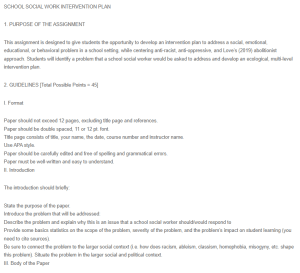
This assignment is designed to give students the opportunity to develop an intervention plan to address a social, emotional, educational, or behavioral problem in a school setting, while centering anti-racist, anti-oppressive, and Love’s (2019) abolitionist approach. Students will identify a problem that a school social worker would be asked to address and develop an ecological, multi-level intervention plan.
2. GUIDELINES [Total Possible Points = 45]
I. Format
Paper should not exceed 12 pages, excluding title page and references.
Paper should be double spaced, 11 or 12 pt. font.
Title page consists of title, your name, the date, course number and instructor name.
Use APA style.
Paper should be carefully edited and free of spelling and grammatical errors.
Paper must be well-written and easy to understand.
II. Introduction
The introduction should briefly:
State the purpose of the paper.
Introduce the problem that will be addressed:
Describe the problem and explain why this is an issue that a school social worker should/would respond to
Provide some basics statistics on the scope of the problem, severity of the problem, and the problem’s impact on student learning (you need to cite sources).
Be sure to connect the problem to the larger social context (i.e. how does racism, ableism, classism, homophobia, misogyny, etc. shape this problem). Situate the problem in the larger social and political context.
III. Body of the Paper
In the main body of your paper, you should present:
Assessment Plan
If you were a school social worker, how would you assess the extent of this problem in your school?
What type of assessment tools would you use?
Who would be involved in the assessment process?
Development of the Intervention Plan
Once you had assessed the problem, describe the process you would engage in when developing the intervention plan.
Who would you consult with when developing an intervention plan?
Intervention Plan
Micro & meso-level interventions (student-level & school-level)
Within the micro & meso-levels present a multi-tier structure of interventions. That is, give examples of how the problem would be addressed at Tier I, Tier II, and Tier III.
Macro-level interventions (district-level or broader – city/state/national policy level)
Justify your use of each specific intervention
Cite the literature on specific intervention models, when possible
When no specific intervention models are relevant, cite literature that would justify your approach to the issue.
Connections to Love’s (2019) Abolitionist Approach
Discuss how your multi-tiered intervention plan could be rooted within an abolitionist approach.
How does your plan address some of the key concepts that Love (2019) discusses, particularly as it pertains to children who are often marginalized in schools? Possible concepts to consider include:
Spirit Murdering
Educational Survival
Mattering
Freedom Dreaming
Critical Race Theory, Settler Colonialism
Accountability / Evaluation
Love (2019) urges us to think of accountability in terms of holding ourselves accountable for “justice, love, healing, and restoring humanity”
As you implement this intervention plan, how could you hold yourselves and your colleagues accountable for keep these values at the center of your work; how could you keep yourselves accountable for your intervention plan leading to freedom, healing, and joy for students?
IV. Conclusion
· Share closing thoughts/reflections on the intervention plan, including a discussion of any challenges or limitations you see to your plan.