
Scheduling and Staffing
Staffing Available
- 5 RN 2 LPN 2 NA
- 30 patients
Acuity Level 1 – 6 Patients
- Room 2301 Susan is a 93-year-old who fell at home and is waiting for nursing home placement. She uses a walker and requires assistance to the bathroom and ADLs
- Room 2312 Fredrick is a 57-year-old recovering from a knee replacement, needs educational reinforcement and is going home today.
- Room 2319 Joshua is a 63-year-old who was in for cardioversion and is going home today.
- Room 2329 Brian is a 49-year-old who has been diagnosed with hypertension and Alzheimer’s disease who wanders off the unit and needs assistance with ADLs.
- Room 2304 James is a 95-year-old who has osteoarthritis and needs help getting out of bed, bathing, and dressing.
- Room 2307 Francis is a 39-year-old who will be discharged today. She received discharge teaching yesterday about her ruptured appendix wound and wants to review the care instructions before she leaves.
Acuity Level 2 – 8 Patients
- Room 2302 Brooke is a 33-year-old who was admitted with new-onset DM with uncontrolled blood sugars. She has started on new medications, including insulin, and needs additional patient and family education.
- Room 2311 Mark is an 83-year-old who is in isolation for MRSA and is on IV antibiotics and ten other medications.
- Room 2320 Jeffrey is a 63-year-old who is non-compliant with his medications and came in with hypertension and crackles in his lungs. He has daily labs and has a wound on his left foot.
- Room 2330 Leslie is a 46-year-old who had unstable angina and had a cardiac catheterization yesterday late afternoon and stayed over for observation.
- Room 2305 Traci is a 72-year-old who has a history of heart disease, a history of myocardial infarction, and mild dementia.
- Room 2308 Alecia is a 33-year-old who was experiencing chest pain and is scheduled for a stress test later today.
- Room 2303 Theodore is a 22-year-old who has had DM since he was a 10-year-old and requires medication adjustments.
- Room 2318 Bruce is a 45-year-old who was placed in isolation for C-Diff and is on several IV medications.
Acuity Level 3 – 9 Patients
- Room 2306 Amelia is an 83-year-old after a stroke and requires total care.
- Room 2313 Audrey is a 78-year-old with newly diagnosed COPD.
- Room 2317 Abigail is a 90-year-old who is a diabetic with a chronic leg infection.
- Room 2328 Roxanne is an 82-year-old with newly diagnosed lung cancer.
- Room 2322 Nancy is a 56-year-old with chronic kidney disease and on peritoneal dialysis.
- Room 2323 Dennis is a 35-year-old who was admitted with right upper quadrant pain that radiates to the right shoulder.
- Room 2314 Roger is a 46-year-old who is wasted and malnourished. She has severe diarrhea.
- Room 2309 Terry is a 59-year-old who has bladder cancer with painless hematuria.
- Room 2310 Barry is a 54-year-old with a history of mitral valve regurgitation.
Acuity Level 4 – 7 Patients
- Room 2315 Karen is a 45-year-old who had an acute myocardial infarction with percutaneous coronary intervention.
- Room 2321 Fredrick is a 43-year-old who was admitted after an overdose and required close monitoring.
- Room 2327, Samantha is a 57-year-old with severe abdominal pain with no bowel sounds.
- Room 2324 Robbie is a 62-year-old who has been vomiting and having pain in the abdomen.
- Room 2325 Jenny is a 58-year-old MVA who has a tracheostomy.
- Room 2326 Annette is a 68-year-old who had a bowel resection and colostomy.
- Room 2316, David is a 54-year-old with weakness and a decreased level of consciousness.
| RN 1 | RN 2 | RN 3 | RN 4 | RN 5 | |||||
| Room # | Acuity | Room # | Acuity | Room # | Acuity | Room # | Acuity | Room # | Acuity |
| 2321 | 4 | 2327 | 4 | 2315 | 4 | 2325 | 4 | 2326 | 4 |
| 2330 | 3 | 2317 | 3 | 2322 | 3 | 2323 | 3 | 2313 | 3 |
| 2318 | 3 | 2328 | 3 | 2316 | 4 | 2306 | 4 | 2310 | 3 |
| LPN 1 | LPN 2 | CNA 1 | CNA 2 | Staff
· 5 RN · 2 LPN · 2 CNA 30 patients · Six acuity level 1 · 8 acuity level 2 · 9 acuity level 3 · seven acuity level 4 |
|||||
| Room # | Acuity | Room # | Acuity | Room # | Acuity | Room # | Acuity | ||
| 2308 | 2 | 2305 | 2 | 2304 | 1 | 2311 | 1 | ||
| 2309 | 2 | 2324 | 2 | 2314 | 1 | 2329 | 1 | ||
| 2320 | 2 | 2305 | 2 | 2307 | 2 | 2301 | 1 | ||
| 2302 | 2 | 2311 | 2 | 2319 | 1 | ||||
How I would direct the staff to their assigned roles for this shift
Staff shortage is one of the healthcare problems in healthcare facilities. Having enough staff in a health facility is essential for providing high-quality care. However, when there is less staff, they should be utilized properly to offer high-quality services. One of the major functions of managers is directing. Directing available staff based on their shifts and roles ensures patients get high-quality care. A nurse manager should consider the level of skills, the experience of the nurses, and the understanding of the patient when directing staff in terms of shifts and roles.
In terms of skills, a nurse manager should ensure a mixture of skills among the nurses providing care to patients. RNs and LPNs have different skills and knowledge, so the manager should ensure that each shift has a mixture of RNs and LPNs. Some complex tasks LPNs cannot perform, yet they can be achieved by RNs (Geng, Stevenson & Grabowski, 2019). RNs also know much about managing patients, such as using the nursing care process. Thus, each shift should have a mixture of both RN and LPN. Mixing of the staff also ensures that the care provided is evidence-based, which leads to high-quality care. The team should also be distributed evenly to ensure each patient receives high-quality care.
In this case, levels three and four have patients with more understanding, requiring a nurse with more skills and knowledge. RN nurses, therefore, should provide care to patients in levels four and three since they have more training in managing patients with complex conditions (Geng, Stevenson & Grabowski, 2019). Patients presenting with respiratory and cardiac complications require well-trained nurses with more knowledge of respiratory and cardiac diseases to provide high-quality care. In levels 3 and 4, with high acuity, the nurse-patient ratio is 1:3, where one nurse provides care for three patients. This ratio ensures that all patients are well managed to prevent complications and address their needs. Those patients who have less understanding and who are at low risk of developing complications can be governed by the LPN or certified nurses. However, LPNs caring for the patients should be supervised by an RN.
How would I communicate with each level of care provider to ensure the best outcomes possible
Communication in a healthcare organization is essential in ensuring that high-quality care is provided to patients. There should be proper communication at each level to prevent role confusion and to pass instructions related to the roles of the nurses effectively. Instructions should be passed to the certified nurses and LPN in a clear way to prevent confusion and to promote the education of the nurses in the provision of care to patients at all levels.
One of the ways to communicate with each level is by holding meetings every morning before the beginning of the shifts. In the morning shifts, communicating what each group is expected to do will be communicated effectively. It is also through the meeting that the challenges of previous changes can be discussed and possible solutions suggested. Proper communication will also be done through the education and training of nurses at each level through continuous meeting education where the LPNs and the certified nurses are reminded of best practices for caring for the patients. Some essential information will be communicated to RNs as team leaders, who later pass the information to other levels.
How would I ensure client equity in the delivery of services?
The intensity of care provided to patients depends on their conditions and expected outcomes. To ensure client acuity, patients with complex needs will first be identified (Chiulli, Thompson & Reguin-Hartman, 2014). Patients at risk of respiratory and cardiac complications require high-intensity care. More sick patients should be identified, and appropriate staff signed to the patients to provide care. Registered nurses will be assigned to care for patients who need more intensive care (Chiulli, Thompson & Reguin-Hartman, 2014). Patients requiring less intensive care will be given to certified LPNs. RNs will, however, be tasked with monitoring the licensed and LPNs.
References
Chiulli, K. A., Thompson, J., & Reguin-Hartman, K. (2014). Development and implementation of a patient acuity tool for a medical-surgical unit. Medsurg Matters, 23(2), 1-12.
Geng, F., Stevenson, D. G., & Grabowski, D. C. (2019). Daily nursing home staffing levels are highly variable, often below CMS expectations. Health Affairs, 38(7), 1095-1100.
ORDER A PLAGIARISM-FREE PAPER HERE
We’ll write everything from scratch
Question 
Scheduling and Staffing
Leadership and Professional Identity Staffing-Scheduling and Staffing
Module 05 Content
Scheduling and Staffing
Competency
Collaborate in healthcare delivery systems settings for improved patient outcomes.
Scenario
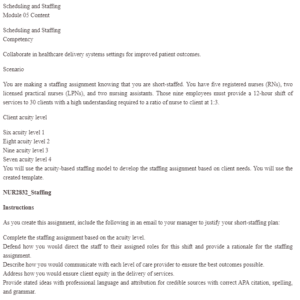
You are making a staffing assignment knowing that you are short-staffed. You have five registered nurses (RNs), two licensed practical nurses (LPNs), and two nursing assistants. Those nine employees must provide a 12-hour shift of services to 30 clients with a high understanding of the ratio of nurse to client at 1:3.
Client acuity level
Six acuity level 1
Eight acuity level 2
Nine acuity level 3
Seven acuity level 4
You will use the acuity-based staffing model to develop the staffing assignment based on client needs. You will use the created template.
NUR2832_Staffing
Instructions
As you create this assignment, include the following in an email to your manager to justify your short-staffing plan:
Complete the staffing assignment based on the acuity level.
Defend how you would direct the staff to their assigned roles for this shift and provide a rationale for the staffing assignment.
Describe how you would communicate with each level of care provider to ensure the best outcomes possible.
Address how you would ensure client equity in the delivery of services.
Provide stated ideas with professional language and attribution for credible sources with correct APA citation, spelling, and grammar.