
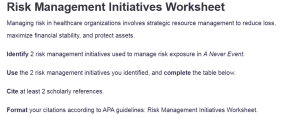
Risk Management Initiatives Worksheet
Managing risk in healthcare organizations involves strategic resource management to reduce loss, maximize financial stability, and protect assets.
Identify 2 risk management initiatives used to manage risk exposure in A Never Event.
Use the 2 risk management initiatives you identified, and complete the table below.
Cite at least 2 scholarly references.
Format your citations according to APA guidelines: Risk Management Initiatives Worksheet.
| Identify the Initiative | What are the Focus and Value of the Risk Management Initiative? | What Results Were Achieved by the Initiative?
(e.g., Has the initiative reduced loss, maximized financial stability, and protected assets?) |
What are 2 Recommendations for Improving the Initiative? |
| Root Cause Analysis (RCA) | RCA is a systematic approach carried out after an event has occurred to establish the root causes of Never Events in health facilities. RCA differs from the blame culture because it concentrates on correcting procedures that led to a particular event or situation (Singh et al., 2024). These reasons make RCA valuable in improving patient safety, implementing a knowledge-based national culture, and preventing preventable cases of adverse events. It also helps to meet the regulation norms and thus avoid regular fines for healthcare institutions.
|
-This has been achieved through the identification of important system problems that have an impact on patient safety.
-Decreased recurrence of the Never Events due to changes in the processes (McKnight & Bennington, 2014). – Increased adherence to accreditation standards and regulatory requirements. -Improved reporting culture to ensure transparency in the investigation of incidences. |
1. Promoting learning among team members entails conducting RCA constantly to improve the analysis of RCA methodologies.
2. Use AI technologies that can enable the handling of big data, meaning the ability to make insights and correlations and recognize future risks that might happen (Bekbolatova et al., 2024). |
| Surgical Safety Checklists | Surgical Safety Checklists are organized documents that can be used to maintain clear communication and ensure compliance with safety measures during, before, and after operations. They intend to reduce the likelihood of performable errors, including wrong site operations, objects left inside the patient and harmful effects from anesthesia (Gul et al., 2022). The value of this approach lies in issues with enhanced consistency of operations, fostering good cooperation among the medical personnel, and minimizing complications that may be encountered in the course of surgery.
|
-Large decreased numbers of Never Events, particularly wrong-site surgery and retained objects (McKnight & Bennington, 2014).
– Improved coordination and communication among surgical teams. – Enhanced hospital reputation and compliance with The Joint Commission and other accrediting bodies. |
1. Increase electronic checklists with the integration within Electronic Health Records (EHR) for easy tracking (Johnston et al., 2022).
2. Engage in checklists, audits and simulation exercises to maintain strict checklists and improve checklists team performance. |
References
Bekbolatova, M., Mayer, J., Ong, C. W., & Toma, M. (2024). Transformative Potential of AI in Healthcare: Definitions, Applications, and Navigating the Ethical Landscape and Public Perspectives. Healthcare, 12(2), 125–125. https://doi.org/10.3390/healthcare12020125
Gul, F., Nazir, M., Abbas, K., Khan, A. A., Malick, D. S., Khan, H., Kazmi, S. N. H., & Naseem, A. O. (2022). Surgical safety checklist compliance: The clinical audit. Annals of Medicine and Surgery, 81(81), 104397. https://doi.org/10.1016/j.amsu.2022.104397
Johnston, C., Butcher, D., & Aveyard, H. (2022). An integrative review exploring the impact of electronic health records (EHR) on nurse-patient interactions and communication quality. Journal of Advanced Nursing, 79(1), 48–67. https://doi.org/10.1111/jan.15484
McKnight, E. V., & Bennington, T. T. (2014). A never event: Exposing the largest outbreak of Hepatitis C in American healthcare history. History Examined, LLC
Singh, G., Patel, R. H., & Boster, J. (2024). Root cause analysis and medical error prevention. PubMed; StatPearls Publishing. https://www.ncbi.nlm.nih.gov/books/NBK570638/
ORDER A PLAGIARISM-FREE PAPER HERE
We’ll write everything from scratch
Question 
Managing risk in health care organizations involves strategic resource management to reduce loss, maximize financial stability, and protect assets.
Identify 2 risk management initiatives used to manage risk exposure in A Never Event.
Use the 2 risk management initiatives you identified, and complete the table below.
Risk Management Initiatives Worksheet
Cite at least 2 scholarly references.
Format your citations according to APA guidelines.
| Identify the Initiative | What are the Focus and Value of the Risk Management Initiative? | What Results Were Achieved by the Initiative?
(e.g., Has the initiative reduced loss, maximized financial stability, and protected assets?) |
What are 2 Recommendations for Improving the Initiative? |
| <Insert Initiative 1> |
|
||
| <Insert Initiative 2> |
|